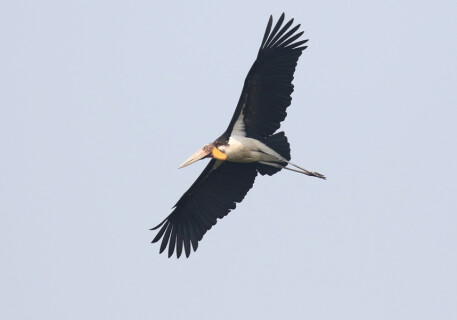
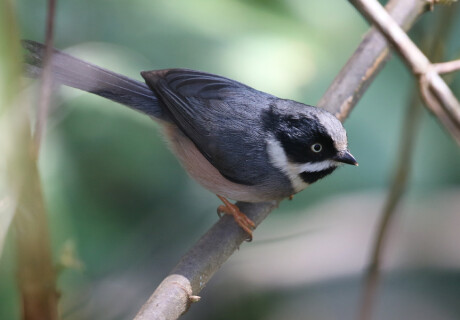
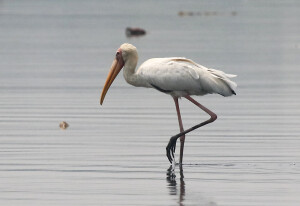
Common Greenshank

Thailand Birding: Common Shorebirds at Pak Thale & Laem Pak Bia

It is mid May now and all but a few of the commoner shorebirds have left Thailand and returned to their breeding grounds further north. However, for those bird watchers who are visiting or resident in Thailand during the months May to July there are still small numbers of shorebirds to be found, mostly birds in their first year that did not mature enough to head to their breeding grounds and other individuals that did not put on enough weight to migrate. Species such as Marsh Sandpiper, Curlew Sandpiper, Lesser Sand Plover and Kentish Plover can usually be found in small numbers.

I spent some time this week reviewing some photographs of the commoner shorebirds that I took at Pak Thale and Laem Pak Bia earlier this year whilst leading a photography tour: Photography Tour of Thailand, March 2013. In March there were still large numbers of waders to be seen and a number of birds were coming into breeding plumage then too.

The following are just a few of the many photographs that I obtained on the tour – it took quite some time to review them all.

Little Ringed Plover

Little Ringed Plover

Wood Sandpiper

Wood Sandpiper

Temminck’s Stint

Common GreenshankCommon Greenshank

Red-necked Stint

Usually some of the commoner shorebirds begin to return by the end of July; these are the non-breeders and birds that have failed at nesting. This is a good time to see some species in their breeding plumage, particularly Curlew Sandpiper.

Often by August or September Asian Dowitchers begin to pass through and by end of September shorebird numbers are really increasing as migration gets into full swing. Every year we wait for some of the rarer birds to return and usually they have shown by the end of October; the most awaited species is Spoon-billed Sandpiper and hopefully it will arrive again this year even though its numbers are very low now.

By early November all the speciality species of shorebirds have returned to Thailand and Spoon-billed Sandpiper, Nordmann’s Greenshank, White-faced Plover and others can be found regularly.

If you need any help in finding these rare species contact me: nickupton@thaibirding.com

spoonbilledsandpiper.jpg

Thailand Birding: Spoon-billed Sandpiper Returns!

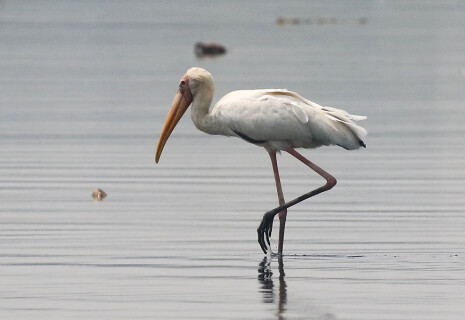
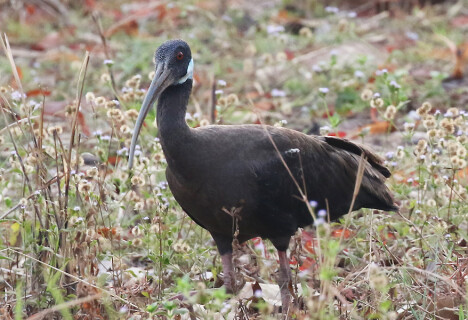
For all the birders visiting Thailand over the next few months who were getting nervous about whether this critically endangered species would make it back to Thailand this winter, the good news is yes it did! Phil Round informed me that at least 2 were seen at Khok Kham from 22nd October and 2 or 3 at Pak Thale from the end of October. I can confirm this as I saw 1 Spoon-billed Sandpiper myself at Pak Thale this morning. Lots of other shorebirds were also present and giving good, close-up views. 1 juvenile Little Stint was amongst numerous Red-necked Stints and 5 Dunlin were with a flock of Broad-billed Sandpipers. A large flock of 1000+ Great Knot, 200+ Eurasian Curlew and large numbers of all the common shorebirds too. More good news for rarity hunters were at least 9 Nordmann’s Greenshank at Laem Pak Bia. I revisited Wat Komnaram too and the Black-headed Ibis from last week had increased to 18 birds, plus the Milky Stork was feeding close to the road.


I couldn’t get any good video clips of the Spoon-billed Sandpiper, so please take a look at the Black-headed Ibises here.

long-toed-stint.jpg

Thailand Birding: Shorebirds at Pak Thale

One of the most anticipated arrivals each year is Spoon-billed Sandpiper. Birdwatchers from all over the world come to Thailand to watch this critically endangered shorebird at Pak Thale and Khok Kham.

A few days ago on 25th October, 2012, I did a little birding at Pak Thale in the company of Jules Tolboom from The Netherlands. We spent around 1.5 hours in the late afternoon at Pak Thale watching large numbers of shorebirds.

Curlew Sandpipers with Broad-billed Sandpiper
Photo by Alex Vargas

We had a long hard look at all the shorebirds that could be seen from the dirt road at the Spoon-billed Sandpiper site at Pak Thale but despite looking hard none appeared to be present. In fact this is pretty much as expected as it was probably about 1 week too early for the bird.

Despite the lack of Spoon-billed Sandpiper there were very impressive numbers of Great Knot (1500+) and Eurasian Curlew (250+) as well as good numbers of Red-necked Stint, Lesser Sand Plover, Greater Sand Plover, Kentish Plover, Curlew Sandpiper, Broad-billed Sandpiper, Eastern Black-tailed Godwit and Marsh Sandpiper.

The most uncommon bird was one Eastern Curlew amongst the flock of Eurasian Curlews which I picked out due to its warm brown buffy appearance. Identification was ensured when it began to preen and showed me its dark underwing (pale/white on Eurasian Curlew). It ought to be noted that length of bill is not an identification point here where the female Eurasian Curlews have bills that are as long (if not longer) than the Eastern Curlews.

Other species present were Red Knot, Dunlin, Whimbrel, Spotted Redshank and Common Greenshank.

Elsewhere at nearby Wat Komnaram a Milky Stork was seen alongside two Painted Storks and 6 Black Ibis and 36 Grey-headed Lapwings were feeding.

Spoon-billed Sandpiper should be back next week!

glaucous-gull.jpg

Birdwatching in UK: Six Weeks Back Home

From mid August to the end of September 2011 I spent six weeks staying with my family in southeast England. Whilst many British people head to Thailand for some warmth it was nice for me to get out of the humidity and heat for a while and experience some cool weather; in fact apart from some very windy days, the weather was actually pretty good for most of my stay.

Catching Up With Common Birds

Every year, when I return to Britain, one of the first things I do is head down to my old local patch along the Darent Valley in Kent. It is a pleasant area, but in terms of birdlife it is not particularly special, although a good number of the commoner birds can always be found. It is always fun to catch up with species such as Blue Tit, Great Tit, Long-tailed Tit, Green Woodpecker, Great Spotted Woodpecker, Chaffinch, Goldfinch and other similar species. People who visit me in Thailand always comment on the colourful birds, but Britain has plenty of colourful ones of its own and for people, like me, who don’t see them all the time, the species just listed are great.

Finding Summer Visitors

I always seem to get back to Britain at the very end of summer/beginning of autumn and it is a very challenging time to find many of the summer visitors. Finding Reed Warbler is always a challenge at this time but I did manage to see a few of these. Chiffachaff, Blackcap and Whitethroat were easy enough but Willow Warbler, Garden warbler and Lesser Whitethroat were a bit of a challenge although I did find them. Birds I missed out on this year though included Sedge Warbler, Common Redstart, Spotted Flycatcher and Pied Flycatcher!

Uncommon Resident Species

Every year it seems that British birds that were formerly common get rarer and rarer. Much is said about conservation efforts in UK but it seems that it is only waterbirds and raptors that are doing okay; farmland and woodland species seem to be vanishing fast. With this in mind I was pleased to see my first Bullfinch for a few years, even if it was a juvenile. I also managed to find Black Redstart, Marsh Tit, Cetti’s Warbler (one that seems to get more common), Corn Bunting, Turtle Dove and Whinchat.

Some New Birds – Seabirds!

Spending most of my time in Thailand means that I hardly see any seabirds. So it is always interesting to look for these birds when I return and for this group I always end up in UK at a good time!  At Dungeness I saw a wide variety of gulls including Yellow-legged, Little, Mediterranean and Glaucous Gull which was a long-awaited bogey bird for me. Also at Dungeness I saw my first Long-tailed Skua as well as great views of the commoner Arctic Skua plus Black, Arctic and Sandwich Terns.


Glaucous Gull approaching second winter plumage
Photo by Nick Upton

I also spent some time in East Yorkshire and at Flamborough I managed some more nice seabirds (at least for me as I rarely get the chance to find them); Kittiwake, Red-throated Diver, Manx Shearwater, Guillemot, Razorbill as well as hundreds of Gannets.

Twitching!

I am not normally one to go twitching but the chance to see two lifers in one go tempted me to make the drive to Graffham Water one morning. Whilst the result was nice; adult Sabine’s Gull and Grey Phalarope right next to each other; the feeling was one that was less than satisfying and it reminded me why I am not a fan of twitching – drive a few hours, spot the crowd of birders, there it is, watch for a while and leave.

Some More Good Birds

My trip also resulted in a number of other species that I was pleased with; Song Thrush – getting rare in my area; Yellowhammer – tough to find at the end of summer;  Lapland Bunting – only the second time I have seen this one; Goosander – first one I have seen for 7 years!; Eider Duck – first for 4 years; Bearded Tit – a bird I see once per year and is always hard to see in the windy conditions of late summer/early autumn; Red Kite – first one for 4 years; Siskin – first for 4 years; Purple Sandpiper – a once a year bird; Rock Pipit – first one for 4 years; Raven – first for 5 years; Water Rail – a bird I see once a year.

A Finishing Flourish

At the end of my stay it was getting tough to see something new without travelling far away. However, a Pallid Harrier was reported at Cliffe. Not wanting to join the twitch I came up with a different strategy. The bird was roosting in some reeds and then heading out down the Thames. However, the news was getting out and I figured that a large group of birders would wait for the harrier on an observation mound which the bird would have to pass if it were to follow its morning routine. I also figured that the twitching crowd would make enough noise to make the bird turn around and head off towards Shorne marshes. With this theory I took a train to Gravesend, walked out onto Shorne marshes and got lucky. The juvenile Pallid Harrier actually flew within 30 feet of me at head height towards Gravesend, then turned around and came back, chasing a skylark but failing to catch it.

What a result!

I also saw some other nice birds on my 15 MILE WALK; Yellow Wagtail, Whinchat, Hobby, March Harrier and many Wheatears.

In total I saw 154 species in six weeks in England without travelling very much.

black-and-red-nest.jpg

Wet Season Birding

The large majority of birders visit Thailand in the dry season (November to April). Why is this?

Well, firstly, there is a far higher number of species present in the country during the dry season due to the visiting migrants from China and Siberia and the largely dry and sunny weather is an attraction for many people. However, it may also be because many books and websites have always labelled the dry season as the “best” time to be birdwatching in Thailand. But best for what?

The dry season is most certainly the time to visit Thailand for migrant species, particularly shorebirds and specifically Spoon-billed Sandpiper. However, for many of the resident species that live in forests, the dry season most certainly is not the best time for birding in Thailand.

Species such as broadbills, pittas, woodpeckers, forest kingfishers and others, are all far easier to find in the beginning and mid wet season, when they are breeding, than in the dry season.

Black-and-red Broadbill on a nest by Alex Vargas

On a recent 3 days trip to Kaeng Krachan we saw 6 species of broadbill, 12 species of woodpecker, 3 species of pitta, 2 species of trogons, Grey Peacock Pheasant, Kalij Pheasant, Banded Kingfisher, Oriental Dwarf Kingfisher, Ratchet-tailed Treepie and many other tough species – this collection of birds could not be expected during a dry season visit to Kaeng Krachan.

Very few birders head to northern Thailand outside of the dry season but a recent wet season visit I made turned up Giant Nuthatch, Spot-winged Grosbeak, Pygmy Wren Babbler, Eyebrowed Wren Babbler, Spot-breasted Parrotbill, Lesser Rufous-headed Parrotbill, Grey-headed Parrotbill, Lesser Cuckoo, Lesser Shortwing in abundance and many other hard-to-find birds.

It has to be admitted that the dry season is the best time for general bird abundance, migrants and certain target birds, but birdwatchers who have been to the region several times and are still looking for many of those tough forest species should consider making their trip in the period May-July when a lot of great birds can be found.

If you are a birder who is looking for difficult resident species contact me and I can let you know whether the wet season might be a better time to look for them than the dry – nickupton@thaibirding.com

sunda-pygmy-woodpecker.jpg

Thailand Birding: Three New Species For Thailand

This morning I was alerted (sadly too late) to the presence of a Sooty Gull, which had been photographed at Bang Poo. This is the third new species for Thailand that I have been recently been made aware of with the other additions being Sunda Pygmy Woodpecker which was photographed in Satun province on the Malaysian border and has long been expected to occur in southern Thailand, and Northern Boobook which was caught and ringed at Laem Pak Bia by Phil Round in April 2011; this is a recent split from Brown Hawk Owl.

sunda-pygmy-woodpecker.jpg
Click the picture to watch Sunda Pygmy Woodpecker in Thailand on Youtube

With large parts of the country being underwatched or not watched at all, the lack of coverage of the seas around Thailand and the possibility of rare migrants turning up, there are undoubtedly more species to be added to Thailand’s growing bird list.

However, it should also be noted that Tawny Eagle and Pink-rumped Rosefinch have both been removed from the Thai list.

Female Maroon-breasted Philentoma by Alex Vargas

Thailand Birding: Maroon-breasted Philentoma

Female Maroon-breasted Philentoma by Alex Vargas

Alex Vargas recently took this photograph of a female Maroon-breasted Philentoma in the vicinty of Km 36 at Kaeng Krachan national park. He also saw the male well, through binoculars but only managed to obtain images of this female.

Maroon-breasted Philentoma is known from Kaeng Krachan but is very seldom seen, in fact it is seldom seen anywhere in Thailand – I have seen a pair just the once myself, at Krung Ching.

In this photo it is difficult to see the dark wash to the breast that field guides indicate the female should have, this may be down to the light conditions or the fact the field guides make more of this feature than is really visible.

Interestingly, Phil Round had this to say about the species;“The easiest place I know to see it, though, is (ironically) at its northerly known limit, at Phu Tho, Thongphaphum District, Kanchanaburi – a good 2 deg N latitude N of Kaeng Krachan. There there is some nice accessible evergreen forest at the base of limestone crags, which also holds Ferruginous Partridge and tons of other good birds. Nobody ever goes there these days since Kaeng Krachan was “discovered” some 20-plus years ago, but I visited the site last in May 2009 and saw a pair of philentomas just as easily as before.”

Alex has several more photographs of the bird here - Female Maroon-breasted Philentoma.

java-sparrow.jpg

Thailand Birding: Finding A Java Sparrow

Although I have lived in Bangkok for years I have never taken the effort to go and track down any of the city’s Java Sparrows; there has long been a self-sustaining population of this species, originating from escaped caged birds. However, beyond the vague instructions of “the Don Muang area” I have never known where to look for Java Sparrows.


Java Sparrow by Peter Ericsson

Don Muang is the name of Bangkok’s old international airport, which is only really used for some domestic flights these days – it is in the north of the city. The area is really busy and I live quite far away, so the prospects of hunting these birds down in residential areas and along busy roads was never one that I relished. However, during a phone conversation with Phil Round yesterday, I finally remembered to ask him where I should look for Java Sparrows and he gave me details of a specific place to look that was easy to find.

With the encouragement of my wife, we went and had a look yesterday afternoon. The location is a small compound of apartments belonging to the airforce, right next to the Amari Airport hotel – easy to find. The hotel is on the opposite side of the road from the airport and there are signs for it in English after you have passed the domestic terminal and are about level with the international terminal. You can park in the car park of the Amari hotel, exit the car park and turn right, walk down the street for about 50 metres and you will see the apartments in a leafy compound.

We checked in with security, who made a bit of a song and dance about letting us in, but after a bit of a chat we entered. Java Sparrows were not obvious. After a bit of a search I spotted a pair, high up on a building, sitting above a ventilation window. Soon another pair joined them and the four of them spent a long time just sitting, preening and flitting about, occasionally disappearing beyond the boundaries of the compound but always coming back quickly. After about 30-40 minutes of watching them we left them to their business.

I understand that Java Sparrows are listed as Vulnerable by Birdlife International with a population of only 2,500-10,000 individuals in its native range, Java and Bali. Due to trapping and increased use of pesticides, Java Sparrow populations are declining; the population in Bangkok may be of significance in this light.

Asian Golden Weaver by Alex Vargas

Thailand Birding: Asian Golden Weaver

The large majority of birders visit Thailand between the months of November and March, which is a great time for winter migrants but not so good for resident birds.

There are a few birds in particular which just are not present in the dry season or not at their best. Asian Golden Weaver is one of the latter; through the dry season months it is in non-breeding plumage and rather dull, but in the breeding season (late March to August) the male is one of the most fabulous birds of the wetlands.

Asian Golden Weaver by Alex Vargas

Over the last few months I have been seeing small nesting colonies of Asian Golden Weavers regularly at Muang Boran Fishponds near Bangkok and Tung Bang Jak near Petchaburi. They make small, ball-shaped nests in emergent vegetation such as Typha whilst their relatives, Baya Weavers, make pipe-shaped nests in trees and Streaked Weavers make a ball with a pipe in emergent vegetation.

Anyone heading to Bueng Boraphet from March to August should also easily see this species by going to the crocodile enclosure at the fisheries research station on the north side of the lake, where they breed, their nests protected by crocodiles.

spoonbilledsandpiper.jpg

Thailand Birding: Spoon-billed Sandpiper

Lots of people have been e-mailing me about Spoon-billed Sandpiper recently. With the species continued decline more and more birders are keen to see it and it seems that Thailand is just about the easiest and most reliable place to see a Spoon-billed Sandpiper right now.


Spoon-billed Sandpiper at Khok Kham by Jörg Hanoldt

Pak Thale is the best place to find this bird with 5 birds seen together recently on salt pans. The area is fairly easy to find using maps on thaibirding.com and following the signs at the site. If all else fails look for the other birders!

Spoon-billed Sandpipers usually arrive at Pak Thale at the very end of October and are usually not seen beyond end of March (last year I think the last date was around 24th March). During this period they are always present and can be found on salt pans with very shallow water.

For those with less time, at least one Spoon-billed Sandpiper still winters at Khok Kham, close to Bangkok. This site is not as good for other birds as Laem Pak Bia/Pak Thale but for those with only half a day to spare, this offers an opportunity to see this rare species. For those with more time, get yourself straight to Pak Thale and see the birds there, then enjoy the many other species that are present.

Free WordPress Themes
Term Life Insurance Quotes
.
.
.