Birding by bicycle, or even Motorized bicycle!

It has often been said that one of the best ways of birdwatching is by bicycle. Certainly I have found this a useful way of covering large areas whilst remaining quiet and connected to the environment and often birding by bicycle can allow one to approach birds more closely than one can on foot.

However, if you live in a hilly or windy area cycling can be more of a chore than a pleasure and there comes a point where increasing the distance one covers shifts the emphasis from birdwatching to hard-core cycling. These issues came to mind when I was alerted to a website which sells do-it-yourself kits to turn a standard bicycle into a motorized bicycle: http://www.bicycle-engines.com - “Turn your ordinary bicyle into a motorized gas scooter today with a complete ready to install bicycle motor kit that includes all the necessary mounting hardware needed to attach it directly to your bike.”

Motorized bicycles are something my father used to talk about when I was younger so I was interested in reading about these kits. I would imagine that these engines make a certain amount of noise but what I was interested in is that with one of these kits it would be possible to visit a number of birdwatching sites in one day by using the engine between them and turning it off to cycle around more quietly once the site has been reached. I could certainly have used one of these outfits when I was doing the fieldwork for my degree dissertation, covering huge distances on foot – what a relief it would have been to have been able to hop on one of these.

Birdwatching aside, where these motorized bicycles would really come into their own is as an alternative, cheap and fairly efficient means of transport. With a lack of a decent public transport system and the rising price of fuel, the 150 miles per gallon that can be achieved on a motorized bicycle is very welcome and travelling along at 35 miles per hour on a summer’s day in order to spend a day birdwatching would be quite thrilling.

Although many people would say that motorized bicycles would turn an environmentally friendly mode of transport into one that produces CO2, by getting lots of people out of cars and using a more energy efficient motorized bicycle CO2 emmissions could actually be reduced as well as reconnecting many people with the environment.

Birding by bicycle really is a pleasure and one that could be enhanced by a motorized bicycle kit.

Orchid Photo Gallery

Due to the poor weather and being busy I have not managed to get out for a while – I’m beginning to feel a bit stuffy. I found a few moments to browse through some of my summer photos, reminding myself of better weather and some interesting plants. Like many other wildlife enthusiasts I have taken a number of orchid photos and I decided to put them together in a gallery and post them here.

The pictures are of Bee Orchid taken at Eske near Beverley, Burnt Orchid near Crowle, North Lincolnshire, Common Spotted Orchid at Eske, Early Purple Orchid at Crowle, Green-winged Orchid at Swinemoor near Beverley, Heath Spotted Orchid at Eskdale in the Lake District, Pyramidal Orchid at Wye Down in Kent.


, , ,

British Birdwatching: Nervous Ducks

Today provided a welcome break in the dull, dismal weather this week and I took a much needed walk to Eske, near Beverley. Walking along the river I saw very little; at this time of the year the vegetation is very low and the few bushes along here are bare and offer little shelter, although I saw a flock of 26 Golden Plover heading south to Swinemoor.

Almost at the lake 2 noisy Fieldfares burst out of a bush, but with the hawthorns now stripped of berries the large flocks of Redwings, Fieldfares and Blackbirds of recent weeks were absent. However, on the lake a huge number of wildfowl were present despite a couple of fishermen by the lakeside. A flock of over 200 Greylag Geese were swimming around along with a Greylag x Canada Goose hybrid. A total of 15 Mute Swans were also gliding about, but when I tried to count the ducks I had some difficulty due to their flightiness, with groups of Wigeon taking off at the slightest disturbance and then being followed by other species. Perhaps they are used to being shot at? Around 120 Wigeon were on the lake with about 150 Mallard, 25 Tufted Duck, 1 male Pochard, 1 male Pintail, about 20 Shoveler and 1 male Gadwall. Also present were 16 Cormorants, 30+ Coot, a few Moorhens and just a couple of Great Crested Grebes.

Some people from the Yorkshire Wildlife Trust were doing something with the Highland Cattle that are supposedly there to manage the grassland but all they seem to do is turn the path into a mudbath whilst other parts of the reserve are becoming covered in hawthorn scrub.

Wandering around to some pools behind the main lake I came across 3 Teal and 9 Gadwall as well as a Kingfisher. In the trees a lone Goldcrest was busy foraging for insects and as I watched it I heard the call of a Green Woodpecker. This species is not common around here and I have seen it on just three occasions at this location. Today I wasn’t able to get a view of it but heard it as it flew away. However, I did find a small flock of birds feeding: a flock which included a Wren, 2 Robins, a Great Tit, a few Blue Tits, a party of Long-tailed Tits, 4 Chaffinches and a Great Spotted Woodpecker.

Not a bad selection of species for a chilly day and as I walked back a flock of 150+ Lapwings flew south as well as a few Common Gulls and a Black-headed Gull. Just before leaving the lake a female Sparrowhawk came cruising over the bushes, searching for prey, oblivious to my presence.

The only birds on the walk back to the car were a small group of Fieldfares, a Song Thrush and a single Meadow Pipit which flushed out from my feet.

, ,

swinemoor-tree-201107.jpg

British Birding: Swinemoor – cold and grey!

Cold and grey sums the day up really, very miserable weather indeed! Walking around Swinemoor most of the regular birds were in their regular places. A few more small passerines were viewable today, mostly feeding in the mud. The increased water level seems to have pushed a number of soil dwelling creatures to the surface and birds such as Chaffinches, Redwings, Fieldfares and Starlings were taking advantage. In the trees a Mistle Thrush was making a noise and a Great Tit was hopping around looking for food..

On the floods huge numbers of Lapwings were present with over 200 birds along with 60-70 Golden Plover. A total of around 25 Redshank were dotted around the common and were easily seen as they noisily moved around. Feeding amongst the Lapwings were 10 Dunlin and the usual groups of Snipe could be found amongst the grassy tufts.

Today the whole place smelt quite bad: it seemed like horse dung rotting in the water which won’t do much for the quality of the grassland, although it didn’t seem to bother the wading birds roosting and feeding amongst it, which also included a single male Ruff.

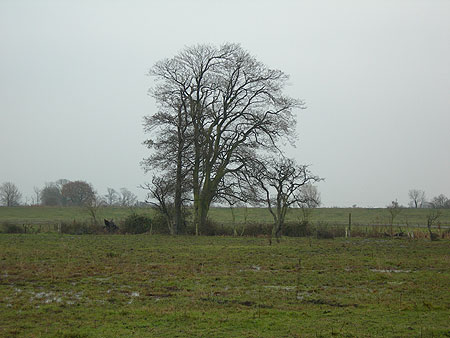
Along by the ditch the, by now, usual group of 5 Curlew were probing the mud alongside their colleagues the Moorhens. Below shows the area they seem to favour, peculiarly, they appear to prefer feeding under the tree.

Whilst watching the curlews a group of 3 Mute Swans flew overhead and flushed the curlews up: they then flew around uttering their distinctive call. A couple of other flyover birds were two Cormorants and an adult Lesser Black-backed Gulls.

Winter flocks of small gulls get quite large on Swinemoor, but at the moment only small numbers of Black-headed Gulls and Common Gulls are present with just about 20 in total today. A Grey Heron stood hunched up in the middle of the floods today looking like the uninspiring weather had also got to the avian inhabitants of Swinemoor as well as myself.

A truly dismal day was at least made a little brighter by a cruising male Sparrowhawk as I left the common and a group of noisy Long-tailed Tits in excitement at its passing.

,

Flora of Swinemoor

I had an enquiry about the flora occurring on Swinemoor Common. Whilst I am more of a birdwatcher than a botanist I have taken note of a number of plants I have seen on the common and even photographed a few.

Swinemoor is quite a large area of species rich, semi-improved grassland which hasn’t been ploughed for hundreds of years and as such it has a fairly rich flora. It is grazed by horses and a few cattle which creates a varied sward structure and there are ephemeral pools, seasonally flooded patches and ditches creating quite a variety of plant habitats.

This is obviously not a complete record of what I have seen on Swinemoor, but just a gallery of plants that I have photographed at the site.

Comments on other species that occur at Swinemoor are very welcome.

, ,

cormorant-figham-151107.jpg

Figham Common

Another sunny morning saw me following up a tip about a Short-eared Owl at Figham Common, Beverley. Unfortunately I didn’t see any owls and apart from large numbers of Redwings, Fieldfares and Blackbirds, birds were a bit thin on the ground.

A few Moorhens were on the river and a single Teal and a Snipe flushed out of the vegetation as I walked along the River Hull flood wall. As I approached a small copse a Grey Heron flew out and a group of Long-tailed Tits began making a noise. The reason for this was an incoming Sparrowhawk which swerved away when it spotted me. Under the shade of the trees the morning frost persisted and set up a nice photo opportunity.

As I wandered over to a swampy corner of the common, 3 Mute Swans noisily flew over head, flying north east and a group of 5 Reed Buntings began squabbling in a small bush. I stood still for a few minutes but very little other than Redwings was to be seen although a couple of Wrens were busy in the undergrowth. Starngely enough the common was very dry and many of the birds which are attracted to the marshy patches were not present today. At a reedy patch which usually hosts dozens of Snipe and Teal, just one Snipe flew out.

I took the time to take a few photos of Figham Common; they aren’t particularly inspiring but it gives those who have never been there an idea of the type of habitat that exists there.


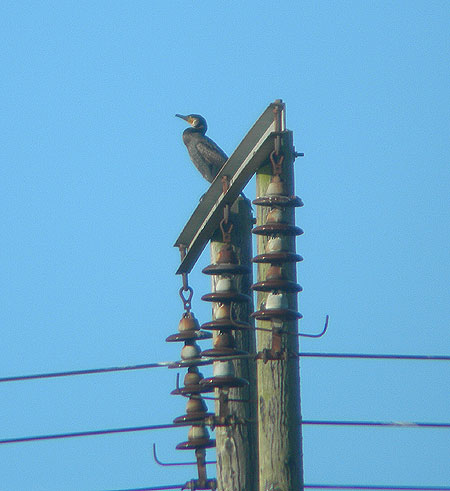
In a hedgerow I watched a Song Thrush preening and tried to photograph it. My efforts, however, were so feeble that I deleted them all but a little further along I did get a reasonable shot of a Cormorant sitting on a telegraph post.
Back on the main part of the common a couple of pairs of Stonechats were arguing over winter territories – this species always spends the winter here in small numbers. I also found a Mistle Thrush feeding on a patch of grass that had been cropped short by the cattle that graze on Figham. Apart from a couple of Black-headed Gulls and two flushed Pheasants I didn’t see much else before getting back to the car.

Walking to Eske and beyond

Today I had company for my morning walk to Eske: Julia Foster, one of my friends I did my degree with. The weather was really nice with bright sunshine and little wind making for a pleasant temperature.

On the walk to the lake we came across a few Meadow Pipits and a number of Fieldfares along with a couple of Redwings. The most interesting species, though, was a Little Egret sitting next to a flooded patch on pasture to the west of the River Hull. Although Little Egrets have become a fairly common sight where I come from in Kent, here in East Yorkshire they aren’t so common.

Up at the lake large numbers of waterbirds were present with a couple of hundred Greylag Geese in the company of 3 Pink-footed Geese and 1 hybrid Greylag x Canada Goose. Also on the lake were 8 Mute Swans, 9 Cormorants, 7 Great Crested Grebes, 70-80 Wigeon, about 30 Shoveler, 2 Pochard, 40+ Tufted Ducks, 100+ Mallard, 1 female Gadwall and, best of all, 1 beautiful male Pintail. A number of gulls were also wheeling around with 2 Herring Gulls, 8 Common Gulls and about 20 Black-headed Gulls; a single Redshank was also sitting by the lakeside.

Walking further north a small party of Long-tailed Tits were accompanied by a Chiffchaff and at the Leven Canal we managed to spot a distant Barn Owl roosting in a tree: its bright white plumage reflecting the sun gave it away at about 500 metres!

On the way back we spotted a number of small common birds such as Pied Wagtail, Goldfinch, Blackbird, Wren, Robin and Dunnock and a group of 4 Skylarks were brought out by the sunshine.

Not a bad walk with Little Egret, a winter Chiffchaff, male Pintail and a Barn Owl we got some decent birds.

Free WordPress Themes