 May 17th, 2026
  Nick
Nick 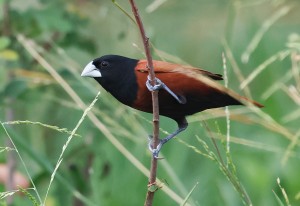
Thailand is full of Birds
Thailand is an extremely popular birding destination because of a number of top-quality sites around the country that provide the opportunity to see a wide variety and number of species, including many that are hard to see elsewhere or have very limited global ranges. Many species of birds are more accessible in Thailand than elsewhere. However, another facet that adds to Thailand being a great birding destination is that one can find places to see good numbers of birds almost anywhere in the country; just pick somewhere to stay and find some interesting places to go birding that few other people have visited, and that is exactly what I found myself doing in Khorat recently.
A trip with my wife, to visit some temples in and around the city of Khorat (Nakhon Ratchasima), gave me the opportunity to stay in a nice hotel in the city and spend a few hours each morning birding nearby wetland sites. These sites were listed on eBird but do not receive large numbers of visits by birders and it is always a bit of fun to see how many species can be seen at a location I have not previously visited. The result was plenty of nice wetland and open country species before returning to the hotel each morning for a very good breakfast.

Waterbirds in the Khorat Wetlands
With lotus-covered water punctuated by areas of Typha and birds such as Pheasant-tailed Jacana in their glorious breeding plumage one might think I had visited a famous and well-preserved wetland reserve but in actuality I picked a couple of waterbodies from a map, both of which were eBird hotspots, fairly average small reservoirs for rural areas of Thailand. These types of places may be average in Thailand but they are always very good for birding.
The most famous birding site in Nakhon Ratchasima province of Thailand is Khao Yai National Park, an area of forest full of colourful birds including hornbills, broadbills and pittas, but this location is hardly one for casual birding while visiting touristic sites with a non-birding partner, it deserves more time and requires more effort than that. Instead we were visiting several temples in and around the city of Khorat including the ancient Khmer ruins of Phimai and Panom Wan and booked a really pleasant hotel in AisanA Hotel Khorat which had very good facilities and food, making a nice base for our day trips. On each of the three mornings we were stayed here I woke up very early (to avoid the intense heat that is a feature of April and May in Thailand) and made a short drive to nearby wetlands/reservoirs for a few hours of birding before returning to the hotel for breakfast.
On my first and third mornings I visited Phutsa Reservoir, just a twenty minute drive from our hotel, set among typical Thai rice agricultural land, close to a village. There weren’t too many people creating a disturbance to the birds but one section of the site was mostly a dust bowl with trucks and excavators creating an utter mess; presumably dredging was taking place in what had obviously becoming a very silted up lake – what the long-term effect on the birdlife will be is hard to predict. However, the larger portion of the site consisted of a lotus-covered lake with plenty of birds within the lake and the fringing vegetation; it didn’t take a lot of searching to find the first Yellow Bittern of the day.
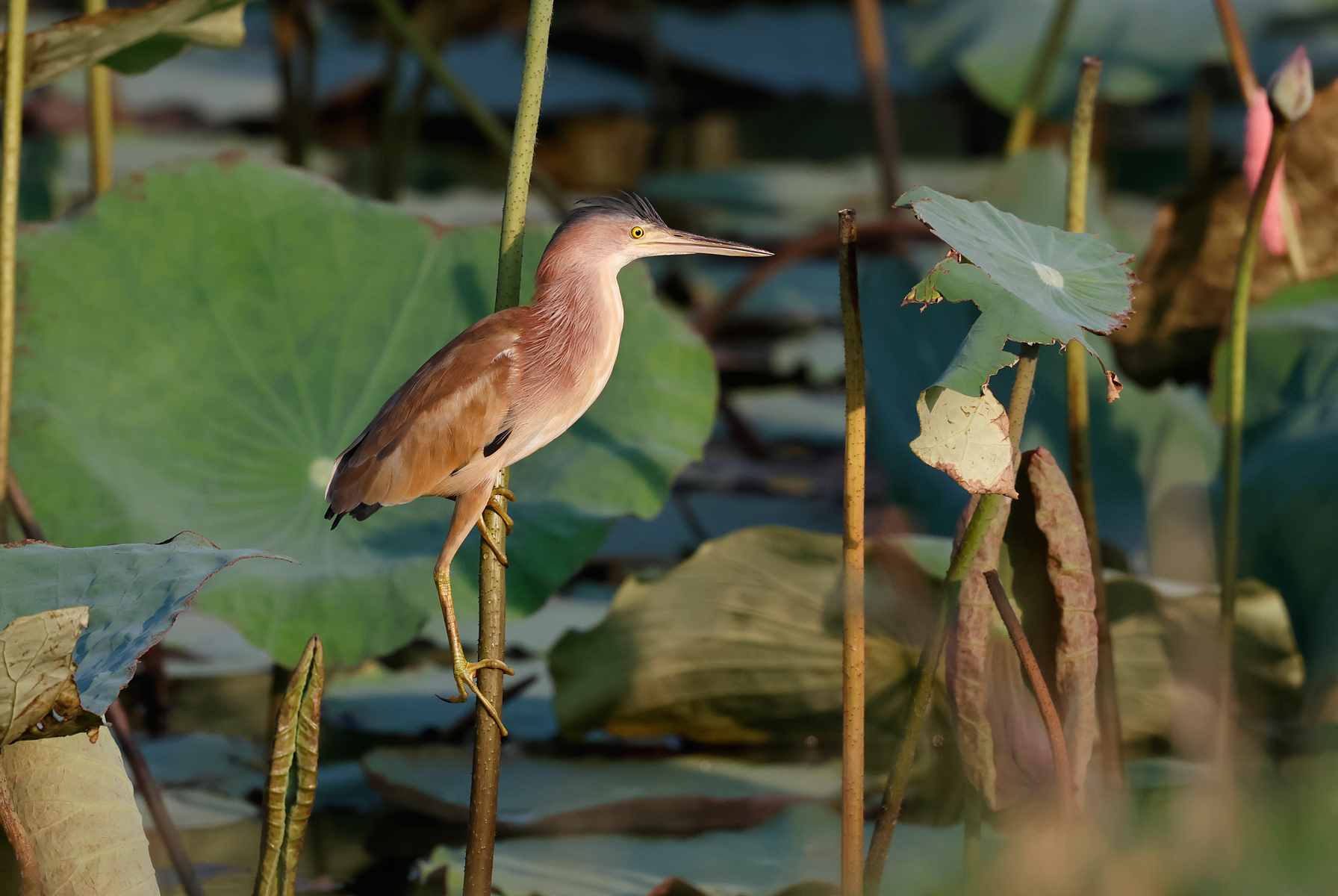
Yellow Bittern is a common bird of this type of habitat in Thailand and I saw plenty of them on both visits. However, the similar Cinnamon Bittern is more scarce and I saw just one of these smart birds on one visit but other herons/egrets included Grey Heron, Medium Egret, Eastern Cattle Egret, Purple Heron, Black-crowned Night Heron and Little Egret as well as good numbers of handsome Chinese Pond Herons in breeding plumage and a single Javan Pond Heron in breeding plumage and, best of all, a single Black Bittern in flight; a good place to visit if you are into egrets/herons/bitterns.
Most birders visit Thailand in the dry season, between November and March when large numbers of migrant species, particularly shorebirds, are present in the country but there are some species that are in non-breeding plumage at that time which light up as it gets towards the wet season and Pheasant-tailed Jacana is one of those birds. In the dry season Pheasant-tailed Jacana is a nice enough bird but when it moults into breeding plumage it is truly spectacular. I saw plenty of these wonderful birds at Phutsa reservoir and at the other site that I visited, Huai Yang Reservoir, where there were also areas of floating lotus and lilies, the type of habitat that this species favours.
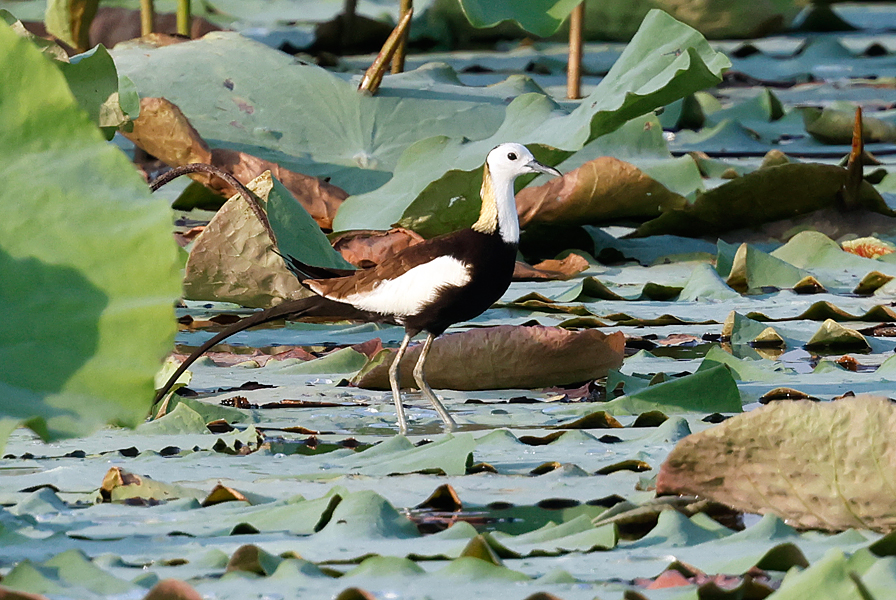
As one might expect in this habitat Bronze-winged Jacana was also found at both locations, although in smaller numbers. There were also a few Grey-headed Swamphens, Common Moorhens and the customary White-breasted Waterhens strutting around close to the water. The main lakes at bother reservoirs had water levels that were too high to see other crakes creeping around on muddy edges but at Phutsa Reservoir I did come across both Ruddy-breasted Crake and Watercock in a nearby ditch.
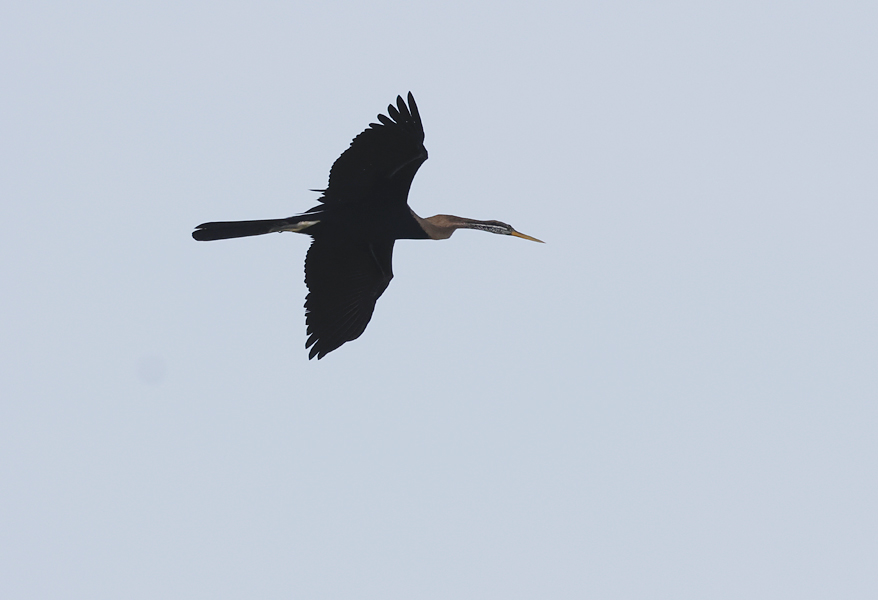
All too often we not only read about the decline of birds but also see it ourselves over the course of time but wetlands in Thailand can provide some birds that are actually increasing in number. When I first visited Thailand in the late 1990s Oriental Darter was pretty much absent, a real rarity but over the years the numbers just keep increasing and they can usually be seen, in small numbers, in wetlands all around the country and, indeed, I saw half a dozen or so Oriental Darters at both sites.
Purple Heron is another wetland bird that has increased wildly in numbers in Thailand. I can remember reporting sightings of this attractive bird in the past but now it is a species that is commonly seen in any available habitat. Indian Cormorant is another species that has increased in number. They are not found all over the country in any number yet but I saw a few on my morning at Huai Yang reservoir.
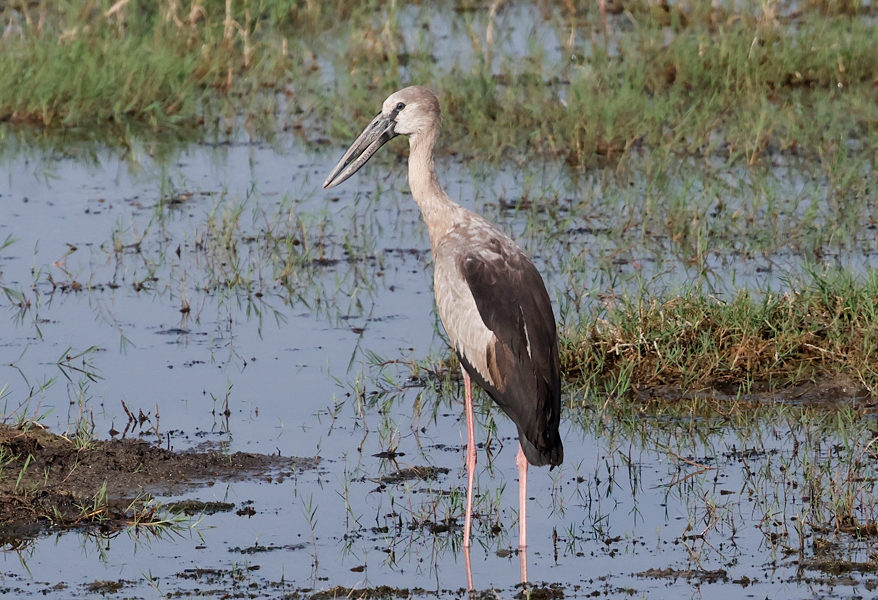
And then there is Asian Openbill.
This curious-looking stork was restricted to a few hundred birds in the 1990s, an idea which is laughable these days given how absurdly common they are. Apparently increasing at something like 500% per year the numbers of Asian Openbill in Thailand are now massive and it was no surprise to see them at reservoirs like these.
Reservoirs such as Phutsa reservoir and Huai Yang reservoir are shallow waterbodies, often natural lakes that have had their water levels raised by small dams, and are common all over Thailand providing a habitat for a very similar avifauna throughout. However, these types of water bodies are also constantly being degraded in quality by constant earthworks that build up the banks and reduce the marginal habitat that is the most rich in birds as well as disturbance by locals using the lakes for fishing.
At Phutsa reservoir (green pin) one section of the site was enduring a lot of “sculpting” by heavy earth-moving equipment but while things were less dramatic at Huai Yang reservoir (blue pin) there was quite a lot of disturbance from people fishing. Although habitat was less than optimal at both of these locations there were still plenty of birds to be seen.
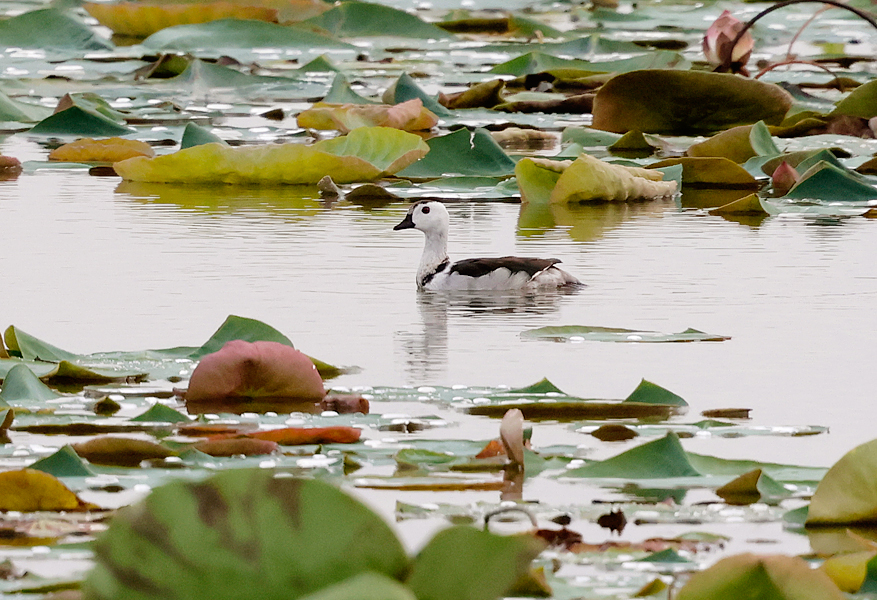
In this type of habitat where there is floating vegetation one of my favourite birds is Cotton Pygmy Goose. If you haven’t seen this cute little duck before then this photograph might illustrate why I like it so much; the breeding plumage males light up with their white heads.
Little Brown Birds
For any birders who find themselves in a similar habitat anywhere in the country there are plenty of species other than waterbirds to look for too. Marginal habitat is a good one to look for rather than deep water in a steep-sided lake and both of these reservoirs had plenty of emergent Typha in which there were species such as Plain Prinia, Yellow-bellied Prinia as well as singing Black-browed Reed Warblers. These birds are quite skulky and will sing from the cover of the vegetation most usually rather than from exposed reeds and suchlike. After seeing several Black-browed Reed Warblers at both sites that I visited I got lucky on my second visit to Phutsa reservoir with one individual that came out onto a grassy area, adjacent to emergent vegetation, to forage.
When birds like Black-browed Reed Warbler, that are normally skulking, come out into the open it is always a moment for birders to treasure.
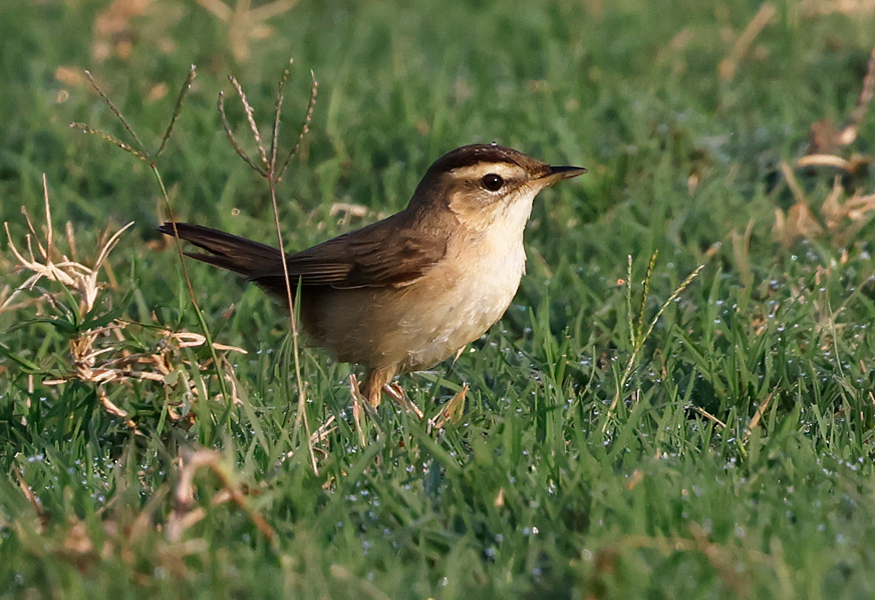
Rather easier to see are Indochinese Bushlarks when they are singing. These small larks seem to like drier patches of habitat, often adjacent to wetlands but also often far from any water, and will sing from exposed perches as well as singing from the ground. I didn’t see that many Indochinese Bushlarks but at both sites they were easy to detect as it was into the breeding season when they are in song announcing their territories.
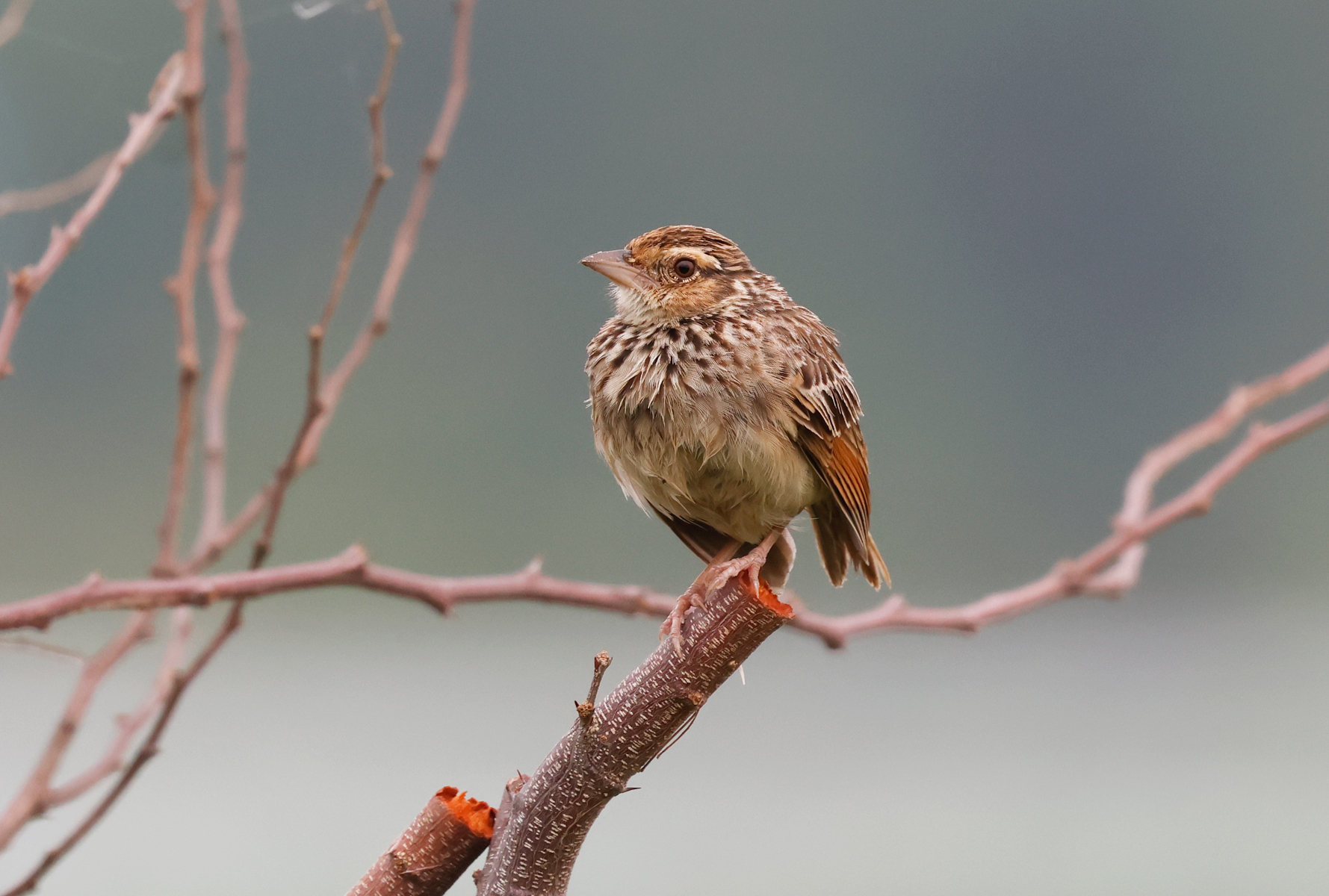
Indochinese Bushlark is rather well-marked for a little brown bird, and it has a pleasant song, so I am always happy to see it. This is a widespread bird in Thailand so it is easy to see and adapts well to many types of farmland uses.
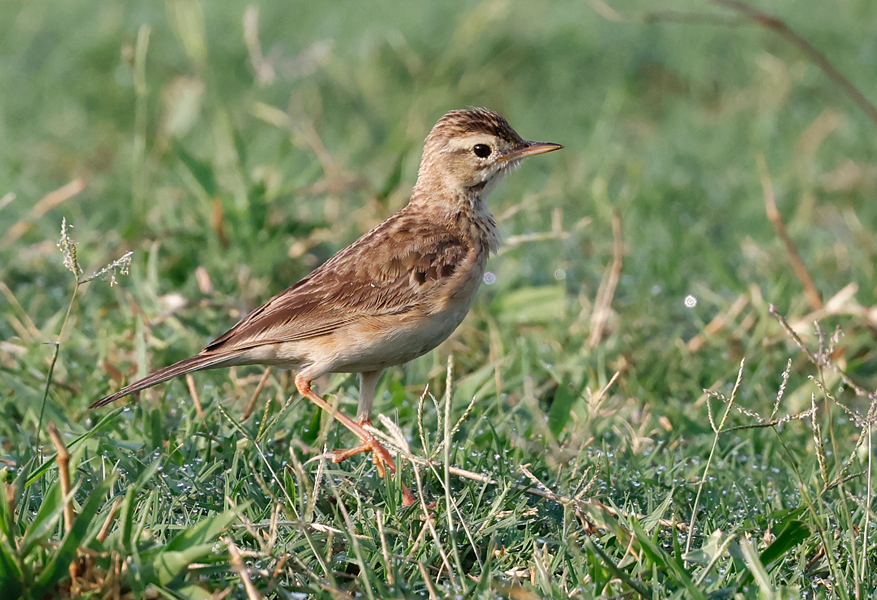
A superficially similar bird that occupies similar habitats as Indochinese Bushlark is Paddyfield Pipit. The most obvious difference between these two birds is the tail length. Even at quite some distance Paddyfield Pipit can be seen to have a long tail (unless worn or moulting) while Indochinese Bushlark has a short, stumpy tail. There are plenty of other subtle differences of course but this feature is obvious. On the drier patches of grassland and surrounding habitat I saw a few of these pipits while at Phutsa reservoir I also saw a Richard’s Pipit which was easily separated from Paddyfield Pipit by its flight call (see this blog post for further details on identification of Richard’s & Paddyfield Pipits). In fact if I had not heard this bird call I would have passed it off as the resident Paddyfield Pipit as migratory Richard’s Pipits are scarce at this time of the year in Thailand. A single Paddyfield Pipit gave me a nice opportunity to get some photos.
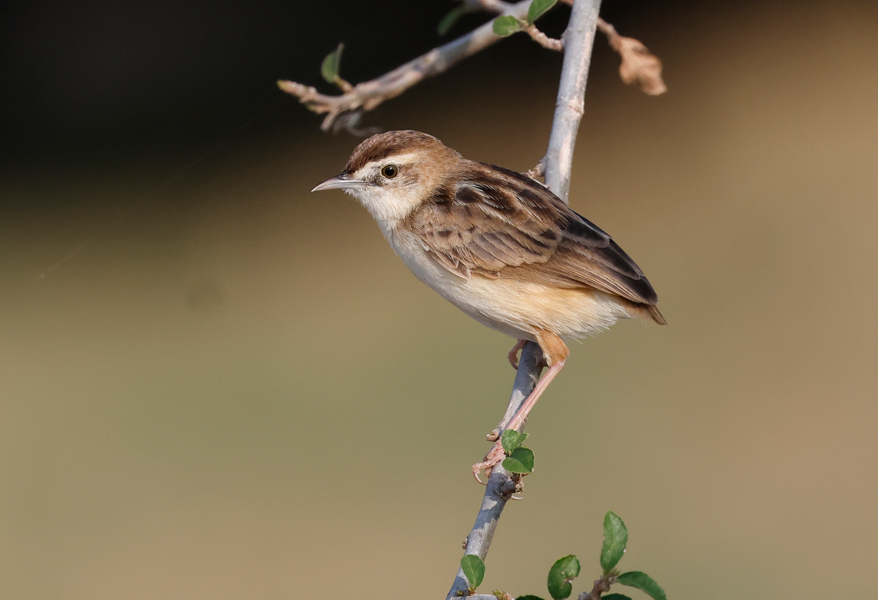
While on the subject of small brown birds there is something I have learned about them regarding photography. While most bird photographers want to get shots of iconic, often colourful or hard-to-find birds it has come to my attention that even the little brown ones look great if you can get a really good photograph of them. Get the right light, the right amount of feather detail and the right pose and then all the birds light up, even the ones that at first might seem dull. This Zitting Cisticola will hopefully illustrate a little of what I mean even though its tail is not fully grown.
A few Notable Birds
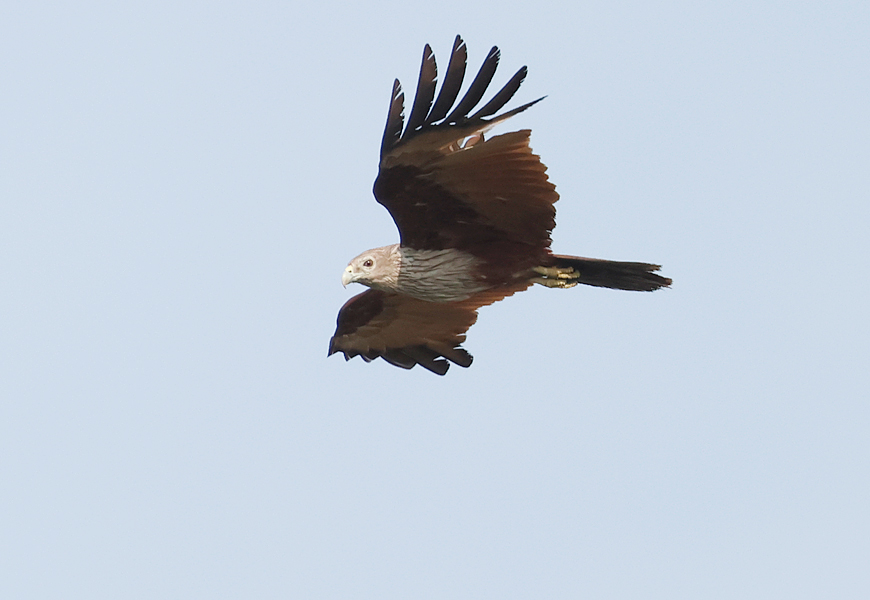
It is always nice to see at least a few birds that might be unexpected in some way; either unusual for the region, habitat or just scarce overall and my visits to these wetland sites in Khorat, Thailand, were not without a few such birds. I have already mentioned Indian Cormorant which is not common far away from the coast in Thailand normally and another bird that I saw here also fits into that category: Brahminy Kite. At Phutsa reservoir these smart raptors were quite numerous and this is very much not the normal case inland in Thailand, although they are common away from the coast in other countries. In wetlands in nearby Buriram and Surin provinces they still do well on inland reservoirs and it seems the case that they occupy this habitat in parts of Nakhon Ratchasima province too.
Although Red Avadavat is a widespread bird globally I have never seen very many of them at any one time; up until my first visit to Phutsa reservoir. Arriving at dawn there were hundreds of tiny birds emerging from a Typha bed which turned out to be Red Avadavats. It was tricky to estimate how many exactly as they were coming out continually in small groups but there would have been at the very least 300+, probably very many more. All of the observations were in flight and I didn’t manage to get any photographs. However, I did get photographs of Chestnut Munia. This is not exactly a rare bird but at the same time it is rarely numerous in Thailand but at these two wetlands they seemed to be the commonest species of munia; at least on my visits they were.
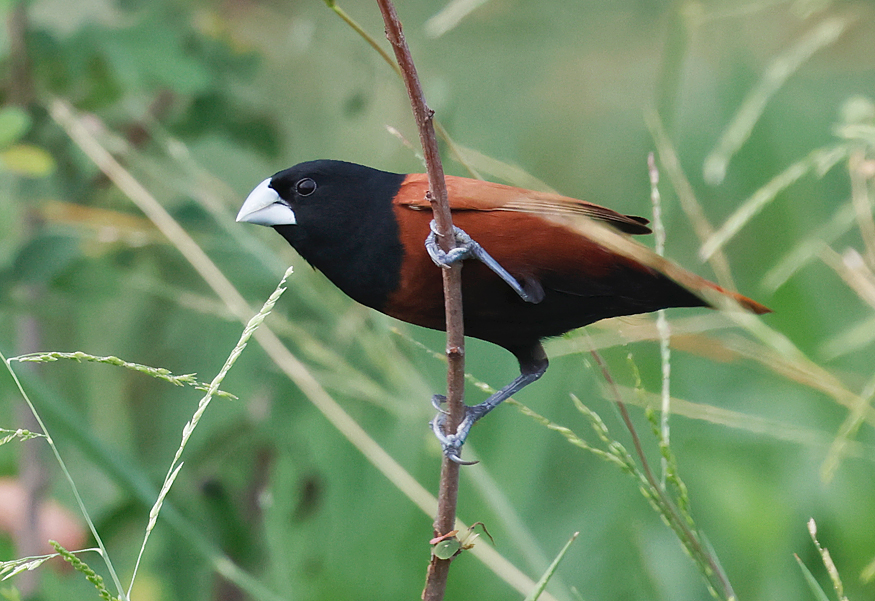
In most areas of Thailand Scaly-breasted Munia is usually the most obvious species in this group of birds and White-rumped Munia can be common too but it made a nice change for the colourful little Chestnut Munia to be the most abundant.
Some Breeding Waders
Most wading birds in Thailand are “winter” visitors and at the time of the year I visited these wetlands in Khorat most of these had begun their migration although I did see a few Wood Sandpipers and a Common Sandpiper. However, there are a few birds in this group that breed in Thailand and, as expected, I found these where the habitat was appropriate.
Oriental Pratincole is more or less a wet season visitor to Thailand and they favour dry areas of open soil, often near water, for their nesting habitat; at Phutsa reservoir there was an area of this habitat and as expected there were good numbers of this attractive bird nesting. Laying their eggs in a small scrape on open ground Oriental Pratincoles employ distraction techniques to lure potential predators away and there was plenty of this going on. I didn’t approach them though, I didn’t want to accidently crush any eggs and I could see them perfectly well from next to the car.
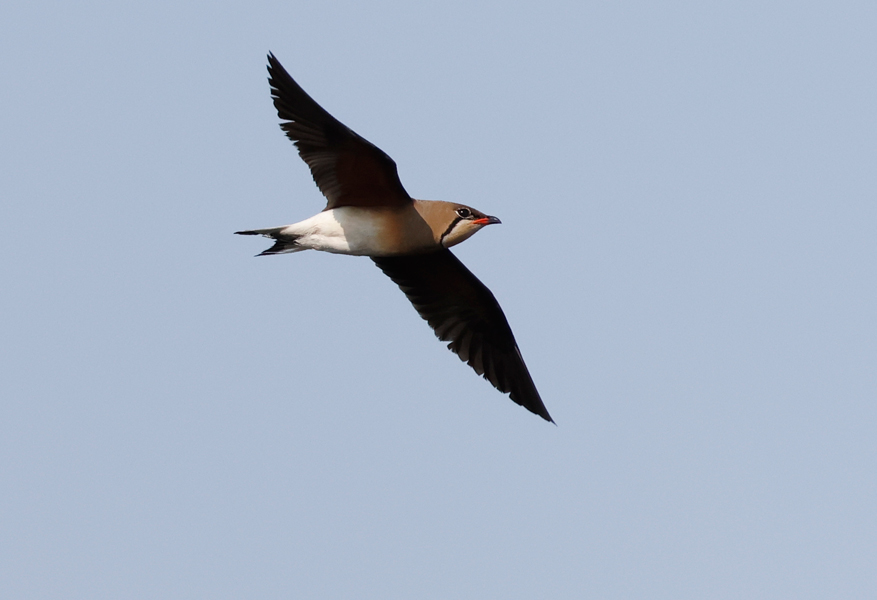
Sharing this habitat were a few Oriental Skylarks, performing their aerial song flight between squabbles on the ground but another shorebird that was breeding in the area was Little Ringed Plover, another bird that nests on areas of bare ground.
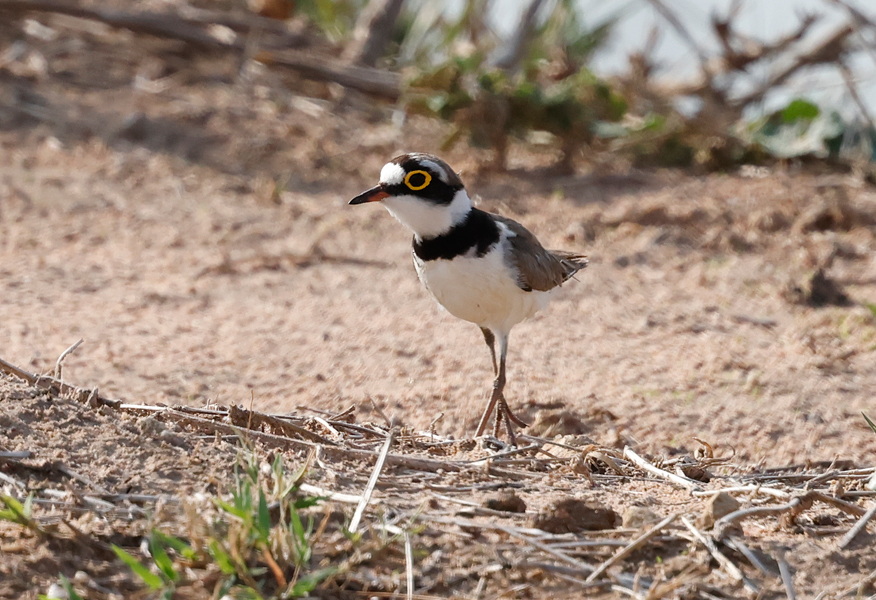
This is the subspecies jerdoni which breeds in Thailand and this bird also was displaying distraction behaviour to lure me away from the nest even though I did not get out of the vehicle! The subspecies jerdoni is resident in Thailand but is joined, in winter, by the migratory curonicus subspecies next to which it is obviously smaller and perpetually in breeding plumage. In this photograph you can also see the wide yellow eye ring and pinkish base to the lower mandible which also separate jerdoni from curonicus when both are in breeding condition. For a more detailed account of these two subspecies of Little Ringed Plover in Thailand read this blog post – Identifying subspecies of Little Ringed Plovers.
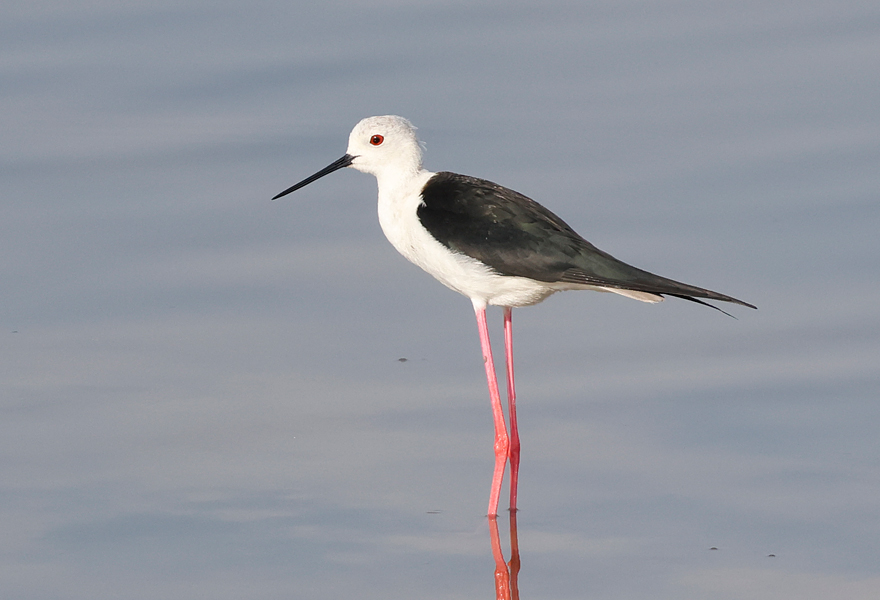
Of course in Thailand there is another obvious wading bird that would be expected in any available habitat: Black-winged Stilt. There were plenty of these long-legged birds to be seen at both wetland sites I visited, as expected, with several nests spotted; nothing more than little hummocks built up on boggy ground. Black-winged Stilt is one of those birds that is so common in Thailand that one can easily overlook them but it is worth reminding oneself of how remarkable its legs are; a bird that is actually well-named!
On the subject of common, resident wading birds in Thailand many readers might be wondering what has happened to Red-wattled Lapwing. Well, remarkably I saw very few of this normally ubiquitous bird and I forgot to photograph the ones that I did see. For those that want to hear its unmistakable and persistent call you can hear it in this short video clip (made elsewhere in Thailand).
Anyone who has done any birding in Thailand will be very familiar with Red-wattled Lapwing and its call. Someone once said to me “it is the first bird that you get bored with in Thailand”. That’s a bit harsh but the call can certainly get infuriating but then I guess that is exactly what it has evolved to do in order to drive off potential nest predators.
Some other Enjoyable Birds
In addition to many of the species mentioned above there were a few other species that stood out including a couple of Bluethroats. I was a little surprised these winter visitors were still around and they gave me very good views too. A small group of White-winged Terns was also superb with all individuals in full breeding plumage; stunning!
Plain-backed Sparrow is a bird I am always happy to see. It is very under-rated given the male’s colourful appearance so seeing this bird was nice too and a singing male Pied Bushchat was a pleasant surprise and more or less the last bird I saw on leaving Phutsa reservoir on the second visit. As a lover of woodpeckers it was nice to find a Freckle-breasted Woodpecker too and Hoopoe’s are always a good bird regardless of them being very widespread. If a Hoopoe with its crest up doesn’t make you smile then not much will.
The full list of species I saw on this short, non-birding trip, can be seen on this eBird trip report – Khorat Birding 2026.
These two wetland sites provided me with plenty of nice birds in three pre-breakfast sessions. Other birders can get out there, find similar sites anywhere in Thailand, and see a very similar set of birds and perhaps find some unexpected species too.
Alternatively, you could join a guided birding trip in Thailand; this itinerary visits the best sites in Northern and Central Thailand and allows the best opportunity to see the highlight species at a pace that is not rushed – North and Central Thailand Birding Tour.
 Posted in
  Tags:
Tags: