Darenth Valley, 11th July 2007

Home for a few days, visiting my family so I decided to make the most of the time with a walk along my old local patch along the Darenth Valley near Dartford in Kent. I walked the section between Hawley and Sutton-at-Hone which includes gravel pits, alder woodland, hay fields, pasture and watercress beds. Over a period of about 25 years I have seen a surprising number of species along here – 109 at the last count. Mind you I didn’t really expect to add to that on this walk.

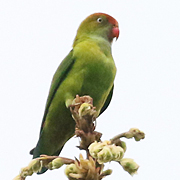
Not a huge amount around, due to both the time of year and the time of day of the walk, but a few nice birds were seen. The local Ring-necked Parakeet population continues to grow with at least four pairs with young seen; 10 years ago this species hadn’t made it this far out of London, but now they are ever increasing in number. A few warblers continue to sing with a couple of Blackcaps, a Chiffchaff and a Whitethroat and a number of common birds such as Linnet, Greenfinch, Blue Tit and Great Tit.

Whilst searching for more Parakeets I noticed a sub adult Grey Heron sitting on a wall. a common species but one I always like to see; it has been one of my favourites since I was a kid.

The lakes held almost nothing with just a couple of Mallard, two Tufted Ducks, a bunch of Greylag Geese and plenty of Coots with young. Just a single Moorhen and 2 Black-headed Gulls.

The watercress beds were very quiet too, but at least there was a Kingfisher present. This spot is much better in winter when it is a reliable location for Green Sandpiper; however, it is one of the prettiest spots along this section of the valley and a place that holds a lot of memories for me. The most amazing was in a very hard winter in 1985 or 86 or maybe 87 (I must be getting old, I can’t remember) when a Bittern flushed out of the cress bed only a few feet in front of myself and my father. The water comes out of a spring and in winter is often the only unfrozen water for miles around.

Not much else was seen, Swallow, House Martin and Swift, and a few Stock Doves along with the more common species. On my way back I came across a number of wild plum trees and helped myself to the ripe fruit. Whilst munching these I noticed a badger sett in the hedgerow – this was confirmed by a number of black and white, wiry hairs in the sett entrance.

Finally, something worth mentioning

Weeks of dismal weather has meant that I have not been out too often, and when I have been out there has been little of interest. However, last monday I got out for a walk up to Eske. The flooding from the rain the previous monday was still very bad and much of the surrounding farmland was still under a few feet of water, turning the whole place into a massive wetland.

At the polo club a group of Tufted Ducks were swimming on what should have been the pitch and a large number of gulls were resting on it: 42 Lesser Black-backed Gulls, 12 Herring Gulls, 5 Common Gulls and 10 unidentifed sub-adult Herring/Lesser Black-backed Gulls. Also present were a pair of Oystercatchers.

Large numbers of House Martins. Swallows and Swifts were feeding over the water and a female Kestrel was hunting over what little dry land remained.

On the lake, about 40 Mallard were reaching eclipse plumage and a apir of Shoveler were resting along with the male Wigeon and female Goldeneye. All the Great Crested Grebes were swimming around aimlessly as if wondering what had happened to their nests.

Further along the river 8 Grey Herons were hunting amongst flooded oilseed rape and 3 Cormorants, 24 Greylag Geese, 7 Mute Swans and a Great-crested Grebe were making use of a flooded barley field, whilst a pair of Marsh Harriers hunted over it.

On the way back I spotted large numbers of Bee orchids just finishing flowering and about 40 spikes of Pyramidal Orchid. A few Common Spotted Orchid were flowering too. Most interesting was a Common Sandpiper on the River Hull on the way back. Perhaps some waders are already making the return journey southwards?

Summer Weather

It was impossible to resist a walk in such sunny and calm weather yesterday afternoon so I headed along the River Hull to Eske. The sounds of summer didn’t disappoint; Skylarks, Yellowhammers and Meadow Pipits in song and the screeching of passing Swifts.

At the lake I decide to just sit and wait for the birds to turn up. Male Wigeon and female Goldeneyes both still present – it really doesn’t look like they are going anywhere now. The pair of Oystercatchers are still tending their almost fully grown chick and a family of Pied Wagtails were feeding at the water’s edge. Three Little Ringed Plovers were present and it appears that one is sitting on eggs -they are very difficult to see on the stony “beach” that is revealed when the water is low. As I stood chatting to another birder a number of Black-headed Gulls settled on a small island and were joined by a sub-adult Little Gull. A soaring male Marsh Harrier, a Kingfisher and a male Great Spotted Woodpecker all put in an appearance too.

Walking a little further north a male Yellow Wagtail perched on the same fence post as I photographed it upon about a month ago and a Hobby was hunting along the river.

Unfortunately I had to dash back to the car in order to collect my wife from work, cutting short this most productive trip.

Swinemoor and crap weather

A truly miserable walk around Swinemoor Common in cold wind and rain produced predictably few species yesterday morning. Just 12 Lapwings, 2 Redshank, 4 Snipe and a single Little Ringed Plover. Plenty of Swifts and Swallows around but very little else.

I should have stayed at home.

Saturday 26th May – Eske

Last Saturday I went for a short walk up to Eske with my wife. The weather was quite nice but we spent most of the time nattering so the number of birds I saw was limited. The usual species were seen, but most notable were two Hobbies hunting at the northern end of the lake. Both birds were catching and “dehusking” insects on the wing before eating them. They also spent time resting in the branches of some dead trees.

On the lake the female Goldeneye was still present and a apir of Canada Geese were swimming around with their new family. Their nest must have been well hidden because I have only seen one Canada Goose for ages now. As we were leaving a Cuckoo flew into the trees and began calling.

On the fields a little south of the lake the Egyptian Goose was still present, grazing amongst the cows.

Eske 25th May

Last Wednesday the weather was really sunny so I went for another stroll up to Eske. Most of the usual species were easily seen with lots of Swifts swooping around and Skylarks singing. However, the grass was being cut for silage in a field to the east of the path; any Skylarks or Meadow Pipits nesting there were out of luck!

Scanning the farms to the west revealed monday’s Egyptian Goose grazing in some set aside where some Lapwing chicks were also feeding along with large numbers of Starlings bathing in what little water remained.

Up at the lake a strange double honk drew my attention to a group of Swans and to my amazement I spotted a Bewick’s Swan displaying to a pair of Mute Swans. Watching this bird revealed that it was very confused as it displayed to families of Greylag Geese and then tried to grab the goslings. Another pair of Mute Swans landed in the lake and the Bewick’s Swan flew over to them and attempted to mate with the female bird! Unfortunately, I had taken a very grainy photo of the Bewick’s when I first saw it and drained the last vestiges of power from the batteries of my camera, so wasn’t able to video this bizarre behaviour, even though it was all very close.

At the north end of the lake 2 Cuckoos were calling from dead trees, occasionally being mobbed by Sedge and Reed Warblers. Walking around the lake also revealed the Terrapin resting on a log, a Slow Worm and my first Common Blue butterflies of the year along with lots of Orange Tips and Wall Browns.

The only other birds of note were the female Goldeneye (no sign of the Wigeon though) and a family of Chaffinches with 3 fledged chicks. On my way back the Egyptian Goose was swimming around in the River Hull only about 20 feet away from me, but as I stood chatting with a farmer it flew away onto some pasture where it joined some cattle grazing.

Eske and Leven Canal

With the weather fine and calm it seemed a good day to go for a long walk along the River Hull. I wandered up to the lake at Eske. On the way up a pair of Mistle Thrushes were hunting on the polo club and Reed Buntings were calling from the reeds. The sunshine brought out the Skylarks, with three or four in song, along with a Meadow Pipit or two. I stopped to have a look at a wet pool in some set aside where a number of Lapwings were lurking and at least two chicks were feeding; a male Shoveler was also resting there, but stirred and flew off north as I was watching. Another migrant put in an appearance as I was watching these birds; a Common Sandpiper flying north along the river made a short landing on a lump of floating debris before continuing north.

A local farmer has put his cows out on the flood defences of the river and they look quite nice until they panic as walkers approach and then they stampede.

.

With the fine weather one of the Little Owls was sitting outside its roosting hole, but this time it was asleep and didn’t seem to be watching me this time.

On the lake the usual birds were present; Mallard, Tufted Duck, Coot, Moorhen, Great-crested Grebe, Greylag Goose, a single Canada Goose, 2 Shelduck and one Gadwall. Two Oystercatchers are still present as are the male Wigeon and female Goldeneye.

Warblers were much in evidence today with many Willow Warblers and a Lesser Whitethroat easily seen and a few Sedge Warblers and a Reed Warbler noisily “singing”.

Walking past the lake towards the Leven canal a distant Cuckoo was calling and as I was looking at a group of Mute Swans a large ducklike bird flew north. After looking at it through my binoculars it was obviously an Egyptian Goose! I watched it fly north, almost out of sight, but then it did a u-turn and returned back south, giving me a second chance to see it properly.

A number of Linnets and Goldfinches were feeding in some weeds and as I was watching these a Common Sandpiper flew north along the river. Presumably it was the same one as earlier, and this time it attempted to land on a Mallard’s head!

Walking along the Leven canal revealed impressive numbers of both Sedge and Reed Warblers, so many that it was easy to get good views of these sometimes tricky to see species. Suddenly, a long overdue Garden Warbler came into song and very obligingly showed itself. A male Blackcap was showing off too and a couple of Whitethroats were also in song as were a few Chiffchaffs. Strangely there don’t seem to be many of this species around up and down the Hull valley, but there were at least three along the canal.

Also along the canal two encounters with Slow Worms made me jump; the first one I saw was about 1 metre long. A Kingfisher made one of those typical photogenic poses on a sign saying no fishing!

The return journey revealed a female Mute Swan building a nest; I took a few photos and a video clip of this – here is one of the pictures.

Back at the River Hull a distant Cuckoo made itself seen as some small songbirds mobbed it. It didn’t move far before resuming its call. A little further down the river a second Cuckoo came into view and performed some surprisingly acrobatic moves as it caught some flies. Immediately after this, a Barn Owl appeared almost at my feet, just a few yards away and below the flood defences I was walking on.

Back on the lake another migrant had turned up; a pair of Common Terns, with the male catching fish and offering them to the female. Last year a pair successfully raised two chicks and it looks like they will attempt to do so again. Another arrival to the lake was an immature Cormorant.

Yet another migrant was a pair of Yellow Wagtails, calling and perching on barbed wire. They didn’t seem too concerned with me and I managed to take a couple of reasonable photos.

With my stomach complaining at this point I marched back to the car with just a few Swifts, Swallows and a flock of House Martins of note, although large numbers of juvenile Starlings were everywhere!

Free WordPress Themes