Eske (Or is it Pulfin Fen?)

Today I didn’t just think about birds, I actually went and looked at some!

From 11am to 1 pm I walked up the Hull river to an area known as Eske. However, part of this area is a Yorkshire Wildlife Trust reserve called Pulfin Fen, so I’m never really sure what to call this location. The weather was fairly good for birding, no wind at all and good visibility. I always walk to this spot from Hull Bridge and take the footpath on the eastern side of the river; there is a path on the western side, but there is no access to the lake from here. I’ve shaded the area where most birds are likely to be seen pale green.


There was almost no bird activity at all until I got to the first hedgerow alongside the path and suddenly there were birds everywhere. Mostly the hedge was full of noisy Blackbirds, Fieldfares and Redwings, stuffing themselves on hawthorn berries. A number of the Blackbirds were huge, so presumably these were birds from Europe.

However, whilst watching this lot, a small bird flew off and began foraging in a sheltered area under the hedge: I was pretty surprised to see that it was a ChiffChaff. I guess I shouldn’t have been that surprised really, I know they winter in the UK more and more, and this winter must be one of the warmest ever. Still, this far north I would imagine that it is unusual.

At the lake there were hundreds of Greylag Geese and lots of ducks, mostly Wigeon and Mallard, but there were also Teal, Shoveler, Pochard, Gadwall, Tufted Duck and a very welcome sight of two male Pintail. On the way back to the car a flock of around 200 Pink-footed Geese flew overhead and I finally saw my first Grey Heron of the year.

Somehow I still haven’t seen a Chaffinch this year. I wonder how long I can go without seeing one.
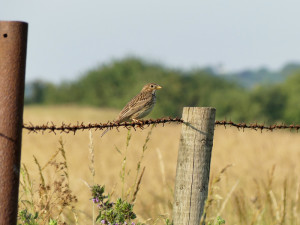
Corn-bunting21

Corn Bunting Data Analysis – British Birding

Today I spent most of my time analyzing the data I have collected observing Corn Bunting habitat selection. I initiated a study of Corn Buntings from May to August 2006 in order to record the crop selection of calling males in the study area and to attempt to make a map which would show all territories. I am currently in the third year of my degree, studying Wildlife and Countryside Conservation, and the data I have collected is to be discussed in my dissertation. I did all the fieldwork in East Yorkshire/North Lincolnshire and I am now writing up my findings and creating all the maps and graphs that are needed to illustrate them.

I surveyed in the region of 100 square kilometres near RSPB Blacktoft Sands and found 168 singing male Corn Buntings. I plotted their territories and recorded the crops that each was using, whilst mapping the land use of the entire area. Fortunately, the weather was really warm and sunny for most of the study period, so the task was very pleasant indeed. Read more »

Too Windy Again – Swinemoor

Woke up really late this morning after having a nightmare where my life was completely screwed up by having a baby (not me: my wife). I couldn’t get this spectre out of my head, so I went out for a walk and some birdwatching despite a howling gale. In fact, the wind had been so bad that the TV aerial blew down overnight, to be left dangling from the telephone cables. Strangely enough the reception has been improved by this, so it can stay there until someone else decides to do something about it.

Anyway, at around midday I got into the car and headed for Swinemoor Common, another one of Beverley’s old commons (See below for map). Swinemoor gets a few dog walkers on it, but it isn’t heavily used and it consists of unimproved grassland and scrub. The piece of the common between the large drain and the Hull river gets really wet in the winter and can be good for waders in the spring. I was hoping that there were a few winter waders around.

The common is really wet at the moment and if this continues, birdwatching here in the spring could be really good. However, not much at all today; lots of Lapwings, which were very flighty, and around 200 Black-headed Gulls with a few Common Gulls. Scanning around revealed almost nothing, so I decided not to extend the walk beyond playing around with my digital camera. Took a few shots of the common, you can see how wet it is from this one.

Some bloke with his dog began shouting at me for some reason. I didn’t bother to respond, he didn’t seem to have polite intentions and I can’t be bothered to speak to rude idiots, so I left. The guy tried to intercept me by cutting across the common and seemed to get stuck in the mud.

Other species I saw were:

Blackbird, Rook, Woodpigeon, Starling, Collared Dove, Mallard, Moorhen, Kestrel and Cormorant; as uninspiring a list as you’ll ever see!

The First One – Figham Common

After spending all morning on the computer doing college work, I managed to get enough energy summoned to go for a walk. As the weather was quite dreadful, strong winds with showers, I opted for a location nearby where a short stroll was an option.

Beverley has a number of ancient commons, and today I went to probably the least visited of these and least manicured: Figham Common. In the map above I’ve shaded Figham common green; it’s just to the south-east of Beverley.

The common is bisected by a large drain, and bordered to the east by the Hull river. The land between these two watercourses is inundated with rushes and I had two Short-eared Owls there in February 2006. I was hoping for something similar today.

Well, what a disappointment. After about 5 minutes I was questioning the wisdom of this trip; the wind was outrageous and, predictably, all the birds were hiding away in the undergrowth. With my mind wandering to the warmth of my flat and tea with scones I was awakened by a large flock of Fieldfares. They all had particularly colourful breasts, but scan as I might I couldn’t find any other species.

That was about the story of the walk really; wind and Fieldfares with a bunch of Redwings thrown in. In fact, the whole common was filled with both these species with probably about 300 Fieldfares and 250 Redwings. A flock of about 40 Linnets and a lone male Yellowhammer were the only other birds to make me stop and look.

So that was it, my exercise for the day. Not one of the most memorable day’s birding.

Free WordPress Themes