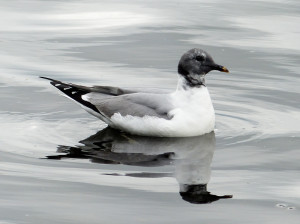
I spent the last few days walking in the mountains in the Lake District National Park, but on my way I decided to stop off to look for a couple of unusual birds, the first being an adult Sabine’s Gull which had been reported as present for a few days at Pennington Flash, near Manchester. Finding Pennington Flash Country Park was easy with just a short excursion off of the M6 motorway and on arrival the large lake had the potential to make for a long search, being full of a variety of Gull species. However, as if often the case when twitching a rare bird, other birders were around to point the way to a nearby hide where it had been seen on a daily basis. A short stroll revealed a small group of birders photographing the Sabine’s Gull which was feeding on pieces of bread being thrown to the ducks; the cutting edge of birding!
Wetland Birding in Khorat | Birding in Thailand
Thailand is full of Birds Thailand is an extremely popular birding destination because of a number of top-quality sites around the country that provide the opportunity to see a wide variety and number of species, including many that are hard to see elsewhere or have very limited global ranges. Many species of birds are more [...]
North Sulawesi Highlight Species | Birding in Indonesia
After leading the highly successful 2026 edition of the Calidris Birding Tours North and Central Thailand tour, I had some time to spare and decided on a return to Indonesia. previously, in 2024 to focus on North Sulawesi’s endemic species. This trip report covers top sites on Sulawesi’s Minahasa peninsula — Gunung Mahawu, Dumoga-Bone and [...]
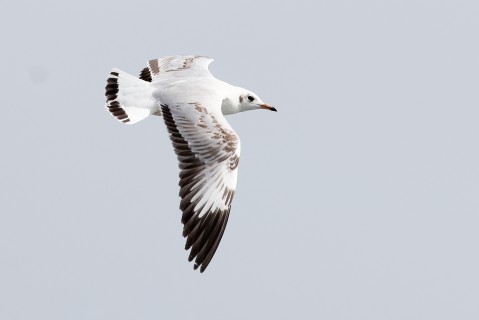
Gull Feeding Frenzy at Samut Sakhon | Birding in Thailand
A beautiful sunrise, thousands of birds, the sound of the sea; all the ingredients for one of the world’s birding hotspots, but in reality this is the atmosphere I was able to enjoy on a short morning excursion from Bangkok when visiting the “Red Bridge” coastal boardwalk in neighbouring Samut Sakhon province. Rather than being [...]
Birds in a Park in Bukhara | Birding in Uzbekistan
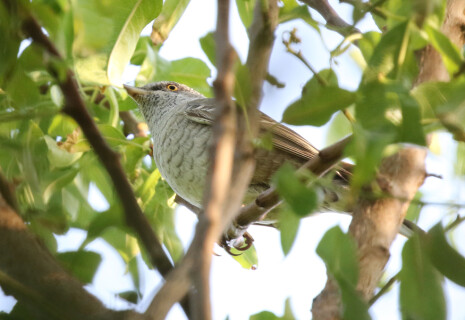
Uzbekistan is one of those countries that is great for birding and at the same time extremely interesting in touristic terms too; an ideal place to travel with a non-birding partner and then to find time to go birding in locations near the tourist spots and to visit some really spectacular scenery. In late April [...]
Top 5 Birds of Vietnam Birding Tour 2025 | Birding in Vietnam
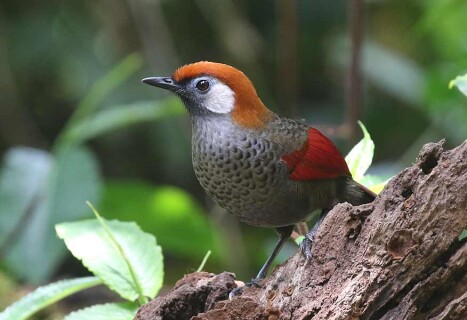
ietnam is the country in mainland Southeast Asia with the highest number of endemic species and the best place to see a number of regional endemics too as well as a fantastic supporting cast of more widespread birds. Leading the Calidris Birding Tours trip to Southern and Central Vietnam in March/April 2025 gave all participants [...]
Black Stork at Dungeness: British Birding
 August 7th, 2015
  Nick
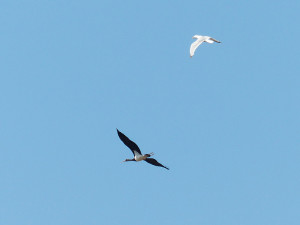
Nick It’s funny how one bird can completely change the way a day is going. After seeing several reports of interesting species at and close to Dungeness I set off to enjoy a sunny day with several species as targets. The first of these was Spoonbill which had been reported on several days at Scotney Gravel Pits. However, despite much searching and waiting a failed to find these birds, instead I spent the time photographing the feral Barnacle Goose flock. Next it was off the Dungeness RSPB reserve where a number of species were possible but despite seeing the Wood Sandpiper which had been present on my previous visit to Dungeness last week, there was very little to see, just Green Sandpiper, Common Sandpiper and a few Golden Plover.
The next birds to miss were a flock of Black Terns that had been reported near the nuclear power plant but had departed only to leave Herring Gulls and a single juvenile Yellow-legged Gull and I also could not find any Black Redstarts which are resident at the power station. At this point I was setting a record for failing to see any target birds but as I was sitting eating my sandwich, parked close to the beach screeching Herring Gulls alerted me to a bird that was to totally turn around my run of poor luck. Read more »
Growths on Legs & Feet of Birds
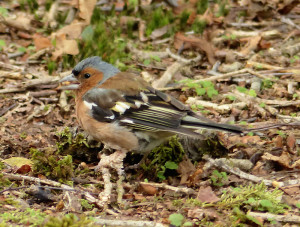
August 4th, 2015 Nick While bird watching at Ashdown Forest a few days ago I spent some time trying to get some good photos of some of the commoner birds occurring in woodlands. A Treecreeper kept me occupied and frustrated for some time until I noticed a male Chaffinch foraging close by in the leaf litter. I was able to approach it quite closely a few times but due to low light conditions and me setting the camera incorrectly I failed to get a really good photo of it. However, when I was checking my photos I noticed that the bird had a large growth on its left leg so I followed it and managed to obtain some slightly better images.
The photos revealed a large, warty growth on the toes and leg of this Chaffinch but it did not appear to be in any distress although it was rather unusual that it repeatedly allowed me to get very close to it as it was feeding. I have seen this type of growth before in Thailand on the legs of Paddyfield Pipit and was informed that it was caused by a parasitic mite, but I decided to do a little research online to see what the cause could be in Chaffinches. Read more »
Reporting Ringed Birds – British Birding
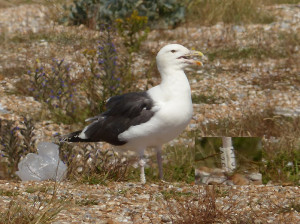
August 2nd, 2015 Nick A lovely sunny day prompted me to head to Dungeness on the coast of Kent this morning in the hope of seeing some terns and gulls at the water outlet of the nuclear power plant – “the patch”. Unfortunately there were very few birds at all there, just 20-30 Herring Gulls of varying ages and a couple of Black-headed Gulls and no terns at all which is a little unusual for the time of year. I spent some time watching but very little of interest was to be seen so I headed back along the access road to see if I could find any roosting gulls, finding a couple of small groups to photograph from the car.
A group of gulls lurking around the back of a fish hut, fighting over scraps, caught my attention and a quick look at them revealed a single juvenile Yellow-legged Gull among a group of Great Black-backed and Herring Gulls. These bold birds allowed me to approach fairly closely and I made sure I got some nice photos of Great Black-backed Gulls in different ages but it was not until I got home that I noticed that one of the birds I photographed was wearing a colour ring with an alphanumeric code on it.
Ashdown Forest – British Birding
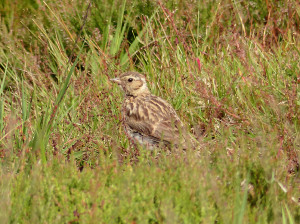
August 1st, 2015 Nick Woodland and heathland birds in UK have both declined in numbers in my lifetime and many species that used to be common now seem to be scarce even in what looks like good habitat. The populations of some heathland species have now stabilized or even increased, probably due to improved habitat management, although others, particularly migrant species, continue to decline. Woodland birds have declined dramatically, particularly in the Southeast of England, to the degree that species such as Willow Tit, Common Redstart, Tree Pipit and Spotted Flycatcher seem to have completely disappeared from places where they used to be fairly common. With this in mind I decided to take advantage of good weather to visit Ashdown Forest to look for some of these birds.
Ashdown Forest is an area in East Sussex that has a number of connecting patches of heathland and woodland, still containing good numbers of birds that are absent in much of the southeast. It is a particularly good place to see European Nightjar, but on this occasion I did not plan to stay out until dusk. I did, however, see a number of other interesting species. Read more »
Returning Waders – British Birding
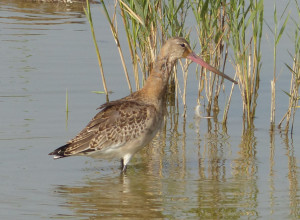
July 29th, 2015 Nick July is a month when waders begin their migration south, from their breeding grounds and it is a good time to see some scarce species as well as some commoner ones in near breeding plumage. Many of the earliest migrating waders are adults that have failed in their breeding attempts as well as some successful breeders and juveniles meaning that their are a confusing variety of plumages for birders to test their skills with at this time of the year.
Having seen a nice Spotted Redshank in near breeding plumage when birding at Oare Marshes about 2 weeks ago I went back to this site today which is often a great place to see passage waders in late July. By far the most numerous species of wader today was Black-tailed Godwit, with a large flock of more than 400 birds resting and feeding in the shallow water, but as usual there were a good number of species to see, including a few scarce ones. Read more »
Shellness; Gulls & Waders – British Birding
July 27th, 2015 Nick Shellness, on the Isle of Sheppey, Kent, is a location where large numbers of birds can be seen at more or less all times of the year. Today I made a late morning/early afternoon visit to see if there were any interesting passage waders at the high tide roost in the hope of getting some close-up views as birds began to feed on the receding tide.
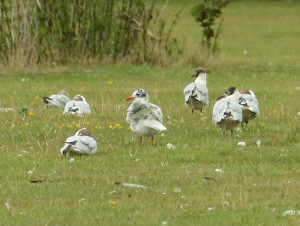
Before reaching Shellness I stopped at the seafront at Leysdown where a group of birds were roosting on the mini golf course, most of which were gulls. I get very little practice with gulls when I am in Thailand so I took this opportunity to take a close look at this group. Within the flock of Black-headed Gulls, which were resting and preening, were a number of Common Gulls and Herring Gulls, both of which are common species, but something far less common was a Mediterranean Gull in full summer plumage. Further scanning of the group revealed a second Mediterranean Gull, this time moulting our of summer plumage and preening extensively – the bird pictured here. Within the flock of gulls were two roosting Oystercatchers but more surprising was Sandwich Tern which seemed out of place on a golf course.