Thailand Birding: Khao Yai – there and back in a day.

Usually I would spend more than a day at Khao Yai due to its distance from Bangkok and the number of birding opportunities it presents but Minoro Shimono, Satomi Kodama and Eriko Kodama were on a brief birdwatching trip to Thailand from Japan and had only a day to spare so, together, we headed off for a day trip.

The day trip is possible, but it results in rather a long day, particularly for those driving. We left at about 4am and arrived at about 7am due to a bad traffic jam outside Saraburi caused by an overturned bus. However, we found some nice birds on the way in – the grassland areas gave us good views of Dollarbird, Plain-backed Sparrow, Hill Myna, Oriental Pied Hornbill and Australasian Bushlark – a species which is not at all common.

However, it was forest birds we came for and at Pa Gluai Mai campsite we found some nice birds – Greater Racket-tailed Drongo, Thick-billed Pigeon, a variety of bulbuls including the jocosus race of Black-crested Bulbul, Hill Myna, Blue-bearded Bee-eater and a superb Collared Owlet feasting on a lizard. Although Collared Owlet is a common forest bird, its “poop, poo-poo-poop” call can be heard throughout the day, it can be quite tricky to find. Abbot’s Babbler is a cute and common bird at Khao Yai and a little imitation of its call brought one out but it was the wintering White-throated Rock Thrush that was the highlight and a number of photographers were busy taking its picture.

Minoro Shimono had told me that it was his dream to see a Great Hornbill and proof that dreams come true came along in the form of a male Great Hornbill hotly chased by 2 Greater Racket-tailed Drongos – one harrassing each wing so that it looked like the hornbill had two huge wing streamers. Fortunately, the hornbill landed in a nearby tree giving us fantastic views for about 5 minutes.

Birding was a little slow for most of the rest of the day but in various spots we saw Wreathed Hornbill, Bright-headed Cisticola, Chestnut-headed Bee-eater, Scarlet Minivet, Rufous Woodpecker, Velvet-fronted Nuthatch and many other attractive birds.

As the day draws to a close, Pa Gluai Mai campsite is a good place to be once more and we found some really nice birds in the last hour or so of light. It is possible to get great views of Oriental Pied Hornbill as they gather to roost and we had one just a few feet away from us in a tree. Behind some huts we found a group of White-crested Laughingthrushes and Lesser Necklaced Laughingthrushes, both superb birds and they moved Eriko to one of her few words of English for the day -”wonderful!”. As darkness came we were on the lookout for nightjars and sure enough a little before dark at least 2 Great Eared Nightjars began circling overhead, uttering their characteristic “pir, pee-weeow” call. These are really big nightjars and provided a nice close to the day – they are regular at Pa Gluai Mai campsite and easy to see.

We stopped in an attempt to see more nightjars but only heard the call of Grey and Large-tailed Nightjars as well as Mountain Scops Owl and Brown Hawk Owl. However, no more birds were seen and it was time to drive back to Bangkok. This day trip to Khao Yai was enjoyed by all, if a little tiring.

lpb_sign.jpg

Thailand Birding: A day trip to Laem Pak Bia/Pak Thale

On 23rd March I collected Andreas Egelund Christensen at 5am from his hotel near Silom Road: Room at Silom Hotel. We arrived at Laem Pak Bia at about 7am and made our first stop at the spot which has been used as a wintering site by a pair of Black-faced Spoonbills: Black-faced Spoonbill wintering site 2008. However, at this time they were not present but a walk around the scrubby vegetation turned up an Oriental Reed Warbler, a pair of Indochinese Bushlarks, an Oriental Skylark, a pair of Plain-backed Sparrows amongst some more common birds. The salt pans here held a single Little Stint in breeding plumage, a number of Curlew Sandpipers as well as Marsh Sandpiper, Kentish Plover, Lesser Sand Plover, Whiskered Tern and Great Egret. In the time it took us to look at these birds on of the Black-faced Spoonbills had arrived and joined a group of Grey Herons and as we watched, the other spoonbill flew in. They proceeded to preen each other in a fashion that suggested courtship behaviour and after watching for 5-10 minutes we left them to it.

Moving on we stopped in hope of Great Knot and Nordmann’s Greenshank. At first all we saw was a large group of Lesser Sand Plovers and Kentish Plovers. I say “all we saw” but at this time of year these birds are beautiful in their breeding colours. Whilst watching these we located a group of Great Knot but the Nordmann’s Greenshank were not present, although a group of over 500 Black-tailed Godwits was impressive.

Standing watching these birds we added White-winged Tern, Common Greenshank, Brown-headed Gull, Gull-billed Tern, Osprey, Red-necked Stint and Long-toed Stint to our list; Andreas was particularly interested in the latter as it was a “lifer” for him.

Rather frustratingly, 6 Nordmann’s Greenshank flew in but did not land, they just flew off into the distance. They could be identified by their pale appearance and white underwings, but this view was not at all satisfying. With this event we decided to move onto Pak Thale for the Spoon-billed Sandpiper.

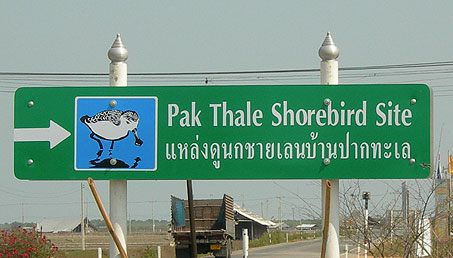
There is now a sign indicating where to turn for this site at Pak Thale – it is very easy to see and is in English with a picture of a Spoon-billed Sandpiper – this map will also help: Spoon-billed Sandpiper map.

Unfortunately for us, most of the Spoon-billed Sandpipers seemed to have departed and recently have been infrequently seen. One had been seen early in the morning but had left by 9.30 am, much earlier than usual. Lots of other birds were available and Little Tern, Red-necked Phalarope and Broad-billed Sandpiper were nice. However, at the mangrove remnants on the sea a fantastic Ruddy Kingfisher perched for a while in a dead tree before flying into dense mangrove cover – what a piece of luck! Amongst the mangroves we found several Dusky Warblers, Pied Fantail and Golden-bellied Gerygone. On the mudflats a number of Eurasian Curlews were feeding as well as many Javan Pond Herons in breeding plumage – no Chinese Pond Herons in breeding plumage were seen.

Feeling the heat we went for some lunch and arranged a boat for the trip to the sand spit. Before the trip though we had time for an hour at the King’s Project. At this time of day the numbers of birds were not so impressive but we found a Black-crowned Night Heron, plenty of Indian and Little Cormorants, Little Egret, Great Egret, Intermediate Egret, Grey Heron and much more.

A monitor lizard eating one of its own kind was an amazing sight and offered a chance for some photographs. read about this encounter and see the photos here: Cannibalistic Monitor Lizard.

In the freshwater filter and reed beds we also found Ruff, White-breasted waterhen and a couple of Ruddy-breasted Crakes as well as a Black-browed Reed Warbler before we headed for our boat trip.

As usual we saw Collared and Black-capped Kingfishers and 2 Chinese Egrets treated us to a great close-up view before flying away. On the sand bar the usual collection of caspian, Lesser Crested, Great Crested, Little and Common Terns were present and on the sand spit malaysian Plover was easily found. However, our quest for “White-faced” Plover was rather trickier and required us to wade through water to investigate the beach further up. Great Sand Plover, Sanderling and many Kentish Plovers were easily seen and just as we were about to give up we found the “White-faced” Plover on a small sand island. After viewing it for some time we headed back to the boat but got very wet wading though waist-deep water as the tide came in!

Our day was almost over but we had time to take another look at Pak Thale. On the way some other birders gave us reason to stop and amongst the large flock of Great Knot, Pacific Golden Plovers, Grey Plovers and other shorebirds were a group of 6 Nordmann’s Greenshank – very satisfying.

However, we weren’t ot be so lucky at Pak Thale and encountered other birders on the same search as us. One more bird for the day list was added though – a Dunlin – a very uncommon bird in Thailand.

We both had a good day however, with almost 100 species seen and pleasant company. The journey back to Bangkok was a little tiresome though, taking over 3 hours due to heavy traffic.

Some photos from Laem Pak Bia/Pak Thale.

, , , , ,

Cannibalistic Water Monitor Lizard

The King’s Project area at Laem Pak Bia is a really good birdwatching site in Thailand. However, any visit is certain to result in sightings of large water monitor lizards in and around the water, as well as birds. Many people ask me what such large lizards eat, and I have long suspected that they eat each other, although I have observed them stalking Pond Herons unsuccessfully. On Sunday 23rd March 2008, Andreas Egelund Christensen and myself saw a large water monitor and stopped to take photographs of it, only to turn a corner and see a much larger monitor in the process of eating one of its own kind. The large monitor was just over 2 metres long, from nose to tail, and the dead monitor was over 1 metre long. We didn’t see the large monitor make its kill, but the dead creature showed no sign of having been run over, instead it had a large gash in its neck which seemed to have been made by the jaws of the cannibal.

Below are the photos, click for larger versions.

As we watched, the predatory monitor was very reluctant to leave its catch, but eventually slipped into the water. However, when we returned to the same spot 10 minutes later it had returned to resume its meal.

, , , ,

lost-grey-headed-lapwing-4.jpg

Thailand Birding: A Quest for Broadbills

On 19th March I joined Alex Vargas on a search for broadbills at Kaeng Krachan as he was after some photographs of those species for his collection:  My Birds, Thailand by Alex Vargas.

Before heading into Kaeng Krachan, however, we spent an afternoon at some paddie fields near Petchaburi before moving on to the King’s Project area at Laem Pak Bia. The paddies are always good for Green Bee-eater and Alex took some nice photos of these. We birded from the car mostly and saw a number of good birds including Pheasant-tailed Jacana, Bronze-winged Jacana, Long-tailed Shrike and a couple of raptors; Peregrine Falcon, Black-eared Kite (formerly lineatus Black Kite, split in Raptors of the World by Ferguson-Lees & Christie), Brahminy Kite and Eastern Marsh Harrier.

Moving on to the King’s Project we arrived for about 5.15 pm which is when a lot of activity is occurring with birds coming in to roost and a last flurry of activity in reed beds. In one muddy pool we found a flock of 40-50 Ruff – this spot is usually good for some Ruff but this was quite a high count. Sitting, looking along some reed beds we got great views of Slaty-breasted Rail, Ruddy-breasted Crake and White-breasted Waterhen; at one point having all three in the same field of view. We also watched Common and Pintail Snipe, dreaming about Swinhoe’s Snipe which I have been told is only reliably seperated from Pintail by its tail feathers; something which is very dificult to see properly unless it is in the hand.

As time stretched on we saw large numbers of Black Drongo coming in to roost and these were accompanied by at least 200 Blue-tailed Bee-eaters and several groups of White-shouldered Starling, numbering in between 200 and 250 birds. Other species coming in to the roost included hundreds of Common and White-vented Mynas and Asian Pied Starlings as well as 60-70 Red Collared Doves. We got a brief view of an Indian Nightjar as it settled on the road whilst we watched Black-crowned Night Herons and Fruit Bats emerge from the mangroves.

Finally we searched for an Indian Nightjar for Alex to photograph but struggled to find one, instead getting fine views of a Barn Owl. Eventually (after we had been asked to leave) we found an Indian Nightjar on the grass but just as Alex was about to photograph it, the bird flew away not to be seen again – that’s birdwatching for you!

After a nice dinner at a beachside restaurant we moved on to our accommodation at Kaeng Krachan.

20th March

Waking up early we were birding in Kaeng Krachan by 6.45am and at our first stop we found some very nice birds. Violet Cuckoo and Drongo Cuckoo were nice to see and good numbers of Thick-billed Pigeons, Black-naped Orioles and other common forest birds were feeding in a fruiting tree along with a few Oriental Pied Hornbills.

Whilst watching these and both Greater and Common Flameback we heard the manic call of a Banded Broadbill. Very fortunately for us a pair of these birds very quickly moved in and we had great views, although they never sat in a location with light good enough for the best photographs. Before moving on to the next stop we spotted a Black Baza circling in the distance and a Crested Goshawk sitting in a tree.

The next interesting bird was spotted as we drove along – a Forest Wagtail – always a nice bird and 6 or 7 more over the next 2 days indicated migratory movements. We also had a roadside Orange-breasted Trogon and Black-thighed Falconet and a number of Crested Serpent Eagles before we reached Ban Krang campsite.

At the campsite we wandered around a little and sat in the shade, waiing for birds and eating our lunch. This proved a good strategy with more Forest Wagtails, a Taiga Flycatcher with an orange throat, a pair of White-rumped Shamas, Ochraceous Bulbul, Hainan Blue Flycatcher, Blue-bearded Bee-eater and another pair of Banded Broadbills all putting in an appearance.

After lunch things were slower, as they often are when birding in the forest in Thailand, but we managed good sightings of Silver-breasted Broadbill, a wonderful species that the guidebook by Craig Robson (A Field Guide to the Birds of Thailand) does not do justice to. We struggled to see very much else with a brief view of Greater Yellownape and Emerald Dove being the most interesting species.

Slowly we made our way out of the park but stopping on the road out is always worthwhile and we saw both Hill and Golden-crested Myna, Greater Racket-tailed Drongo, Green-eared and Blue-eared Barbets and Thick-billed Pigeon to liven things up.

Back at our accommodation we heard Large-tailed Nightjar but failed to see it as it was in dense forest calling but not flying.

21st March

Another early start and we drove quickly up to Ban Krang as we wanted to be in the more moist forest early on. Our day started well with more Silver-breasted Broadbills showing themselves and plenty of the more common forest birds such as Blue-winged Leafbird, Great Iora and Rufous-fronted Babbler which is a really cute and curious character.

Close to the first stream we hit a bird wave with Grey-capped and Laced Woodpeckers, Greater Racket-tailed Drongo, Chestnut-breasted Malkoha and Asian Fairy Bluebird. For us, though, the best bird was a beautiful male Blue-and-white Flycatcher in the lower canopy. This is not a common bird at all and it was only the third or fourth time I have seen it. Another nice species was a Black-bellied Malkoha.

Things got quiet quite early on and it was noticeably hotter than it was a month ago, however, walking along we steadily picked up good birds, with a nice Moustached hawk Cuckoo that we got in the telescope, a Chinese Blue Flycatcher and a very obliging Indian Cuckoo which sat right above our heads catching insects that looked like flying ants. Another Drongo Cuckoo out in the open was also nice and a pair of Great Hornbills was heard by their wingbeats before they passed across the road – always a good bird to see!

The Brown Hornbills were not to be seen, probably we were too late for them, but a family group of bery noisy Dusky Broadbills was our third broadbill species of the trip and Alex got some good photographs of them – a fairly successful quest for this group of birds which was confirmed by another group of Silver-breasted Broadbills which gave the opportunity for the best photos yet.

With this success we went back to the campsite for some lunch and did some birding here with Black-headed Bulbul, Violet Cuckoo, Golden-fronted Leafbird, Greater Yellownape, Hainan Blue Flycatcher and Black-winged Cuckooshrike all welcomed. As we were pretty tired and feeling flush with success we decided to take a slow drive back to Bangkok. There was plenty of time to stop in the forest though and another Indian Cuckoo was a great sight but probably the strangest sighting were 2 Grey-headed Lapwings on the road in the forest! This species is normally found on wetlands unlike Red-wattled Lapwing which likes dry open areas and is commonly found at Kaeng Krachan. We watched these for some time until they began peering strangely into the sky. Up we looked and saw 3 soaring Oriental Honey-buzzards and a Crested Serpent Eagle; no wonder the lapwings seemed nervous.
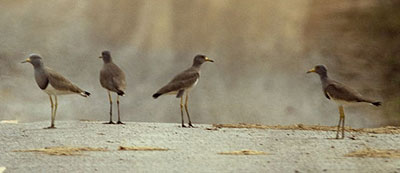

Lost Grey-headed Lapwings
(Photo by Alex Vargas)

We stopped just a little further on to see some Stump-tailed Macaques and Black-naped Monarch taking a drink at a roadside pool when the lapwings flew past, with 2 more of their kind – 4 Grey-headed Lapwings in a forest!!!! The previous night there had been a thunderstorm and this species is migratory so I guess the storm had put them down in a strange spot.

This time we really did head out, stopping briefly at the HQ where we saw a few common birds such as Ashy Woodswallow, Little Egret, Cattle Egret, Kentish Plover, Little Ringed Plover, Black-collared Starling  and Javan Pond Heron before taking a trouble-free drive back to Bangkok.

, , , , ,

Trade in Endangered Species at Chatuchak Market

On Sunday 16th March 2008, my wife and I went to Chatuchak Market in Bangkok to do some shopping. I took the opportunity to take a look at the animal section and was appalled to see large numbers of birds, mammals and reptiles being sold illegally. Squirrels were particularly numerous as were reptiles, but it was particularly disturbing to see a significant number of birds that had obviously been trapped in the wild in Thailand being offered for sale.

I managed to secretly take a few photos of the situation there, although the quality is rather poor. For those interested, the list of bird species and numbers seen are listed here: Illegal Wildlife Trade Flourishing at Chatuchak Market.


Unfortunately, wildlife in Thailand comes under a lot of pressure from such activities and they are so widespread that only a few cases are dealt with. The Wildlife Friends of Thailand do a good job of rescuing a number of abused animals; take a look at their website: Wildlife Friends of Thailand.

It seems that all too often I am adding information to pages on thaibirding.com that deal with issues such as wildlife abuse, bird trapping and suchlike: Bird Persecution, Large Numbers of Dead Birds at Muang Boran Fishponds, Roads Through Wilderness Areas Inevitably Lead to Problems, Abuse of Wildlife for Tourists, Mass Trapping of Birds at Chiang Saen.

However, yesterday there was some good news reported in The Daily Xpress. Over 200 rare animals were seized by the police who raided Chatuchak Market on Saturday 21st March, arresting a number of traders in the process. The rescued animals included Slow Lorises, Madagascar Tortoises and many birds.  Although this is just the tip of the iceberg in terms of the illegal trade in wildlife in Thailand, it is at least a small victory for the police and conservationists.

, ,

Butterflies at Kaeng Krachan

Kaeng Krachan national park is a great place for birdwatching with regular sightings of many species of woodpeckers, broadbills and other exciting birds. It also happens to be a superb place for seeing butterflies with huge clouds of them coming to wet patches to take salt in the middle of the day. If one stands close to these clouds of butterflies eventually they will begin to settle on your arm, attracted by the sweat.

For photographers there are some good opportunites for great pictures and even with just a compact camera and a little patience it is possible to get some nice photos. I took these butterfly pictures close to Ban Krang campsite on 21st March 2008 whilst on a birding trip with Alex Vargas.


, , , ,

Thailand Birding: Searching for “White-faced Plover”

On 13th March Mark Tunmore and Neil Armitage joined me for a trip to Laem Pak Bia/Pak Thale. Their priority species were Malaysian Plover, “White-faced Plover” and Black-faced Spoonbill all of which had been reported as still being present just a week previously.

The drive from the centre of Bangkok to Laem Pak Bia took the usual 2 hours and we made our first stop at the Black-faced Spoonbill site. It is worth noting that at this time in the morning, the spoonbills were not present but when we returned later in the day (about 4.30-5pm) they were both present and feeding amongst large numbers of Grey Herons and 17 Painted Storks. The morning stop at the spoonbill site did turn up some interesting birds though with Oriental Skylark, Dusky Warbler, Oriental Reed Warbler and Indochinese Bush Warbler. Amongst the Red-necked Stints was a Little Stint coming into breeding plumage.

The large flock of Great Knot were obliging at their usual spot but the Nordmann’s Greenshank, which are usually close-by, did not show up.

However, it was the trip to the sand spit which was most anticipated and we arrived just as the tide began to go out. Actually, a short distance from the spit is a sand bar and that is where our boatman (Khun Meta) skillfully landed us a short distance from a large group of terns without scaring them away. Amongst the many Common and Little Terns were 1 Caspian Tern, 5 Lesser Crested Terns and 17 Great Crested Terns. Moving on to the spit itself we quickly found Sanderling, Kentish Plover and the awaited Malaysian Plover. These birds are easily picked out from Kentish Plover by their longer legs, slimmer appearance and slightly different plumage. Many of the Malysian Plovers here also carry leg rings, making them even easier to seperate even in poor light.

Also on the beach was a Greater Sand Plover in breeding plumage – a nice sight! The “White-faced Plover” proved harder to see today than on previous trips and we spent much time scanning across the emerging mud flats and beaches looking for it. In this way we saw a Chinese Egret, a dark morph Pacific Reef Egret and a breeding plumage Javan Pond Heron as well as large numbers of Lesser Sand Plover and Kentish Plover. Occasionally we would see a pale-looking Kentish Plover, causing some excitiment, but the “White-faced Plover” is a really distinctive bird and easily picked out.

Just as we were beginning to give up and wilt from the heat a cockle-picker came along on a motorbike and flushed a group of birds from behind some rocks, onto the sand. Luckily for us this included our “White-faced Plover” which proceeded to run around and aggressively chase other birds away. Mark commented on the distinctive behaviour of this bird too as it seems to make long, fast runs across the sand where Malaysian and Kentish Plovers tend to make shorter runs.

Happy with our lot here we returned to the boat pier. We checked out the Spoon-billed Sandpiper site too but there was very little to see there – a later meeting with Uthai Treesucorn revealed that the Spoon-billed Sandpipers hadn’t been seen for 2 days. We did find 3 Pied Avocets though, close to the Black-faced Spoonbill site, and many other of the more common shorebirds.

We finished the day in the King’s Project area with drongos flying in to roost and many waders in the filter beds, including both Common and Pintail Snipe as well as a bird which was a possible Swinhoe’s Snipe – it had many features of Pintail Snipe (dark underwings, although slightly contrasting to the flight feathers, no white trailing edge to the wings, short call) but it had the long bill of a Common Snipe. If anyone has any information on the identification of Swinhoe’s Snipe I would really appreciate knowing. Other birds at the King’s Project were Black-crowned Night Heron, Ruddy-breasted Crake and Ruff.

We were very pleased with the sighting of “White-faced Plover” because it was high on the list of desired birds and because we had to work quite hard to see it. It will be interesting to know how much longer this bird stays for and when it departs for its breeding grounds -wherever that may be.

, , , ,

Free WordPress Themes