Thailand Birding: Birds in a Bangkok housing estate

Bangkok is a crowded, busy and noisy city but it is amazing how many birds still manage to eke out an existence within the city boundaries. The housing area I have been living in for the last few weeks is quite crowded, with few areas of open land, although it is close to the edge of the city, but still I have seen a number of bird species that has surprised me, even with no vegetation other than what is in people’s window boxes and small front yards.

Today the call of some bee-eaters caught my attention and I went out the front to see 2 Blue-tailed Bee-eaters flying overhead, presumably driven along by the advancing rainstorm.

Other species I have seen here in the last few weeks are:

1. Oriental Magpie Robin
2. Plaintive Cuckoo
3. Red Collared Dove
4. Olive-backed Sunbird
5. Scarlet-backed Flowerpecker
6. Scaly-breasted Munia
7. Peaceful Dove
8. Eurasian Tree Sparrow
9. Large-billed Crow
10. Streak-eared Bulbul
11. Common Myna
12. White-vented Myna
13. Spotted Dove
14. Common Iora
15. Common Tailorbird
16. Pied Fantail

Hopefully soon I can move to a leafier area where a larger number of species can be seen from the front door!

mb5.jpg

Thailand Birding: Muang Boran Fishponds

On Saturday morning (08/03/08) I finally got myself back to Muang Boran Fishponds in Samut Prakarn province – a place which used to be one of “local patches” in Thailand. Despite the slightly convoluted way in, I remembered how to get there and was on site by about 6.45am. It seemed little had changed here since my last visit four years ago and after a few minutes I had seen Striated Grassbird, Common Kingfisher, Whiskered Tern, Coppersmith Barbet (which somehow was a new bird for my site checklist: Muang Boran Fishponds Checklist), Purple Heron, Intermediate Egret, White-browed Crake, Pheasant-tailed Jacana, Asian Golden Weaver and much more – in fact I saw over 30 species within five minutes of arrival. I walked further in to the site hoping to get into the area which was always good for Acrocephalus warblers in the past but it was very difficult to walk past the large concentrations of waterbirds that were present. I was compelled to stop to count waterbirds at one pond, such was their number. I counted over 600 Lesser Whistling Ducks which is by far the highest number I have ever seen here – what does this mean? Is it that the habitat here has improved for this species or that in their past wintering grounds have been destroyed? I suspect that the latter is true. Suvarnapoom airport is not so far away and that used to be a large swampy area with many birds, perhaps many of them have moved to this site? Other interesting counts were 88 Pheasant-tailed Jacanas, 15 Bronze-winged Jacanas, over 50 Common Moorhen, 8 White-browed Crakes (1 with a small juvenile) and hundreds of Pond Herons and Egrets.

Interesting to note that out of the hundreds of Pond Herons, most were still in winter plumage, but a few Chinese Pond Herons were in breeding plumage and probably twice as many Javan Pond Herons were in breeding plumage. I have noticed over the last few weeks that Javan Pond Herons seem to come into breeding plumage slightly earlier than the Chinese Pond Herons – I don’t know if this is a regular thing or just wrongly-drawn conclusion from my own casual observations.

I hurried along to my favourite warbler hotspot but found only a few Black-browed Reed Warblers and lots of Oriental Reed Warblers, although lots of Plain Prinias were doing their best to convince me they were warblers. As I searched for more warblers, successfully finding large numbers of Black-browed Reed Warblers (couldn’t make any of them Manchurian Reed Warbler which also occurs here) and a single Rusty-rumped (Pallas’s Grasshopper) Warbler, I suddenly noticed that virtually every pond had strings across it with hooks hanging down. From these hooks were bird corpses; birds that had foolishly decided to steal fish from these ponds. In the past this practice was restricted to just a few ponds but now almost every part of the site is infested with birds traps of some sort. Here are a few pictures that I took.


Anyone who is interested can read more on this matter here: Large numbers of dead birds Muang Boran Fishponds.

On a more upbeat note, there are still large numbers of birds at this site and although Yellow and Cinnamon Bitterns seem particularly prone to ending up on a hook I saw at least 12 of the former and 6 of the latter. Another interesting bird that is commoner here than at many other locations is Yellow-bellied Prinia; I saw plenty of these little chaps, just listen for their call. It is also worth mentioning how common Striated Grassbird is here too – I have probably seen more of this species at this site than I have at all the other sites put together. Despite it being a brown job I like Striated Grassbird very much – I particularly appreciate it being very noisy and easy to see and I saw at least a dozen of them without trying. One  day I will have to go back and try to count and map the number of birds holding territories here.

Continuing on I found a nice group of 11 Cotton Pygmy Geese in the corner of one pond and continued to see good numbers of White-browed Crake – one would have to be blind to miss this species here. Another good bird here is Asian Golden Weaver and the males were already in breeding plumage and busy weaving nests to impress the females. Of two small colonies I found, the larger had a total of 11 nests under construction and the smaller had 3 nests being built. In total I counted around 20 of this colourful little character. It is worth getting to Muang Boran Fishponds now just to see this lovely little species.

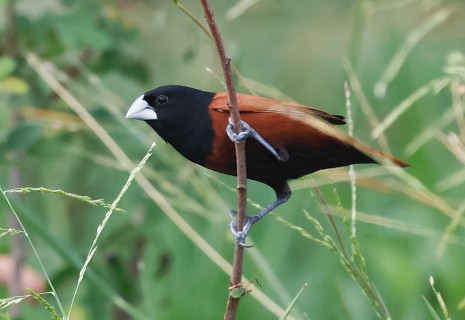
Another nice addition to the day list was 4 Chestnut Munias, feeding alongside the weavers. 5 Baya Weavers were also present although I saw no males in breeding condition. At this point the sheer numbers of birds inspired me to try a photo. Here is the rather feeble result.

I decided that I am better with flowers; they don’t run away or fly away.


Other birds worth mentioning were 3 Ruddy-breasted Crakes, 8 Purple Herons, 38 Indian Cormorants and 69 Oriental Pratincoles. The pratincoles seem a little early and most of them were seen scattered amongst the flames of burning undergrowth!!!

As I headed out of the site I walked back a slightly different way and as usual this detour resulted in more species. Particularly satisfying were 8 White-winged Terns amongst numerous Whiskered Terns, 3 Oriental Skylarks involved in a territorial dispute and a single Grey-headed Lapwing alongside 3 Red-wattled Lapwings.

All in all a good day’s birding and a male Greater Painted Snipe flying in close to me made it a very good day as I left. In total 79 species were a decent reward for 5 hours birdwatching in Thailand. I would have stayed for a while longer but even with a decent breeze the heat and humidity were getting to me.

, , ,

Thailand Birding: Return to Kaeng Krachan & Laem Pak Bia/Pak Thale

On the evening of the 22nd February I joined up with Masayuki and Yasue Shimada from Japan for a few days birdwatching in Thailand at Kaeng Krachan and Laem Pak Bia/Pak Thale.

Travelling in the evening we stopped in the town of Petburi for some food – finding an open air food court serving cheap and tasty food. We arrived at our accommodation at about 9.30pm and found the Gaeng Phet Resort to be very busy with Thais spending the weekend here. Still, the owners were helpful in arranging breakfast for the early morning and taking an order for a packed lunch to take into the park.

23rd February

We were into Kaeng Krachan national park by 6.30 am, just as it was getting light. we decided to stop along the way to observe some of the many birds that can be found along the access road. Green-eared Barbet is always easy here and we also found a Blue-eared Barbet calling from a dense tree. Woodpeckers are fairly common along this stretch of road and we managed to get good views of Greater Yellownape and Greater Flameback as well as a few Grey-headed Woodpeckers.

Unusually things became a little quiet and for a while we had to make do with a variety of bulbuls before coming across 2 very handsome White-rumpoed Shamas in full song having a territorial dispute. At this same spot we also managed to call out a group of very curious Puff-throated Babblers and saw our first hornbills; Oriental Pied Hornbills.

A little further along the road a Red Junglefowl made us stop and a group of 7 Thick-billed Pigeons gave us a very obliging show. While we struggled to find much of interest here a Drongo Cuckoo began calling and eventually flew into view. It was very nice to see this character, particularly as it began calling as we watched.

Reaching the campsite at Ban Krang we walked along the road finding some of the commoner forest birds; Ochraceous Bulbul, Greater Racket-tailed Drongo, Great Iora, Blue-winged Leafbird etc. but as the day grew hotter we went back to the campsite and ate our lunch in the shade of the shelter there. As we finished eating Yasue spotted some birds in the stream behind us and a Crested Goshawk flew overhead doing its distinctive display of fluttering wings and heavily puffed out white undertail coverts. The Goshawk continued to fly about, displaying and then a male Crimson Sunbird came in to visit us.

At 1 pm the road opens to traffic going uphill and we used this opportunity to get a bit further along the road. Although things were fairly quiet we added Velvet-fronted Nuthatch, Blue-throated Flycatcher, Verditer Flycatcher and Grey-headed Canary Flycatcher to our list. Eventually we found a tree hanging over the road which was bearing some fruit and as usual with such trees, there were birds to be seen. Bulbuls included Black-crested, Black-headed, Grey-eyed and Ochraceous and a male Asian Fairy Bluebird caught the eye but it was a single Little Cuckoo Dove that was most noteworthy. This species is anything but common and was a nice bird for everyone.

Again things became quiet as they often do in the afternoons when forest birding and we struggled to see Large Woodshrike. However, one last push before leaving for the evening was worth it as we gained a superb view of an Asian Barred Owlet being harrassed by 2 Grey-headed Canary Flycatchers who obviosly didn’t appreciate this species as much as we did. A little further along we ran into a splendidly confiding Green Magpie which was not at all shy and allowed us to watch him feeding.

With this we moved along. One the way back we discovered that the entrance road is excellent as light is failing, although the park rangers ask people to be out well before dark due to the danger of elephants. We saw a number of Greater Flamebacks and also some roosting Golden-crested Mynas before heading back for dinner. However, there was one more treat in store. I heard a calling Indian Nightjar and managed to spotlight it very quickly by the lakeside for us all to see – an excellent end to the day.

 24th February

Our second day in Kaeng Krachan was much anticipated, and we had a different strategy for the day – to get straight into the moist forest near Ban Krang.  However, the drive in was very birdy and we found it impossible not to stop. This was fine as it got us better views of Golden-crested Myna and added Hill Myna into the bargain; we also found a tree with a number of woodpeckers on it, including Common Flameback and a pair of Heart-spotted Woodpeckers.

With brief stops for Dollarbird, Spangled Drongo, Black-naped Oriole and other forest species we got to Ban Krang 1 minute after the gate closed for uphill traffic (7.30am). This meant we had to walk again, but this had its bonuses – in particular 3 Great Hornbills which flew across the valley. The forest was kind to us this morning with many Lesser Necklaced Laughingthushes, a Green Magpie, 2 Sultan Tits and a flock of Silver-breasted Broadbills. On a distant snag we managed to ‘scope a Buff-rumped Woodpecker which was then joined by a pair of Greater Flamebacks.

Shortly after this we spotted a Black-thighed Falconet on a dead tree and spent some time watching this bird through the telescopes until a group of Leaf Monkeys drew our attention.


Unfortunately, just as we were getting lots of birds the downhill traffic began to come down and this made birding quite unpleasant for some time. Fortunately, Masayuki and Yasue were very persistent and patient birders and slowly but surely we hunted down a number of nice birds, Hainan Blue Flycatcher, Rufous-fronted Babbler, Black-naped Monarch and Eastern Crowned Warbler being just a few. Our turning back point was to be the Brown Hornbill nest tree and we were so lucky to get superb views of the pair sitting in full view on the tree. We managed to get the birds in the telescope and could see that they were using a dead lizard asa courtship offering. This excellent sight was our cue to go back for lunch but our luck continued with a great sighting of a soaring Black Eagle and 2 Wreathed Hornbills flying over at low altitude.

Lunch was taken at the ranger station at Ban Krang where some photographers alerted us to a Chinese Blue Flycatcher. This bird is not in many field guides, being previously treated as a subspecies of Blue-throated Flycatcher. Also at this spot was the regular pair of White-rumped Shamas.

When lunch was finished it was time to go uphill to Panoen Tung for a few hours. The road uphill is quite horrible and whilst a 4 wheel drive is not as absolute essential, it is advisable and a vehicle with good ground clearance is a must even for getting across the streams near Ban Krang.

Being the afternoon we struggled a bit at Ban Krang but we were happy with Vernal Hanging Parrot, Himalayan Swiftlet, White-browed Scimitar Babbler, Moustached Barbet, Blue-throated Barbet, Flavescent Bulbul, Mountain Imperial Pigeon, White-rumped Munia and Orange-bellied Leafbird.

This short trip to the high point of the park was over very quickly and we descended before the gate closed. On the way we stopped along the very productive road getting many excellent sightings of woodpeckers, hornbills and barbets.

Finally we went back for a nice dinner and a well-deserved shower.

25th February

Another early start to get to some freshwater wetlands near Petburi was tiring for everyone. However, it was worth it as these paddies are very birdy in the morning. Species such as Green Bee-eater, Indochinese Bushlark, Plain-backed Sparrow, Baya Weaver, Long-tailed Shrike, Black-capped Kingfisher and many other open-country birds are very common here and we had good views of all of these. We decided to take a short walk into the paddies and were rewarded with a female Fulvous-breasted Woodpecker.

Birding here consists of driving along the road and stoppi g at various points and we picked up some good birds in this way. A couple of Oriental Pratincoles were good for the time of year and a field being prepared for sowing turned up Intermediate Egret and Blue-tailed Bee-eater. Whilst watching these a pair of Greater Spotted Eagles came over and circled above our heads – superb. Other raptors included Black-eared Kite, Black-shouldered Kite and Pied Harrier.

As we moved into some fishponds we found a few different birds with Purple Heron, Asian Openbill Stork, Pheasant-tailed Jacana and Bronze-winged Jacana being the most interesting.

With time creeping on we headed for Laem Pak Bia where we spent time appreciating the shorebirds. 7 Red-necked Pharalopes were nice and a first winter Pallas’s Gull was also good. Large numbers of all the common shorebirds were present as ever.

The focus of our trip though was the boat trip to the sand spit and we enjoyed Collared Kingfisher on the way out. At the spit our time was limited but we found Lesser Crested Tern, Great Crested Tern, Pallas’s Gull, Brown-headed Gull and Sanderling before the Malaysian Plover – one of Masayuki’s most wanted species. Into the bargain I found him the “White-faced Plover” which seems to be reliable here. As time was ticking down I spotted a very distant Chinese Egret; so distant in fact that I don’t think Masayuki and Yasue quite believed me. However, our boatman (Khun Daeng) skillfully got us close to the bird and we could quite clearly see that I was right. The last bird of the day was a passing Gull-billed Tern which rounded off the trip quite nicely; with over 180 species in 3 days we had to be happy.

, , , ,

Thailand Birding: A drive down the road

My wife and I got up early to take a drive along the road to Ban Kuntien. This is close to where I used to live and work and where I used to do a little birding from a bicycle. However, there has been a lot of development in the four years I have been away and it took us a bit longer to get into some reasonable habitat than it did in the past.

Still, a pond which always held good numbers of Cotton Pygmy Goose was still worth a stop and I counted 73 of this attractive little duck. In fact, for this region that is a significant number.

A little further along the road we stopped at a drained pond which was covered in egrets and pond herons. I counted 214 Little Egrets here and a similar number of pond herons was present. 3 Javan Pond Herons were entering breeding plumage but there were no Chinese Pond Herons showing signs of their colours. On this muddy pool were also good numbers of Greenshank, Marsh Sandpipers and a couple of Common Redshank.

As we moved towards the University at Ban Kuntien I was sad to see that the small patch of mangroves that used to serve as an interesting myna roost has been cut down – for no apparent reason. Perhaps the people who have built a house on the other side of the road ordered its destruction so they didn’t have to put up with the noise??

A little further round the corner the birding was okay though with 2 nice Striated Grassbirds, a couple of Asian Golden Weavers, a Purple Heron, 2 Yellow Bitterns and some Black-crowned Night Herons still hunting at 9.30 am. We watched a large water monitor lizard, about 2 metres long, stalking a Pond Heron, but it didn’t get within a metre of it before the bird flew away.

As the weather warmed up things slowed down but a Black-browed Reed Warbler was nice, although by the time we came back past this area, locals were cutting down the small patch of reeds we had seen it in. With this depressing sight we went back home.

, , ,

Thailand Birding: 2 Great Days Birdwatching

On the 19th and 20th February 2008, Michael and Mandy Buckland joined me for a 2 day trip to take in the shorebirds at Laem Pak Bia/Pak Thale and to sample the forest species of Kaeng Krachan. The trip was a remarkable success with the highlights at Laem Pak Bia including 7 Spoon-billed Sandpipers, 12 Nordmann’s Greenshank, 4 Malaysian Plovers, 100s of Great Knot, 5 Red-necked Pharalopes, 2 Black-faced Spoonbills, 4 Pallas’s Gulls, 1 Heuglin’s Gull and 2 Chinese Egrets. The best birds at Kaeng Krachan were Silver-breasted Broadbill, Black-and-yellow Broadbill, Banded Broadbill, Orange-breasted Trogon, Tickell’s Brown Hornbill, Large Scimitar Babbler, Black-thighed Falconet and Greater Necklaced Laughingthrush.

We also saw this big spider hanging from a thread – I almost ended up with it on my face!

I have written a trip report on this excellent 2 days: Laem Pak Bia/Pak Thale & Kaeng Krachan, 19-20th February 2008.

Michael took some excellent photographs during the two days and was kind enough to e-mail some of them to me. Here are just a few:


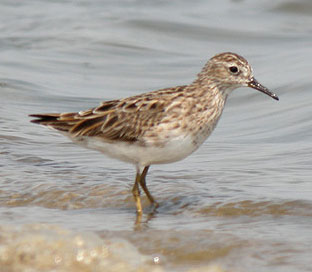
Nordmann’s Greenshank by Michael Buckland


Long-toed Stint by Michael Buckland


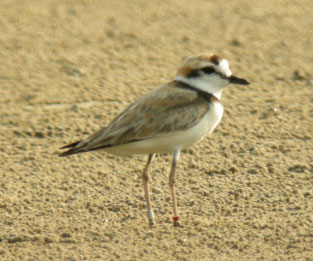
Malaysian Plover by Michael Buckland


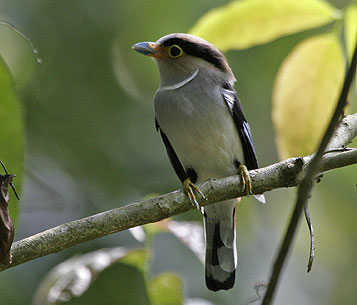
Silver-breasted Broadbill by Michael Buckland

More photos can be seen on the trip report on thaibirding.com: LPB/Pak Thale & Kaeng Krachan, 19-20th February 2008.

, , , ,

htt.jpg

Thailand Birding: Huay Tueng Tao

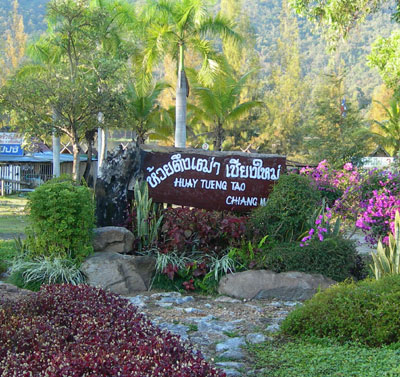
Having read about this site in Tony Ball’s blog and having made a brief and rainy visit a few days previous, I decided to make the most of the good weather on 3/2/08 to explore Huay Tueng Tao. This site is quite well-known amongst the locals of Chiang Mai and all the tuktuk drivers seem to know it. It is quite a distance from the town centre and I paid 180 baht which I didn’t haggle over so I am sure I could have got it cheaper, but it seemed a fair price to me. If you cant communicate with the tuktuk drivers where you want to go the Thai script on this photo may help you.

Walking around the whole site is quite tiring as it is fairly large, but obviously, walking turns up more birds than driving. The first good birds I saw were a group of Red-billed Blue Magpies flying around noisily but I quickly added Little Heron, Ashy Woodswallow, Common Kingfisher and Common Moorhen around the lake. Towards the end of the lake is an area of farmland and in a tree here I first heard, and then saw a Fulvous-breasted Woodpecker. This was followed by the strange call of a Bright-headed Cisticola which I found quite easily.

Scanning around lots of Green Bee-eaters were making the most of the morning sun and Spotted Doves were confusingly abundant. There were so many bee-eaters loafing around and catching insects that I decided to try a few pictures – out of about 40 I got just 4 half decent ones.


The morning chorus was still in full swing and the twittering of Purple Sunbirds was everywhere and lots of these little birds were easily found in flowering trees. White-crested Laughingthrush was calling from some bushes but the morning crowing of Chinese Francolins proved more of an attractive force for me. I was practically standin gon one bird but still couldn’t see it in the undergrowth when, fortunately for me, another Chinese Francolin flew across the dry stubbles, landed and ran into some thorny bushes.

I began to have to work quite hrd for birds and in general my visit was a slow one. However, with persistence I eventually saw lots of nice stuff although every other bird was Spotted Dove, Purple Sunbird or Sooty-headed Bulbul.

Thick-billed and Yellow-streaked Warblers were nice and moving into some woodland I picked up Great Iora, Green-billed Malkoha, Fire-breasted Flowerpecker and Grey-headed Canary Flycatcher but it was back on the farmland that a real treat awaited; 2 Rufous-winged Buzzards perched in a tree. I watched these until one flew off and was attacked in the air by a Grey Heron!!!

Things were getting a bit hot and slow by this time so I gradually moved out with a couple of Lineated Barbets on the way. Getting out of this site without transport proved very difficult and I ended up walking miles in an effort to obtain a ride – not something I would recommend. The best policy is to arrange a pickup time with the tuktuk driver who brings you to the site – something my driver was keen to do but I foolishly didn’t arrange.

Still, my prolonged walk resulted in a couple of nice birds that I wouldn’t have otherwise seen: Rufous Treepie and Burmese Shrike. 61 species seen for a morning’s birdwatching in Thailand wasn’t bad!

, , , ,

starling.jpg

Thailand Birding: A Morning at Mae Hia

Mae Hia Agricultural College is a site I have visited in the past, but I decided to visit again on one of my spare days in Chiang Mai – the 2nd February 2008. From Chiang Mai town centre I took a tuktuk to the site which is a little tricky to describe in Thai, but eventually I got there. Basically, head down the canal road from the city and after about 4.5 kilometres the entrance can be seen on the right. The name is in English and Thai but the sign is tricky to see as it is laid out on a grassy bank.

Once into the site birds began to show themselves. The grassy areas are good for Indochinese Bushlark and a walk around flushed a few up soon enough. Plain and Grey-breasted Prinias were easy enough to see as were Pied Bushchat and Siberian Stonechat and  I also managed a quick look at a Baya Weaver.

As I moved towards the back of the site, where it abuts the lower slopes of Doi Suthep, I began to see a few forest species with a group of Red Junglefowl in a scruffy field being a bit of a surprise, Tickell’s Blue Flycatcher an interesting sighting and 3 Puff-throated Babblers jumping around on a road. Tony Ball has often described Mae Hia on his blog and I found Red-wattled Lapwing exactly where he predicted and as he has often noted, Bombax trees held some nice birds including Spangled Drongo and Racket-tailed Treepie. Whilst watching these a Shikra flew into the tree and got mobbed by the drongos.

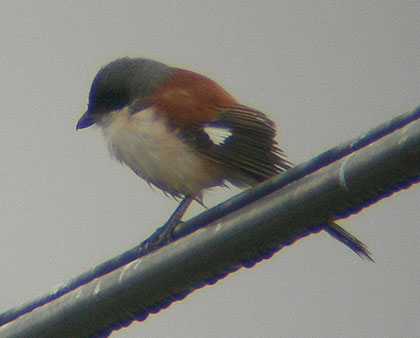
Due to the ridiculous levels of overstocking of the cattle here, there are some areas with a lot of insects attracted by the animals and the dung. Taking advantage of this were a number of birds including Dusky Warbler, Thick-billed Warbler and a couple of Yellow-streaked Warblers – all nice to see. The overgrazed fields were an easy place to pick up birds like Brown Shrike, Spotted Dove and Green Bee-eater but as I walked towards some experimental farmland plots I came across one of the specialities of the site: Burmese Shrike. This beautiful bird is always present here in the winter months and this one gave me plenty of time to get a few half decent photos. Here is the best one.

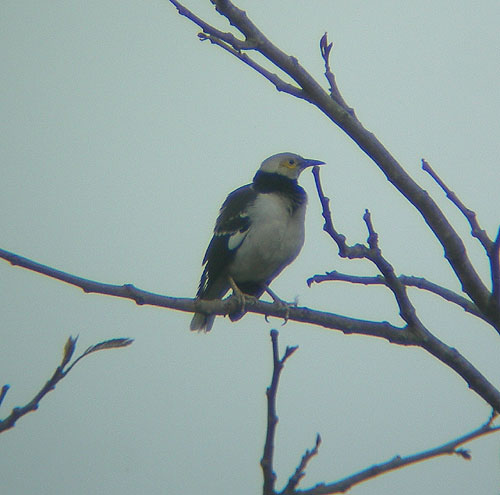
A couple of Black-collared Starlings also allowed me to photograph them and also to prove that digiscoping still requires more skill than just sticking a digital camera on a telescope. 

As the weather got hotter I began to flag but still added Richard’s Pipit, Peregrine Falcon (japonicus), Crested Serpent Eagle, Arctic Warbler and White-rumped Shama to the day list. On my way back to the road I stopped at the little pool behind an office and found a group of about 250 Lesser Whistling Ducks and overhead I spotted 3 Wire-tailed Swallows, proving that this is still a reliable spot for this species. The only thing left for me to do was to take a couple of photos for my website and flag down a passing songthaew to get back into Chiang Mai.


, , , ,

Free WordPress Themes