Eske and the Leven Canal

So infused with enthusiasm was I yesterday morning that instead of going home after my Swinemoor visit, I continued north up the river Hull to Eske/Pulfin Fen.

On the way up I didn’t see too much; a distant male Marsh Harrier was being attacked by two Lapwings and a few Swallows were flying around. A single Swift and 2 House Martins also flew past.

At the lake a number of gulls were resting on some exposed rocks, 2 adult graellsii Lesser Black-backed Gulls, 2 1st winter Herring Gulls, 5 2nd winter Greater Black-backed Gulls and a single 1st winter Common Gull. Plenty of Tufted Ducks and Mallard also on the lake as well as two families of Greylag Geese, one with 5 and the other with 6 youngsters. A male Wigeon still lurking around on the island along with nesting Canada Geese and the pair of Oystercatchers seemed intent on fighting to the death about something. Plenty of Great-crested Grebes too but no sign of chicks yet.

I decided to walk up to Leven canal to see if I could find some warblers and I wasn’t disappointed there. 5 Sedge Warblers, 6 Willow Warblers, 1 Chiffchaff, 1 Lesser Whitethroat were all heard and seen along with my first Whitethroat of the year. 5 Swifts were also present and I could hear a very distant Cuckoo. The canal is a nice place and far away from anywhere else for it to be visited by very few people. There is always a lot of wildlife here and yesterday Moorhens, Coots and Mute Swans were busy with nests and lots of flowers were in bloom. Also there were quite a few toads about, and I got a couple of photos of toads in quite contrasting states of fortune.

Back at the lake I decided to walk around to the reedy areas where warblers were everywhere! An amusing sight was two male Blackcaps sitting right next to each other singing like mad. In the reeds I saw my 2nd, 3rd, 4th, 5th and 6th Reed Warblers of the year. Overlooking the lake from a different angle a party of Swallows, House Martins and Sand Martins had arrived but the highlight was a male Garganey sitting amongst some Tufted Ducks. This is the third year in a row I’ve seen Garganey here so its obviously a regular stopping off point.

Other species seen were Redshank, Snipe, Carrion Crow, Jackdaw, Robin, Wren, Goldcrest, lots of Reed Buntings, Yellowhammer, Meadow Pipit, Skylark, Greenfinch, Linnet, Goldfinch, Chaffinch, Blue Tit, Great Tit, Long-tailed Tit, Blackbird, Starling, Grey Heron, Dunnock and Rook.

Swinemoor yet again

With more time and energy on my hands than I’ve had for a while I couldn’t resist another look at Swinemoor, from 8.30am to 11am. As I drove past part of the common I noticed the first horses have been put on. However, they haven’t made their way over to the birdy areas yet.

Just one Shelduck was present today, but 3 male Snipe were in a mid air drumming battle. Walking along the main drain an Oystercatcher flew overhead and landed at the far end of the common – it didn’t stay long though. About 100 Golden Plover were scattered all over the place and two Little Ringed Plovers were obvious – the third one was probably hiding somewhere. The two Wheatears from the previous two visits were still in exactly the same place and two Redshank remain devoted to their ever shrinking patch of water. Redshank watching paid off again as it did yesterday as a very scruffy looking Whimbrel joined them for a short time.

In the sky 3 Swifts circled around and 2 House Martins headed south, quickly followed by 4 Sand Martins. A number of Swallows were also feeding over the common.

Just a single Willow Warbler was singing today, although with the grey skies and intermittent rain I didn’t feel much like singing either. All the normal common birds were seen along with a Stock Dove and a Dunnock which strangely I don’t see very often here. Also a female House Sparrow turned up right in the middle of the common, which is unusual, they usually stick to the edges where the buildings are.

Not much esle of note around until I was almost back to the car. Alongside the river Hull in the reeds I heard the faint song of a Reed Warbler. I stayed long enough to get a reasonable look but it wasn’t being too obliging. A Sparrowhawk and Song Thrush provided a distraction before getting back to the car.

More Spring migration

Yesterday morning I went to Swinemoor Common again hoping for some more spring migrants. Once again I wasn’t disappointed despite the rapidly disappearing water – not much more than a few puddles left now.

The first bird of interest was a male Wheatear next to the Beverley-Barmston drain, a different bird than the two I saw previously as it was much more brightly marked. As I approached what is left of the wet areas I heard the screeching of a Swift – the first of the year! It was quickly joined by 3 more and a group of 10 House Martins. 3-4 Swallows were also flying around.

I found a good place to sit and scan the common; this turned out to be a good idea as a number of birds were moving through. 5 Shelduck were present today along with about 20 Lapwings – many of them on nests now. A group of about 300 Golden Plovers dropped in and began to bathe themselves and a Little Ringed Plover came in very close. This bird seemed to be a first year bird as it still hasn’t reached full adult plumage. However, two more Little Ringed Plovers further away seemed so happy with Swinemoor that they began copulating! Two Redshank were foraging in the wet grass and whilst watching them the same two Wheatears in the same place as Saturday made an appearance as did the male Yellow Wagtail.

Two drumming Snipe were very noisily displaying – Swinemoor is a very good place to watch male Snipe perform an aerial battle.

I decided to look around the scrubby areas of the common finding 7 Willow Warblers, a Lesser Whitethroat and plenty of common birds: Starling, Blackbird, Greenfinch, Goldfinch, Linnet, Pied Wagtail, Collared Dove, Meadow Pipit, Skylark etc. The scrubby areas of Swinemoor are a good place to look for plants and I took some photos of some interesting ones:

Water Crowfoot

At the southernmost end of Swinemoor is a very damp and spongy area of grass which attracts Whimbrel every year and yesterday a group of 9 were feeding amongst the Starlings and a male Yellowhammer sat calling in a small bush.

Walking back to the car a few Reed Buntings were noisily calling, two Long-tailed Tits were feeding in a tree and the Lapwings were busily chasing Carrion Crows away from their nests. The last birds to add to the list before returning to the car were 2 first summer Lesser Black-backed Gulls and a giant Mistle Thrush.

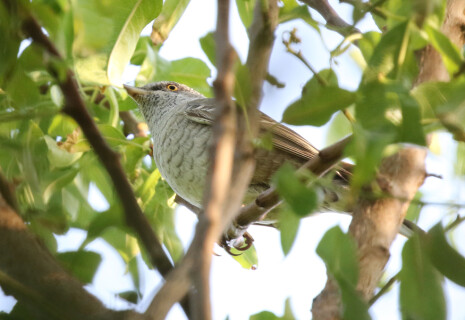
Large-billed Reed Warbler seen in the wild!

After the recent rediscovery of Large-billed Reed Warbler Acrocephalus orinus all eyes have been out to see who can be the first to see it in the field (not in the hand). As predicted it has been seen in northern India, not Thailand where it is apparently a vagrant.

Have a look at the photos of the bird: A. orinus

I would imagine that every birdwatcher in South and Southeast Asia is scrutinising every reed warbler they see with unprecedented fervour. Most birders will be eagerly awaiting discovery of the bird’s breeding grounds; I wonder if isotope analysis of the feathers taken from the bird caught in Thailand are being carried out to find out where it came from.

Yet more migrants at Swinemoor

Time for a quick walk around Swinemoor this morning from around 11.15 am to 1 pm. Sadly the water levels are getting terribly low, obviously due to the warm weather as the pasture master has not opened up any drains – he hasn’t needed to. The good news is that there aren’t any horses yet and lots of Lapwings seem to be on nests, at least they spend plenty of time chasing carrion Crows and Jackdaws away.

Some birds are still using what wet areas are left and today 4 Shelduck were present and two Redshank were feeding. One Redshank that has been around for a while now has an unusually long bill and it keeps making me think it is something else, but no, it is a Redshank. Two Little Ringed Plovers still remain, and as much of the mud is baked hard they could be around for a while yet. The only other wader was a single Snipe.

However, as I was scanning across the muddy pools I noticed a female Wheatear and as I went a little closer I flushed a male Yellow Wagtail who gave seemed to blame a Meadow Pipit for the disturbance as he angrily chased it away. The female Wheatear was then joind by a male – these two were my first of the year, spring is such a great time, so many firsts!

I checked out the scrubby areas but found only a Mistle Thrush and two Willow Warblers. A Lesser Whitethroat was heard but not seen. Some common birds were around, Goldfinches, Greenfinches, Blackbirds, a Wren and a Robin, but nothing special.

Over at the river Hull a Common Tern surprised me, particularly as it was following the river southwards. Luckily for me it spotted a fish and dived right in front of me – another first for the year!

On the way back to the car a group of 4 Lesser Black-backed Gulls flew south ( 3 adults and a first summer bird), later followed by an adult Herring Gull. The sun then came out enough to set 2 Skylarks off into song and I noticed two pairs of Swallows checking out nest sites under the eaves of a house the other side of the river.

Another productive walk, I’ll try to get back there again tomorrow.

Eske – More migrants

Having finally handed in my degree dissertation it was time to get out and relax. I decided to walk up to Eske/Pulfin Fen in the hope of seeing some spring migrants. Unfortunately the weather wasn’t so good, but it was still fairly warm if a little breezy and overcast. Not too much on the way to the lake, but 3 Swallows and a Sand Martin were nice to see. A little further along a Snipe flushed out of a ditch and 4 Linnets sat feeding in some grass. Two House Martins were my fist of the year, but at the lake there were plenty of them, along with Swallows and Sand Martins. There must have been a few hundred with Swallows, Sand Martins and House Martins roughly in the ratio of 2:2:1.

Wildfowl were predictably sparse but a pair of Wigeon were still present along with a female Goldeneye that seems to have forgotten to migrate. Other birds on the lake were 7 Great-crested Grebes, 8 Greylag Geese, 2 Canada Geese, 22 Mallard, 28 Tufted Duck, 2 Gadwall, 1 Little Grebe and a pair of Mute Swans.

An interesting sight was a Moorhen with a single chick, the first young birds I’ve seen this year. However, a number of Mallard seem to be sitting on nests on the island, along with an Oystercatcher which very aggresively chased away a nosey Carrion Crow. Two Redshank seemed to have taken a liking to the location too and remain.

In the scrubby areas plenty of summer birds were present. I got nice long views of a singing Lesser Whitethroat, a Blackcap and lots of Willow Warblers although best of all were a pair of Marsh Harriers circling around. 3 pairs of Teal were also present in the flooded fen.

So, a nice walk with plenty to see, but I had to rush back to collect my wife from work. Still, on the way back I managed to see a pair of Reed Buntings, a male and female Kestrel and another Snipe.

It’s great that it is spring time!

Quick visit to a drier Swinemoor

After the Red-necked Grebe yesterday morning I made a brief trip to Swinemoor and was disappointed to see that it is rapidly drying up, this was also reflected in the lack of birds. The three Little Ringed Plovers were still present as were 20-30 nesting Lapwings. Just 2 Redshank and a single Snipe were the only other wetland species present.

In the scrub large numbers of Willow Warblers were still present, but only 2 Swallows were seen compared to the dozen or so on saturday. However, a pleasant surprise were three singing Lesser Whitethroat, although I didn’t manage to get a look at any of them, I guess I’ll have to wait for my first one of the year!

Free WordPress Themes