spoonbilledsandpiper.jpg

Thailand Birding: Spoon-billed Sandpiper

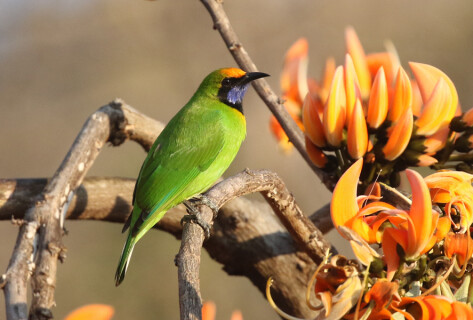
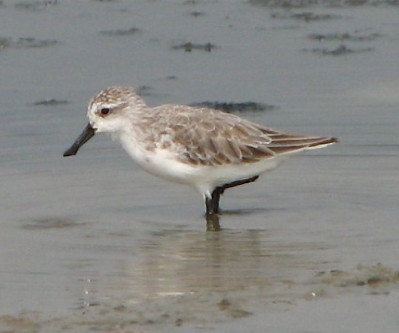
Lots of people have been e-mailing me about Spoon-billed Sandpiper recently. With the species continued decline more and more birders are keen to see it and it seems that Thailand is just about the easiest and most reliable place to see a Spoon-billed Sandpiper right now.


Spoon-billed Sandpiper at Khok Kham by Jörg Hanoldt

Pak Thale is the best place to find this bird with 5 birds seen together recently on salt pans. The area is fairly easy to find using maps on thaibirding.com and following the signs at the site. If all else fails look for the other birders!

Spoon-billed Sandpipers usually arrive at Pak Thale at the very end of October and are usually not seen beyond end of March (last year I think the last date was around 24th March). During this period they are always present and can be found on salt pans with very shallow water.

For those with less time, at least one Spoon-billed Sandpiper still winters at Khok Kham, close to Bangkok. This site is not as good for other birds as Laem Pak Bia/Pak Thale but for those with only half a day to spare, this offers an opportunity to see this rare species. For those with more time, get yourself straight to Pak Thale and see the birds there, then enjoy the many other species that are present.

Thailand Birding: Year List 2009

Whilst I am not a twitcher (tried it and don’t like it at all), nor do I usually chase birds in any way, I do keep all sorts of lists as I find that doing so keeps my enthusiasm going. Of course I have kept year lists for many years, but never go looking for birds just to get a big list, just that it is interesting to see how each year varies.

In 2009 I spent a far greater time out birding than I ever have before and of course this resulted in my biggest year list ever; 648 species in Thailand in 2009.

Highlights for me in 2009 included a couple of sightings of Cutia at Doi Lang, a fantastic Diard’s Trogon at Khao Nor Chu Chi and a couple of seldom seen species at Kaeng Krachan – Rufous-browed Flycatcher and Ferruginous Partridge, both of which I got to see a couple of times.

In 2009 I finally caught up with some migrants that are common back in UK but I had never before seen in Thailand; Great Cormorant, Gadwall, Mallard, Common Teal, Common Ringed Plover, Common Shelduck, Northern House Martin are a few of these.

I will be keeping a year list for 2010 too but it will be difficult to top 2009.

chiffchaff.jpg

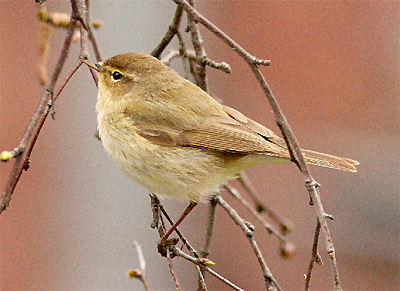
Thailand Birding: Chiffchaff calling at Chavit Park, Bangkok.

Walking along Sukhumvit Road, Bangkok, this afternoon I heard the distinctive call of a Chiffchaff above the roar of the traffic. Wow! This would be a new bird for Thailand!

The call was coming from some trees in nearby Chavit park, a small park created a few years ago to make some green space in the concrete jungle, and was easy to track down quickly to perch in a tree about 2 metres of off the ground; right above my head.

Unfortunately the song was coming from a speaker mounted on a tree; indeed my suspicions had been aroused beforehand as the Chiffchaff’s call was backed up by a number of other northern European birds. It seems that the park keepers had decided that the ambience of the park would be improved with the addition of some bird song, and it was quite pleasant, just that the species were a little out of place in Bangkok.

crane.jpg

Thailand Birding: Chiang Saen

I recently had a couple of visits to Chiang Saen in Chiang Rai province which proved very interesting for some unusual winter migrants. Chiang Saen is close to lots of wetland areas including Chiang Saen lake, Yonok wetlands and The Mekong but there are interesting areas all around to investigate.

Chiang Saen Lake
The lake is not quite the birding spot it once was with its permanently raised water levels there are few marginal areas for birds to feed in but there are still some good birds to be found. Some of the more regular birds included Pintail Snipe, Citrine Wagtail, Purple Swamphen, Grey-headed Lapwing, Lesser Whistling Duck, Spot-billed Duck and Dusky Warbler but on checking the duck flock I found some interesting species.

Observing the ducks here takes some time because the birds are at great distance. One has to wait until the ducks get close and/or find a secluded place to watch the birds from close to where they like to feed. After spending a lot of time I found the following species on 11th December: Mallard, Gadwall, Garganey, Baer’s Pochard, Tufted Duck, Ferruginous Pochard, Northern Pintail, Northern Shoveler, Eurasian Wigeon and Common Shelduck.

Baer’s Pochard is now is an endangered species and there was a male and female present. Mick Davies and Dowroong Danlamajak have been reporting a female Baer’s Pochard from the lake since late November and I saw the same pair again on the 21st December so they are obviously in the area for the winter.

Also on 11th December I saw a subadult Common Crane at Chiang Saen lake. As far as I am aware this is only the 3rd record for Thailand. I got a record shot of the bird.
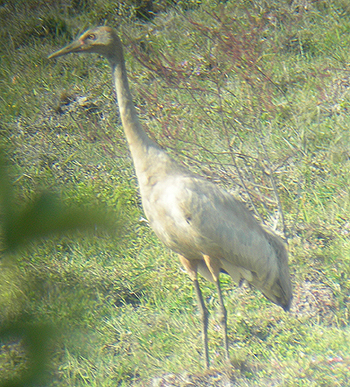

Common Crane (Photo by Nick Upton)

Some other nice birds at the lake were 2 Siberian Rubythroats, Chestnut-tailed Starling and Red-throated Pipit.

On my second visit on 21st December I checked the ducks again and saw these: Mallard, Northern Shoveler, Baer’s Pochard, Common Teal, Garganey, Spot-billed Duck, Lesser Whistling Duck, Northern Pintail, Ferruginous Duck, Tufted Duck, Gadwall and 1 female Baikal Teal. This last bird is apparently only the second record for Thailand and I will submit a description and my field sketch to the Thai Record’s Comittee to see if it is accepted.

The Mekong
On 10th December to 12th December the water levels of the river were pretty high and very few birds were seen. We did see a female Peregrine and an osprey on sand bars and 13 River Lapwings. Eventually a Long-billed Plover was found on some sand and gravel at the back of an old warehouse on the river. This spot can be found by heading towards the Golden Triangle from Chiang saen town. After a few kilometres there is this sort of white geodesic dome on the right. Enter here and go to the river where birds are foraging on mud, sand and gravel close to the river bank.

On 21st December the water levels were much reduced and many birds were feeding in the area described above. These included many Temminck’s Stints, many Little Ringed Plovers, a few Kentish Plovers, 17 River Lapwings, 2 Common Snipe, 2 Long-billed Plovers, a few Long-toed Stints, a few Common Greenshank, 12 Spotted Redshank, 10+Citrine Wagtails and many White Wagtails. For me the most interesting bird was a Common Ringed Plover which I spotted because of its bright orange legs. Whilst this is a common bird in Europe there are very few records in Thailand.

Yonok
This area has some good birds and interesting areas to investigate. At one of the harrier roosts 60-70 birds came in on 10th and 11th December, mostly male Pied Harriers but good numbers of Eastern Marsh Harriers and 1 male Western Marsh Harrier.

Only 1 Small Pratincole was seen on the Mekong but at Yonok there were a few resting on mud and hundreds flying around at dusk.

Close to Yonok on 12th December some burnt rice stubble produced some farmland species that apparently used to be common but are not now. This included 100s of Red-throated Pipits and 1 Rosy Pipit. Alos many Yellow, White and Citrine Wagtails, Bluethroat, Oriental Skylark and 6 Chestnut-eared Buntings.

Other Birds
Chiang Saen has a lot to offer other than the sites I have mentioned. With so many rice fields and other wetlands other birds are waiting to be found.

I was told that a Chestnut-crowned Bush Warbler has recently been seen along with Falcated Duck. Mick Davies also has sensible sounding claims to Lesser Kestrel and Great Snipe in the last few months, both would be new for Thailand.

Both Grass Owl and River Tern have regularly been seen at Yonok over the last few years but I didn’t see them this time. The tern may have disappeared but the owls are still around, I just didn’t put any effort into looking for them.
scaly-breasted-munia.jpg

Thailand Birding: An Unexpected Visitor

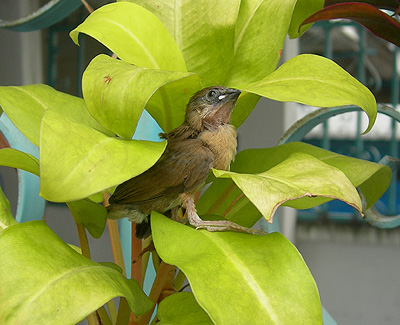
This morning I had an unexpected visitor to my front yard. Whilst I am used to seeing Olive-backed Sunbirds every day, this fledgling Scaly-breasted Munia was a bit more of a surprise, particularly as it flew out of the plants at me as I was watering them.


Fledgling Scaly-breasted Munia
Photo by Nick Upton

Actually, I should not have been so surprised as a pair of Scaly-breasted Munias constantly nest in some bamboo in a neighbours yard. Scaly-breasted Munia is one of Thailand’s resident birds that breeds all year round and this pair make a new nest as soon as the chicks are fledged.

I watched this chick for a while and it was able to fly around okay and its mother was in attendance the whole time, feeding it when it called for food.

Thailand Birding: Some Notes on Pak Thale and Laem Pak Bia

I recently spent two days at Laem Pak Bia and Pak Thale (6th & 7th November). After reporting some problems with the road into the Spoon-billed Sandpiper site at Pak Thale I am happy to say that the road has been finished and it is now negotiable by any vehicle again.

Spoon-billed Sandpiper
On the 6th I saw two Spoon-billed Sandpipers at Pak Thale and 1 on the 7th. I am sure the second bird was also present on the 7th but in a large flock of small waders virtually every bird was roosting will its bill tucked under its wing until workers on the salt pans flushed all the birds which then dispersed over a wide area.

I have been told that a survey in Russia has produced some bad news; in an area which previously held 200 Spoon-billed sandpipers on the bird’s breeding grounds, only 2 were found! With only 2 birds present at Pak Thale on 7th November and none reported from Khok Kham by 5th November things are a bit worrying.

Some Other Birds
Other birds which have been seen in the area include 1 Dunlin, Terek Sandpiper and Grey-tailed Tattler at Pak Thale, plus a few Nordmann’s Greenshank. At least 32 Nordmann’s Greenshank on salt pans at Laem Pak Bia on 6th was the largest count so far this winter.

Sand Spit
So far, on the sand spit, 1 White-faced Plover, as many as 3 Chinese Egrets, 2 Pacific Reef Egrets, a few Greater Crested Terns and Lesser Crested Terns have been reported. As far as I know no large gulls have been seen yet.

Thailand Birding: Great Hornbill

There are lots of great birds to see in Thailand but one of the best, to me, is the Great Hornbill. Whilst it is not the rarest bird, it is certainly one of the most memorable and any sighting is a highlight in my book: a few years ago I did a survey and Great Hornbill was voted the third most wanted bird by birders visiting Thailand.

A Vocalizing Great Pied Hornbill in the Top of a Fig Tree

Buy at AllPosters.com

Great Hornbills are striking looking birds but when you hear them flying over the forest canopy the sound is amazing. I have had people ask me in the past if a helicopter is over head; the surprise on their faces when I tell them it is a Great Hornbill is quite funny.

I see Great Hornbills virtually every time I go to Kaeng Krachan or Khao Yai national parks, but it is one of those birds I never tire of seeing and every time it is one of the highlights of the trip for me.

Free WordPress Themes