chinese-pond-heron.jpg

Thailand Birding: Chulachomklao Fort

This morning I took a visit to Chulachomklao Fort at the river mouth of the Chao Praya in Samut Prakan province. There are some mangroves at this site but actually the location consists mainly of gardens, scrubland, wetland patches and buildings serving the Navy, in fact there is a pre WW2 warship there, many naval guns and a fort that fought a skirmish with the French Navy in the 19th century: Chulachomklao Fort.


However, it was birds I was after but things didn’t turn out quite as well as hoped. Although there is a reasonable bit of mangrove boardwalk, which is in good condition, there were few birds in evidence. A few Pied Fantail, a couple of Golden-bellied Gerygones and lots of Collared Kingfishers were about all that was to be seen. Despite playing the call of Mangrove Whistler I neither saw nor heard one, although there seems to be enough mature mangrove remaining to support a few pairs. Common and Dark-necked Tailorbirds were also easily seen and as I was leaving the mangrove boardwalk I happened upon an Eastern Crowned Warbler – a passage migrant.

A Few Migrants
Indeed, the whole site has great potential for passage migrants, situated as it is at the mouth of a major river. Unfortunately I arrived too late in the day to pick up much migratory movement, although I did come across a few common migrants including 1 Brown Shrike, 3 Common Kingfishers, 2 Black-capped Kingfishers and a few waders; 3 Long-toed Stints, 5 Wood Sandpipers, 6 Common Sandpipers and 2 Little Ringed Plovers. Also worth noting was that out of 20-30 Pond Herons seen only 1 Chinese Pond Heron was still in breeding plumage and just 1 Javan Pond Heron – all the others were in winter plumage and unidentifiable.
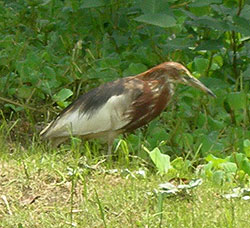

Chinese Pond Heron

A few flooded areas of grassland produced a few nice birds including some more migrants, 3 Yellow Wagtails, as well as a few Great Egrets, Little Egrets, Cattle Egrets and 1 Intermediate Egret. Also in this area were 3 Blue-tailed Bee-eaters, an Indian Roller, 1 White-throated Kingfisher and a Paddyfield Pipit.

Although the birding was not spectacular, there were enough birds to make it interesting and alongside the ship, the fort and a decent seafood restaurant, this site is worth a visit – even if for just the once.

A pier goes out into the river but even just 1 hour before low tide there was no sign of any mud being exposed although the view out to sea produced many Whiskered Terns, Little Cormorants, a few Indian Cormorants and lots of Great Egrets.

By 1pm I decided it was time to quit and go home, but I always seem to find myself hunting down more birds and in this way I came across a Black-crowned Night Heron and 2 Brahminy Kites.

Public Transport
Public transport to this spot does exist but it would involve such a convoluted set of connections that I don’t recommend trying. Come here in a taxi or your own vehicle and stay for a nice lunch.

Lots of Common Species
Although I didn’t find many notable birds at Chulachomklao there were lots of birds to see. Brown-throated and Olive-backed Sunbirds were both common as were Oriental Magpie Robin, Streak-eared Bulbul, Scaly-breasted Munia, Asian Koel, Common Myna, White-vented Myna, Asian Pied Starling, Scarlet-backed Flowerpecker, Large-billed Crow., Spotted Dove etc.; all the species that are common in any open-country and park situation.

Other Wildlife
Apart from birds I saw a number of large Water Monitors and two small parties of Long-tailed (Crab-eating) Macaques that were very nervous of humans – probably used to navy personel throwing stones at them. Additionally I happened upon a small green snake which fell out of a mangrove tree onto my shoulder before flicking itself off into the water: I don’t know if it was me or the snake that was more shocked.

One other bit of (unwelcome) wildlife were a lot of aggressive mosquitos.
, , , ,

samutmangrove.jpg

Thailand Birding: mangroves at Samut Sakorn

This morning I decided to pay a visit to the Mangrove Research Centre at Samut Sakorn in hope of finding it a good place to see Mangrove Whistler. Having read in Phil Round’s  “The Birds of the Bangkok Area” that both this species and Asian Dowitcher were frequently seen at this location I had high hopes, however, finding the site didn’t prove so easy.

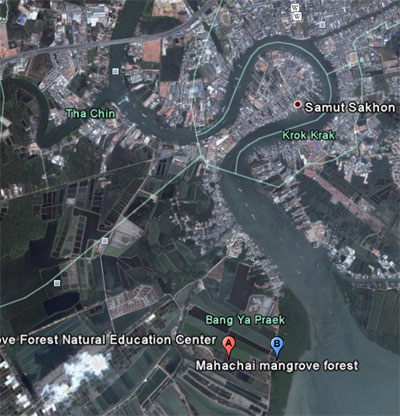
This location is situated to the west of the Tachin River and after crossing it I found the correct turn off. After this I got a bit lost but eventually discovered that the route in is not so convoluted after all. In time I will create a page, with full directions, for this site on the Birdwatching Locations directory on thaibirding.com but for now this image from Google Earth will have to suffice.

Once at the research station I was looking forward to walking on the mangrove boardwalks. However, they are in a treacherous state of repair and in fact have closed signs boarded across them. With a little trepidation it is possible to walk a short distance along one section but even this involved tiptoeing across lots of weak and broken boards; anyone weighing over 75kgs should not attempt it at all.

Still, the mangroves were quite birdy, which was something of a surprise to me as I usually find mangroves to be somewhat sterile. Golden-bellied Gerygone, Common Tailorbird, Pied Fantail, Collared Kingfisher and Common Iora were all very common and numerous. Whilst walking to the shore I also saw Oriental Magpie Robin and a single Racket-tailed Treepie in mangroves.

Unfortuantely the tide was a long way out and shorebirds were quite distant. Through my ‘scope I could see hundreds of Common Greenshank, Common Redshank along with a few Eurasian Curlew, 50-70 Whimbrel and around 200 Black-winged Stilts. Also present were large numbers of Javan Pond Heron, Little Heron, Little Egret and Great Egret. On the water’s edge a huge flock of Whiskered Terns contained a few White-winged Terns still in partial breeding plumage and at least 3 Gull-billed Terns. There were no Asian Dowitchers.

In fact I was more interested in Mangrove Whistlers than Dowitchers as I know this is a good spot for the Dowitcher – I just timed the tide wrongly and got a bit unlucky. So, I did my best with the mangrove boardwalk but had to turn around after a few hundred metres due to its terrible state. However, I managed to run into quite a few birds including a flock of Oriental White-eyes, a male Brown-throated Sunbird, lots of Golden-bellied Gerygones and Pied Fantails followed by my target; 2 Mangrove Whistlers being very confiding. As I watched these, a flicker of yellow caught my eye and I turned to see a male Yellow-rumped Flycatcher performing nicely quite close. With the departure of these birds after about 10 minutes and the collapsing walkway I decided it was time to take a few photos and go home for lunch.


As I walked around taking photos I ran into a few more birds including large numbers of Germain’s Swiftlet and Blue-tailed Bee-eaters overhead, a Brown Shrike, several Barn Swallows, a Common Kingfisher, 2 Streak-eared Bulbuls and some Spotted Doves.

, , , ,

yvbulbulmap.jpg

Thailand Birding: Yellow-vented Bulbul

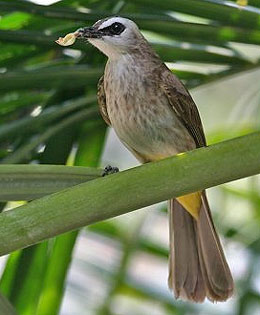
Yesterday afternoon a pair of Yellow-vented Bulbuls flew over my house on the outskirts of Bangkok, making me think about this much-overlooked species. Yellow-vented Bulbul is most certainly one of the more striking bulbuls in Thailand with its bright yellow undertail coverts and silvery-white head, but is one that seems to be under-recorded, particularly by visiting birders. 


Yellow-vented Bulbul
by Peter Ericsson

Although not uncommon, Yellow-vented Bulbul prefers well-watered areas such as fruit gardens and coconut orchards – habitats that are virtually never visited by birders, due to their relatively low diversity of birds, making Yellow-vented Bulbul a species that is usually only encountered by birders in very small numbers despite having a fairly wide distribution.


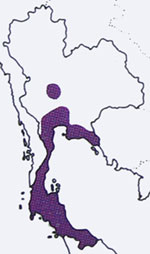
Yellow-vented Bulbul distribution map
from “A Field Guide to the Birds of Thailand” by Craig Robson

As with many other birds, Yellow-vented Bulbul seems to have undergone a decline in and around Bangkok as the city is allowed to sprawl without any planning regulations, but can still be seen around the edges of the city and in small numbers in parks such as Suan Rot Fai and Suan Luang.

For those birders who have made a number of trips to Thailand but have managed to miss Yellow-vented Bulbul (and there are a surprisingly high number who have), Bang Pra in Chonburi has a healthy population of this attractive bird.

Acknowledgement: Much of the information here comes from “The Birds of the Bangkok Area” with Phil Round’s kind permission.

, , , ,

crow.jpg

Clever Crows

Crows and other corvids have long been recognised as being among the most intelligent of birds, indeed among the most intelligent in the animal kingdom. When I was young my father used to tell me stories of a pet Jackdaw that he had which had learned to say a few words and on “The Life of Birds” BBC series there is remarkable footage of a “school for crows” where an allocated adult bird teaches juveniles how to catch grubs using a stick. Also on this series is an amazing clip of a crow in Japan which drops nuts on a pedestrian crossing and waits for cars to crush them, then when people cross the road it is safe for the crow to come down and eat the crushed nuts!!! Clever birds indeed.


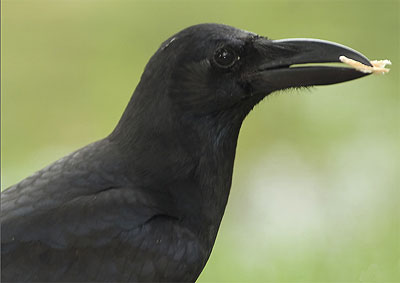
Large-billed Crow by Alex Vargas

Possibly the highest example of avian intelligence has been dispalyed by a crow under research conditions whereby a female crow fashions a piece of wire into a hook and uses it to hook out a piece of food placed into a tube by researchers; a video of this behaviour can be seen here: 10 Bird Video Clips (it’s number 10 on the list).

Recently I was sent a very interesting article on this subject which originated in the New York Times:

August 26, 2008 Friend or Foe? Crows Never Forget a Face By MICHELLE NIJHUIS

 It Seems  Crows and their relatives — among them ravens, magpies and jays — are renowned for their intelligence and for their ability to flourish in human-dominated landscapes. That ability may have to do with cross-species social skills. In the Seattle area, where rapid suburban growth has attracted a thriving crow population, researchers have found that the birds can recognize individual human faces.John M. Marzluff, a wildlife biologist at the University of Washington, has studied crows and ravens for more than 20 years and has long wondered if the birds could identify individual researchers. Previously trapped birds seemed more wary of particular scientists, and often were harder to catch. “I thought, ‘Well, it’s an annoyance, but it’s not really hampering our work,’ ” Dr. Marzluff said. “But then I thought we should test it directly.”To test the birds’ recognition of faces separately from that of clothing, gait and other individual human characteristics, Dr. Marzluff and two students wore rubber masks. He designated a caveman mask as “dangerous” and, in a deliberate gesture of civic generosity, a Dick Cheney as “neutral.” Researchers in the dangerous mask then trapped and banded seven crows on the university’s campus in Seattle. In the months that followed, the researchers and volunteers donned the masks on campus, this time walking prescribed routes and not bothering crows.The crows had not forgotten. They scolded people in the dangerous mask significantly more than they did before they were trapped, even when the mask was disguised with a hat or worn upside down. The neutral mask provoked little reaction. The effect has not only persisted, but also multiplied over the past two years. Wearing the dangerous mask on one recent walk through campus, Dr. Marzluff said, he was scolded by 47 of the 53 crows he encountered, many more than had experienced or witnessed the initial trapping. The researchers hypothesize that crows learn to recognize threatening humans from both parents and others in their flock.

After their experiments on campus, Dr. Marzluff and his students tested the effect with more realistic masks. Using a half-dozen students as models, they enlisted a professional mask maker, then wore the new masks while trapping crows at several sites in and around Seattle. The researchers then gave a mix of neutral and dangerous masks to volunteer observers who, unaware of the masks’ histories, wore them at the trapping sites and recorded the crows’ responses.

The reaction to one of the dangerous masks was “quite spectacular,” said one volunteer, Bill Pochmerski, a retired telephone company manager who lives near Snohomish, Wash. “The birds were really raucous, screaming persistently,” he said, “and it was clear they weren’t upset about something in general. They were upset with me.”

Again, crows were significantly more likely to scold observers who wore a dangerous mask, and when confronted simultaneously by observers in dangerous and neutral masks, the birds almost unerringly chose to persecute the dangerous face. In downtown Seattle, where most passersby ignore crows, angry birds nearly touched their human foes. In rural areas, where crows are more likely to be viewed as noisy “flying rats” and shot, the birds expressed their displeasure from a distance.

Though Dr. Marzluff’s is the first formal study of human face recognition in wild birds, his preliminary findings confirm the suspicions of many other researchers who have observed similar abilities in crows, ravens, gulls and other species. The pioneering animal behaviorist Konrad Lorenz was so convinced of the perceptive capacities of crows and their relatives that he wore a devil costume when handling jackdaws. Stacia Backensto, a master’s student at the University of Alaska Fairbanks who studies ravens in the oil fields on Alaska’s North Slope, has assembled an elaborate costume — including a fake beard and a potbelly made of pillows — because she believes her face and body are familiar to previously captured birds.

Kevin J. McGowan, an ornithologist at the Cornell Laboratory of Ornithology who has trapped and banded crows in upstate New York for 20 years, said he was regularly followed by birds who have benefited from his handouts of peanuts — and harassed by others he has trapped in the past.

Why crows and similar species are so closely attuned to humans is a matter of debate. Bernd Heinrich, a professor emeritus at the University of Vermont for his books on raven behavior, suggested that crows’ apparent ability to distinguish among human faces is a “byproduct of their acuity,” an outgrowth of their unusually keen ability to recognize one another, even after many months of separation.

Dr. McGowan and Dr. Marzluff believe that this ability gives crows and their brethren an evolutionary edge. “If you can learn who to avoid and who to seek out, that’s a lot easier than continually getting hurt,” Dr. Marzluff said. “I think it allows these animals to survive with us — and take advantage of us — in a much safer, more effective way.”

, ,

sharp-tailed.jpg

Thailand Birding: Sharp-tailed Sandpiper

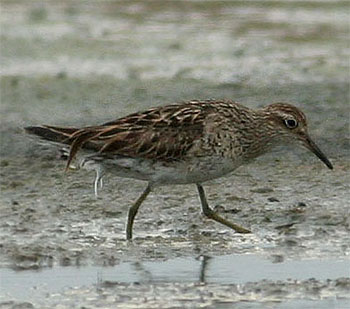
Sharp-tailed Sandpiper is a very rare, but seemingly regular, passage migrant in Thailand. One recently put in an appearance at Khok Kham, in Samut Sakorn province but unfortunately I was otherwise engaged in the south so did not get a chance to see it myself.

Amongst others, Peter Ericsson got some photos and has allowed me to reproduce one here.

Please take a look at Peter’s photo galleries where he has hundreds of great photos of Thai birds: Peter Ericsson’s Photo Galleries.

, , , ,

Thailand Birding: Some Photos from the South

On my trip to Southern Thailand I took a number of photographs to add to the relevant pages of thaibirding.com. As I also visited a few new places I took photographs for upcoming pages on those locations too, but for the meantime I will post the photos here for people to view.

Photos from Krabi

Photos from Khao Sok

Photos from Krung Ching Waterfall

Photos from Krabi Tiger Cave Temple

, , ,

Thailand Birding: A Trip to the South

Yesterday evening I returned to Bangkok after a 10 day trip to southern Thailand; the trip was a mixture of birding and visiting friends. For the birding I visited Laem Pakarang, Khao Sok, Krabi Mangroves, Krung Ching waterfall and the Tiger Cave Temple.

I don’t make many trips to southern Thailand so it is always interesting to see so many species that I don’t often see – even many of the common birds in the south haven’t bored me yet.

A good number of shorebirds were present at Laem Pakarang with the highlight being a Terek Sandpiper.

Birding at Khao Sok was very slow but eventually some good birds showed themselves. Highlights were Buffy Fish Owl, Fulvous-chested Jungle Flycatcher, Black-and-red Broadbill, Black-and-yellow Broadbill, Chestnut-naped Forktail, Bushy-crested Hornbill, White-crowned Hornbill, Great Hornbill. The Buffy Fish Owl sat out in the open in the daylight for so long that I managed a couple of record shots using a digital camera through my binoculars.

In the mangroves at Krabi things were pretty quiet apart from good numbers of Brown-winged Kingfishers calling and easily seen. One Mangrove Pitta responded to call playback and gave me good views.

By far the highlight of the birding portion of my trip was Krung Chiang waterfall in Nakorn Sri Thammarat province. I will write a full trip report soon but for now it is enough to say that the forest there is excellent, it has decent accommodation and a really nice trail for birding. My bird highlights were Maroon Woodpecker, Buffy Fish Owl, Scarlet-rumped Trogon, Green Broadbill, Banded Pitta, Maroon-breasted Philentoma, Gold-whiskered Barbet, Brown Barbet, Dark-throated Oriole and Blyth’s Hawk Eagle.

On my last day in Krabi I visited the Tiger Cave Temple to look for Streaked Wren Babbler. I eventually found a pair which I saw well and also found some other good birds: Black-and-yellow Broadbill, Banded Kingfisher, Gold-whiskered Barbet and Fulvous-chested Jungle Flycatcher.

More will follow on this trip soon.

, , , ,

Free WordPress Themes