ducks.jpg

Thailand Birding: Birdwatching Sites around Petburi

Having survived the worst of the Songkran water fighting I was joined, on the 15th April,  by Mark Thomas, Jenny Atkins and Jason Goodwin for a day of general birding around Petburi province. After a little trouble finding it, I collected them from the Twin Towers Hotel near HuaLompong station at a little after 5am and we headed off to Laem Pak Bia.

On arrival we stopped at the spot which has been favoured by a pair of Black-faced Spoonbills all winter, not sure if they would still be around at this late time in the season. At first very little was to be seen at this spot; Indochinese Bushlark, Plain-backed Sparrow, Green Bee-eater, Collared Kingfisher, a Painted Stork and many egrets but just as we were about to move along, Jason spotted a Spoonbill in flight. Unfortunately, although we could clearly see it was a Black-faced Spoonbill it landed way out of sight. As we waited for it to emerge again we added White-winged Tern, Whiskered Tern, Curlew Sandpiper and Blue-tailed Bee-eater to our tally before some workers flushed the spoonbill again. This time we had longer flight views but again it landed way beyond where we could see.

Although the Spoon-billed Sandpipers seemed to have moved on some weeks back we headed to Pak Thale for an outside chance that one might be lingering. It was not to be but we did see 5 Red-necked Phalaropes coming into breeding plumage along with Gull-billed Tern, Red-necked Stint, Long-toed Stint, Curlew Sandpiper, Marsh Sandpiper, Spotted Redshank and Curlew. Little Terns seemed to be nesting on a dry salt pan which to me didn’t seem to be a good choice as it could get reflooded at any time.

With the sun beating down on us a Dusky Warbler and Common Tailorbird weren’t enough to detain us any longer and we headed to the boat yard for a drink. After some ice cold water we hired a boat to take us out to the sand spit in search of “White-faced” Plover. First of all though we landed on the sand bar to view the roosting terns. We had a great selection of species here with a single Caspian Tern, around 20 Great Crested Terns, 3 Lesser Crested Terns and many Common and Little Terns – great opportunities for photographers! Further out to sea we could also see Whiskered and White-winged Terns and we were lucky enough to get 3 White-winged Terns land on the sand bar to bathe. One bird was in complete breeding plumage and stood out beautifully amongst the other species.

On to the sand spit we easily found Malaysian Plover nesting and spotted a Grey-tailed Tattler, an uncommon passage migrant in Thailand. Also present were Kentish Plover, Sanderling and Little Terns. Out on the mudflats Jenny spotted 2 Pied Avocets in flight – another very uncommon species in Thailand – and Javan Pond Herons were nice in their breeding plumage. Amongst the other species a Chinese Egret was spotted, its distinctive behaviour helping separate it from the similar Pacific Reef Egret – subtle structural and plumage details such as the shape of the head plumes and the bill structure could also be seen when it came into close range.

As we proceeded to leave I spotted a Greater Sand Plover in breeding plumage and as I looked at it through my telescope I saw what seemed to be a “White-faced” Plover in the background. Whilst we watched this bird Mark noticed that it had a black ring on its left leg and a yellow/green ring on its right leg. Although this bird had a white-face (all white lores) and was quite striking when it turned face on, I later found out from Phil Round that this combination had been fitted to Malaysian Plovers from the nest – thus this bird was a Malaysian Plover and not a “White-faced”. Indeed, the genuine “White-faced” Plovers are so distinctive that I really should have ruled this bird out beforehand: take a look at photos of the “real thing” – “White-faced” Plover.

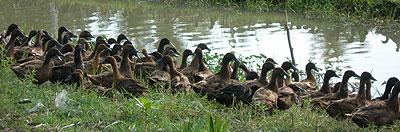
After a welcome lunch at the boatyard we drove to Tung Bang Jak, an area of rice agriculture and reedy areas in search of waterbirds.  We spent and hour and a half birding along the quiet road finding a good number of birds including Asian Golden Weaver, large and numerous flocks of Baya Weaver, Green Bee-eater, Brown Shrike, a lingering Siberian Stonechat, Indian Roller, Plain-backed Sparrow, Chestnut Munia, Purple Heron, Cotton Pygmy Goose, Pink-necked Green Pigeon, Watercock, hoards of Asian Openbill Storks and Cattle Egrets and Bronze-winged Jacana amongst many other species. This area is always good for birds and a large number of species can be seen quickly, particularly in the early morning, but as our visit proved, it is also worth a look at any time of the day. The traditional styles of agriculture in this area make for a patchwork of habitats and as in many parts of the world, where extensive agriculture occurs, biodiversity remains high. The sight of a herd of ducks being shepherded around by a couple of herders was pleasant and some photos were almost obligatory. The herder told me that he had 4000 ducks under his care!
With time pressing on we went back to Laem Pak Bia to spend some time in the King’s Project area. This spot is really good at dusk as many birds come in to roost in the mangroves. In the reeds we found Oriental Reed Warbler and Black-browed Reed Warbler. White-breasted Waterhen was easy but Ruddy-breasted Crake only gave us fleeting views. However, the roosting birds were good; large numbers of Black Drongo and Mynas came in as usual but a surprise was 1500-2000 Bee-eaters, most of which were Blue-tailed Bee-eaters with a few Green Bee-eaters. It was an amazing sight with clouds of birds circling before they chose their roosting spot. At the same time we enjoyed a very nice sunset.

As this proceeded large numbers of Black-crowned Night Herons were exiting the magroves and after seeing a few huge fruit bats we got into the car to search for nightjars. After a brief drive we found 2 Indian Nightjars on the road and got excellent views of them at close range. Always a good ending to a day birdwatching in Thailand!

Thailand Birding: Late afternoon at Bang Pra

After lazing on the beach at Bang Saen for most of the afternoon yesterday, my wife and I moved on to Bang Pra reservoir in Chonburi province to look at the late afternoon birds.

The non-hunting area is suffering badly from high water levels reducing the amount of grassland habitat and overuse of what remains both by livestock herdsmen and people driving around in vehicles. Compared to the amount of grassland habitat that used to be at Bang Pra, very little remains and what is left is in poor condition with almost no marginal habitat remaining – just one of many conservation issues in Thailand. In the 2 hours I spent there, however, I managed to see a good selection of species although numbers of waterbirds were very low.

What allows birdwatchers to see so many species at Bang Pra is that there is wetland habitat, grassland and woodland all next to each other and in the short time I spent there I saw a good range of birds from all three habitats. Green Bee-eaters nesting, Rufous Treepies foraging a few feet away and large numbers of Oriental Pratincoles were very nice sights.

These are the species I saw from 4.30-6.30 pm as the weather became pleasantly cooler.

Whiskered Tern, Little Cormorant, Grey Heron, Great Egret, Little Egret, Cattle Egret, Chinese Pond Heron, Javan Pond Heron, Black-winged Stilt, Red-wattled Lapwing, Common Greenshank, Wood Sandpiper, Oriental Pratincole, Black-shouldered Kite, White-breasted Waterhen, Common Kingfisher, White-throated Kingfisher, Black Drongo, Greater Racket-tailed Drongo, Large-billed Crow, House Swift, Asian Palm Swift, Barn Swallow, Green Bee-eater, Indian Roller, Hoopoe, Lineated Barbet, White-crested Laughingthrush, Taiga Flycatcher, Indochinese Bushlark, Paddyfield Pipit, Yellow Wagtail (macronyx), Grey-breasted Prinia, Yellow-vented Bulbul, Asian Pied Starling, White-vented Myna, Vinous-breasted Starling, Oriental Reed Warbler, Spotted Dove, Peaceful Dove, Racket-tailed Treepie, Rufous Treepie and Oriental Magpie Robin.

I also heard Chinese Francolin in the distance and a Greater Racket-tailed Drongo that had learned to mimic perfectly the sound of a car central locking alarm system – that tells you something about the overuse of the site by people in vehicles!

, , ,

Thailand Birding: A look at Soi 119

Many local birders visit Soi 119, Bang Poo for good views of freshwater wetland birds. I had never visited this location before so after lunch at Bang Poo I went to take a brief look.

Now, Soi 119 is not to be mistaken for Sukhumvit 119 near Bang Na . It is slightly confusing as the road in Bang Poo area is also Sukhumvit Road, but here there is obvious potential for birding whereas the other 119 is completely built up. The soi 119 for birding is about 5-6 kilometres beyond Bang Poo, on the left hand side of the road as one heads towards Chonburi. It is actually easy to find and it runs through reedy wetlands. It seems easy to view birds from the car and road but birds were not in the same abundance as at Muang Boran Fishponds, although I was only here for a very brief time and may have missed the best spots. The main advantage here is that one does not need to walk any great distance in the heat or avoid barking dogs.

In the very brief time I was along soi 119 I saw a good number of species: Lesser Whistling Duck, Little Grebe, Blue-tailed Bee-eater, Greater Coucal, Plaintive Cuckoo, House Swift, Asian Palm Swift, Red Collared Dove, Peaceful Dove, Moorhen, White-breasted Waterhen, Watercock, Red-wattled Lapwing, Whiskered Tern, White-winged Tern, Brahminy Kite, Little Cormorant, Little Egret, Chinese Pond Heron, Javan Pond Heron, Cinnamon Bittern, Asian Openbill, Long-tailed Shrike, Brown Shrike, Black Drongo, Pied Fantail, Oriental Magpie Robin, Asian Pied Starling, Common Myna, White-vented Myna, Barn Swallow, Streak-eared Bulbul, Striated Grassbird, Plain Prinia, Yellow-bellied Prinia, Black-browed Reed Warbler, Yellow Wagtail (macronyx) and Scaly-breasted Munia.

 Interesting to note that here, all but one of the Pond Herons were Chinese Pond Herons and at Bang Poo, on the mudflats, all the pond herons were Javan Pond Herons. In Robson’s Field Guide to the Birds of Thailand it says that Javan is found particularly along coasts and Chinese in freshwater wetlands – this may help those who birdwatching in Thailand in January and February and are unable to distinguish the two species from each other in their winter plumage.

Although I only spent a few minutes at soi 119 I will certainly come back although Muang Boran Fishponds seems to have a higher concentration of birds.

, , ,

Thailand Birding: Lunch and Seabirds at Bang Poo

Yesterday (Sunday 6th April) my wife and I intended to go to the Muang Boran open air museum but when we got there we found the price had been increased to 100 baht for Thais and 300 baht for foreigners. I have been there before and whilst it is pleasant I don’t think it is very good value for money at that price, particularly as the staff were quite surly and unpleasant about it. So, instead, we headed to nearby Bang Poo for lunch at the seafood restaurant located at the end of the pier.

As we arrived the tide was out and I had a brief look at the birds. A few Javan Pond Herons, some Black-winged Stilts, a few Kentish Plovers, a couple of thousand Brown-headed Gulls and some egrets were all I spotted before we had our lunch.

Lunch was very good – crab fried rice, fried fish in garlic, shrimps in chilli sauce and crab’s legs washed down with some beer came to around 700 baht (just over £11) and by the time we had finished it the tide had come in.

Outside it was rainign a bit but not enough to stop me watching the gulls and terns. The Brown-headed Gulls are always easy to observe here as they wheel around feeding from people’s hands but yesterday I got great views of both Whiskered and White-winged Terns as they fished close to the pier. I spent some time taking some photos and got some reasonable shots with just a compact camera – the opportunities for proper photographers here are very good!


, , , ,

littleegret.jpg

Thailand Birding: Bang Poo

It was some time since I had been to Bang Poo but on Sunday afternoon (30/03/08) I spent the afternoon there. However, it was somewhat disappointing with thousands of people partying, feeding the gulls, picnicking and doing aerobics and not too many birds. In the past I used to get away from people by walking to the pools in the mangroves where waders feed and roost but this area has now been made into a nature reserve, sponsored by the WWF, and is now closed to casual visitors!!!!! A few local birdwatchers were in this area and when I appraoched the gate I was told, not too politely, to get out. Obviously the concept of public access to nature reserves in order to promote the message of conservation has not reached this corner of Thailand and I found it quite surprising that the WWF would sponsor a project that made access to this area so restricted when managing access for all those that wish to watch the birds here would be so easy.

On the pier I managed to watch the Brown-headed Gulls which had a few Black-headed Gulls for company but waders were limited to a few hundred Pacific Golden Plovers, 20-30 Common Greenshank, some Marsh Sandpipers, a few Lesser Sand Plovers and Kentish Plovers. It was interesting to note, however, that amongst the large number of pond herons present there were no Chinese Pond Herons at all, and with all the birds in breeding plumage this identification problem is now easy.

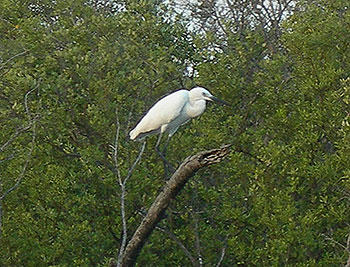
Tired of the noisy crowds I walked around the quieter corners of the site finding a pair of Chestnut (Black-headed) Munias, a couple of Plain-backed Sparrows, more than a dozen Wood Sandpipers, a Grey Heron, many, many Pied Fantails and a pair of Golden-bellied Gerygones feeding young. Quite frankly, things were quite slow and the large numbers of people milling around didn’t fill me with enthusiasm so I just played around with my camera, getting this blurry picture of a Little Egret.

As it began to get dark a few Mynas came in to roost, but in far lower numbers than I have seen in the past, but a group of cirlcing Asian Openbills gave me something to look at before leaving. Next time I come here it will certainly be during the week and I will try and find out how to gain access to the shorebird roosting pools. Finding the right information on birdwatching in Thailand can be tricky.

Here are a few photos from Bang Poo.

Thailand Birding: Khao Yai – there and back in a day.

Usually I would spend more than a day at Khao Yai due to its distance from Bangkok and the number of birding opportunities it presents but Minoro Shimono, Satomi Kodama and Eriko Kodama were on a brief birdwatching trip to Thailand from Japan and had only a day to spare so, together, we headed off for a day trip.

The day trip is possible, but it results in rather a long day, particularly for those driving. We left at about 4am and arrived at about 7am due to a bad traffic jam outside Saraburi caused by an overturned bus. However, we found some nice birds on the way in – the grassland areas gave us good views of Dollarbird, Plain-backed Sparrow, Hill Myna, Oriental Pied Hornbill and Australasian Bushlark – a species which is not at all common.

However, it was forest birds we came for and at Pa Gluai Mai campsite we found some nice birds – Greater Racket-tailed Drongo, Thick-billed Pigeon, a variety of bulbuls including the jocosus race of Black-crested Bulbul, Hill Myna, Blue-bearded Bee-eater and a superb Collared Owlet feasting on a lizard. Although Collared Owlet is a common forest bird, its “poop, poo-poo-poop” call can be heard throughout the day, it can be quite tricky to find. Abbot’s Babbler is a cute and common bird at Khao Yai and a little imitation of its call brought one out but it was the wintering White-throated Rock Thrush that was the highlight and a number of photographers were busy taking its picture.

Minoro Shimono had told me that it was his dream to see a Great Hornbill and proof that dreams come true came along in the form of a male Great Hornbill hotly chased by 2 Greater Racket-tailed Drongos – one harrassing each wing so that it looked like the hornbill had two huge wing streamers. Fortunately, the hornbill landed in a nearby tree giving us fantastic views for about 5 minutes.

Birding was a little slow for most of the rest of the day but in various spots we saw Wreathed Hornbill, Bright-headed Cisticola, Chestnut-headed Bee-eater, Scarlet Minivet, Rufous Woodpecker, Velvet-fronted Nuthatch and many other attractive birds.

As the day draws to a close, Pa Gluai Mai campsite is a good place to be once more and we found some really nice birds in the last hour or so of light. It is possible to get great views of Oriental Pied Hornbill as they gather to roost and we had one just a few feet away from us in a tree. Behind some huts we found a group of White-crested Laughingthrushes and Lesser Necklaced Laughingthrushes, both superb birds and they moved Eriko to one of her few words of English for the day -”wonderful!”. As darkness came we were on the lookout for nightjars and sure enough a little before dark at least 2 Great Eared Nightjars began circling overhead, uttering their characteristic “pir, pee-weeow” call. These are really big nightjars and provided a nice close to the day – they are regular at Pa Gluai Mai campsite and easy to see.

We stopped in an attempt to see more nightjars but only heard the call of Grey and Large-tailed Nightjars as well as Mountain Scops Owl and Brown Hawk Owl. However, no more birds were seen and it was time to drive back to Bangkok. This day trip to Khao Yai was enjoyed by all, if a little tiring.

lpb_sign.jpg

Thailand Birding: A day trip to Laem Pak Bia/Pak Thale

On 23rd March I collected Andreas Egelund Christensen at 5am from his hotel near Silom Road: Room at Silom Hotel. We arrived at Laem Pak Bia at about 7am and made our first stop at the spot which has been used as a wintering site by a pair of Black-faced Spoonbills: Black-faced Spoonbill wintering site 2008. However, at this time they were not present but a walk around the scrubby vegetation turned up an Oriental Reed Warbler, a pair of Indochinese Bushlarks, an Oriental Skylark, a pair of Plain-backed Sparrows amongst some more common birds. The salt pans here held a single Little Stint in breeding plumage, a number of Curlew Sandpipers as well as Marsh Sandpiper, Kentish Plover, Lesser Sand Plover, Whiskered Tern and Great Egret. In the time it took us to look at these birds on of the Black-faced Spoonbills had arrived and joined a group of Grey Herons and as we watched, the other spoonbill flew in. They proceeded to preen each other in a fashion that suggested courtship behaviour and after watching for 5-10 minutes we left them to it.

Moving on we stopped in hope of Great Knot and Nordmann’s Greenshank. At first all we saw was a large group of Lesser Sand Plovers and Kentish Plovers. I say “all we saw” but at this time of year these birds are beautiful in their breeding colours. Whilst watching these we located a group of Great Knot but the Nordmann’s Greenshank were not present, although a group of over 500 Black-tailed Godwits was impressive.

Standing watching these birds we added White-winged Tern, Common Greenshank, Brown-headed Gull, Gull-billed Tern, Osprey, Red-necked Stint and Long-toed Stint to our list; Andreas was particularly interested in the latter as it was a “lifer” for him.

Rather frustratingly, 6 Nordmann’s Greenshank flew in but did not land, they just flew off into the distance. They could be identified by their pale appearance and white underwings, but this view was not at all satisfying. With this event we decided to move onto Pak Thale for the Spoon-billed Sandpiper.

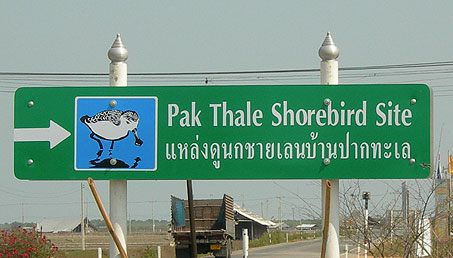
There is now a sign indicating where to turn for this site at Pak Thale – it is very easy to see and is in English with a picture of a Spoon-billed Sandpiper – this map will also help: Spoon-billed Sandpiper map.

Unfortunately for us, most of the Spoon-billed Sandpipers seemed to have departed and recently have been infrequently seen. One had been seen early in the morning but had left by 9.30 am, much earlier than usual. Lots of other birds were available and Little Tern, Red-necked Phalarope and Broad-billed Sandpiper were nice. However, at the mangrove remnants on the sea a fantastic Ruddy Kingfisher perched for a while in a dead tree before flying into dense mangrove cover – what a piece of luck! Amongst the mangroves we found several Dusky Warblers, Pied Fantail and Golden-bellied Gerygone. On the mudflats a number of Eurasian Curlews were feeding as well as many Javan Pond Herons in breeding plumage – no Chinese Pond Herons in breeding plumage were seen.

Feeling the heat we went for some lunch and arranged a boat for the trip to the sand spit. Before the trip though we had time for an hour at the King’s Project. At this time of day the numbers of birds were not so impressive but we found a Black-crowned Night Heron, plenty of Indian and Little Cormorants, Little Egret, Great Egret, Intermediate Egret, Grey Heron and much more.

A monitor lizard eating one of its own kind was an amazing sight and offered a chance for some photographs. read about this encounter and see the photos here: Cannibalistic Monitor Lizard.

In the freshwater filter and reed beds we also found Ruff, White-breasted waterhen and a couple of Ruddy-breasted Crakes as well as a Black-browed Reed Warbler before we headed for our boat trip.

As usual we saw Collared and Black-capped Kingfishers and 2 Chinese Egrets treated us to a great close-up view before flying away. On the sand bar the usual collection of caspian, Lesser Crested, Great Crested, Little and Common Terns were present and on the sand spit malaysian Plover was easily found. However, our quest for “White-faced” Plover was rather trickier and required us to wade through water to investigate the beach further up. Great Sand Plover, Sanderling and many Kentish Plovers were easily seen and just as we were about to give up we found the “White-faced” Plover on a small sand island. After viewing it for some time we headed back to the boat but got very wet wading though waist-deep water as the tide came in!

Our day was almost over but we had time to take another look at Pak Thale. On the way some other birders gave us reason to stop and amongst the large flock of Great Knot, Pacific Golden Plovers, Grey Plovers and other shorebirds were a group of 6 Nordmann’s Greenshank – very satisfying.

However, we weren’t ot be so lucky at Pak Thale and encountered other birders on the same search as us. One more bird for the day list was added though – a Dunlin – a very uncommon bird in Thailand.

We both had a good day however, with almost 100 species seen and pleasant company. The journey back to Bangkok was a little tiresome though, taking over 3 hours due to heavy traffic.

Some photos from Laem Pak Bia/Pak Thale.

, , , , ,

Free WordPress Themes