British Birding: Last Birdwatching of the Year

Yesterday afternoon I found an hour to visit Dartford Marshes. I headed straight for the riverfront and as the tide was out, large numbers of gulls were present on the mud. Unfortunately, very shortly after my arrival a large ship passed along the river and its bow wave scared off most of the large gulls. Still, enough birds remained to make things a little interesting.

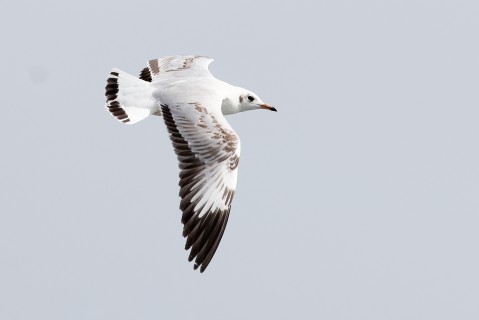
Huge numbers of Black-headed Gulls were present both on the mud and on the river and most of the large gulls proved to be adult Lesser Black-backed Gulls. A few immature Lesser Black-backed were also present along with an adult Herring Gull, a first winter Great Black-backed Gull and a rather sickly looking first winter Yellow legged Gull as well as good numbers of Common Gulls. A few waders were also feeding on the mud with around 150 Dunlin, 50-60 Redshank, about 40 Lapwings and 2 Black-tailed Godwits.

Scanning across the river I also picked up 7 Wigeon on the Crayford side of the Dartford Creek, a pair of Teal and about 7 Mallard on the Rainham side of the Thames. A couple of Reed Buntings were foraging in some weeds and a group of Linnets and a couple of Goldfinches flew overhead as I walked back to the car.

Of course a number of common species such as Magpie, Blackbird, Robin, Carrion Crow and Woodpigeon were also in the locality and small groups of Ring-necked Parakeets kept flying overhead on their way to their evening roost. Many of these parakeets were coming in from the Essex side of the river – a total of about 8 birds – heading for the roost at Foots Cray.

Not a bad hour’s birding and the Yellow-legged Gull was the final addition to my 2007 year list.
,

waterrail.jpg

British Birding: Water Rail Heaven

This afternoon I went for a quick visit to Sutton-at-Hone watercress beds – Sutton-at-Hone is a village a few miles south of Dartford in Kent, along the Darenth Valley. This little spot is always good in winter for birds and an hour spent there at this time of year is bound to turn up something of interest.

As I walked down the track I spotted a fox strolling across the grounds of St. John’s Jerusalem National Trust. This fox was a very sleek country fox, looking very plump and healthy and as I watched it, it sneaked into a garden and came running out with a slice of bread which I imagine was intended for the birds. The Chaffinches, Goldfinches and lone Song Thrush in the area didn’t seem too bothered though as they tucked into the other food someone had provided for them.

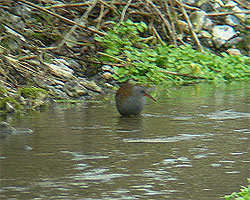
As I approached the River Darent I flushed out a Little Egret which in recent years has become a regular winter visitor to this spot. However, the real treat was a feeding water Rail in the cress beds themselves – another regular winter visitor here although one which ismuch harder to get a sighting of. I watched this bird for about 10 minutes as it fed oblivious to my presence before moving along to look down another ditch. Whilst watching this bird 4 Ring-necked Parakeets flew overhead, screeching on their way to their evening roost and a Jay flew across a field and disappeared into some trees. I took a couple of blurry record shots of the Water Rail.


 4 Moorhens were feeding in the second of the ditches that make up the cress beds and a couple of Wrens were creeping around in the Brambles along with a number of Blackbirds. A couple of flyover birds were 2 Cormorants, 4 Black-headed Gulls, 2 Common Gulls and 2 Lesser Black-backed Gulls.

Moving to another part of the cress beds I spotted a Grey wagtail at the water’s edge – another of the regular winter birds at this location. I scared my water Rail into a bramble thicket but immediately spotted a second Water Rail, followed by a third, just sitting in the water picking through dead vegetation. I don’t ever remember seeing three Water Rails all together but made the most of this performance, watching them for 5 minutes before my freezing hands sent me back to the car for some warmth.

,

Last Visit to Eske – British Birding

Now that Christmas is over and I have finished dealing with moving all my stuff out of my flat I have a chance to write about my final walk to Eske. The reason that it was my last visit is that I am soon moving back to Thailand, after nearly 4 years in the UK – for the next few weeks I will be doing some birding in Kent as I am staying with my family there.

Although I was busy on Saturday 22nd December, I managed to find a couple of hours to walk along the River Hull to the lake at Eske. Foggy weather made visibility rather poor but on the walk up I got some fantastic views of a hunting Barn Owl which then caught something in the rough grass and gave me a long look at it as it sat on the ground eating. A little further along a large flock of Fieldfares and a few Redwings were hopping around picking up insects from the feet of a herd of cows.

At the lake the numbers of ducks were quite high with over 200 Wigeon, 150+ Mallard, 2 Gadwall, 20+ Shoveler, 30-40 Tufted Duck, 3 Pochard and 2 female Goldeneye although just 1 Great Crested Grebe, 2 Greylag Geese and no coots were a surprise. Other birds on the lake included 7 Cormorant and a large group of Common and Black-headed Gulls.

Very little else was around on this quiet day, just a few common passerines such as Goldfinch, Blue Tit, Wren and Blackbird, with some flyovers including 200+ Golden Plovers, about 100 Lapwings and 7 Lesser Blak-backed Gulls.

With such cold weather and limited time I didn’t hang around for long and headed back to the car – on the way back a small group of 7 Meadow Pipits accompanied me and 2 Reed Buntings called from a willow tree. Almost back to my car a nice Song Thrush began foraging on a grassy field and 2 Collared Doves flew overhead.

I would imagine that it will be some time before I am back in East Yorkshire again, but when I am I will certainly check out Swinemoor and Eske. In the meantime this blog will continue, although for the next few weeks the focus will be in Kent and then move on to Thailand.

turnstone.jpg

British Birding: Scarborough Harbour

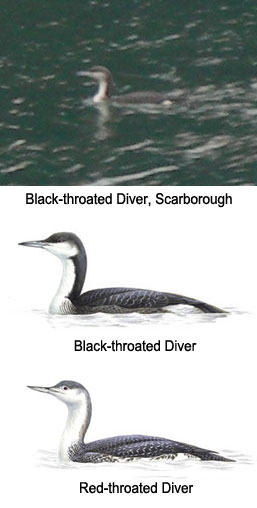
Scarborough harbour always has something of interest for birdwatchers in winter and my trip there today turned up a couple of nice birds. A quick scan of the harbour after parking the car resulted in a nice sighting of a Black-throated Diver in the harbour itself. I got a record shot of it and the identifying features can be seen by comparing it to the pictures below of both Black-throated and Red-throated Divers in winter plumage. Luckily there was also a Red-throated Diver just outside the harbour, coming in very close allowing me to compare the two birds.

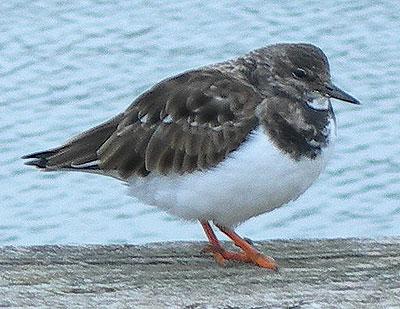
I searched through the large numbers of gulls present for something unusual but only found large numbers of Herring Gull, a few Great Black-backed Gulls and a couple of Black-headed Gulls. A few Turnstones were lurking around the harbour too, including one poor individual that had already lost one foot and had a large infection on the other 3-toed foot.

Here is a photo of a rather healthier Turnstone at the harbour.

On closer inspection this bird seems to have a toe missing too. I have noticed from the Turnstones I have seen at close quarters at both Bridlington and Scarborough that most Turnstones have some toes missing. I wonder if this could be a major cause of Turnstone mortality?

,

British Birding: Tawny Owls from the car

This evening I was sitting in my car at Hessle High School. Before anyone questions my motives let me say that I was waiting for my wife whilst she was at an adult education course. Anyway, the point is that whilst I was waiting, reading a book I suddenly heard the screeching call of a Tawny Owl, quickly followed by another one calling fromthe opposite direction. I turned on the headlights to see if I could locate one of the owls and as I did so, one Tawny Owl flew out of some trees and landed on the playing field in front of me. Incredibly a second Tawny Owl then flew down and pounced upon whatever it was the first one had caught and an owl tug-of-war ensued! This only proceeded for a few moments until the second owl flew off with the prey and the first owl sat, bemused, before heading off to its perch again.

Although I didn’t see the owls again I kept hearing them call and it seemed like there were at least 4 different owls calling – a good spot for tracking down Tawny Owls!

,

Birding by bicycle, or even Motorized bicycle!

It has often been said that one of the best ways of birdwatching is by bicycle. Certainly I have found this a useful way of covering large areas whilst remaining quiet and connected to the environment and often birding by bicycle can allow one to approach birds more closely than one can on foot.

However, if you live in a hilly or windy area cycling can be more of a chore than a pleasure and there comes a point where increasing the distance one covers shifts the emphasis from birdwatching to hard-core cycling. These issues came to mind when I was alerted to a website which sells do-it-yourself kits to turn a standard bicycle into a motorized bicycle: http://www.bicycle-engines.com - “Turn your ordinary bicyle into a motorized gas scooter today with a complete ready to install bicycle motor kit that includes all the necessary mounting hardware needed to attach it directly to your bike.”

Motorized bicycles are something my father used to talk about when I was younger so I was interested in reading about these kits. I would imagine that these engines make a certain amount of noise but what I was interested in is that with one of these kits it would be possible to visit a number of birdwatching sites in one day by using the engine between them and turning it off to cycle around more quietly once the site has been reached. I could certainly have used one of these outfits when I was doing the fieldwork for my degree dissertation, covering huge distances on foot – what a relief it would have been to have been able to hop on one of these.

Birdwatching aside, where these motorized bicycles would really come into their own is as an alternative, cheap and fairly efficient means of transport. With a lack of a decent public transport system and the rising price of fuel, the 150 miles per gallon that can be achieved on a motorized bicycle is very welcome and travelling along at 35 miles per hour on a summer’s day in order to spend a day birdwatching would be quite thrilling.

Although many people would say that motorized bicycles would turn an environmentally friendly mode of transport into one that produces CO2, by getting lots of people out of cars and using a more energy efficient motorized bicycle CO2 emmissions could actually be reduced as well as reconnecting many people with the environment.

Birding by bicycle really is a pleasure and one that could be enhanced by a motorized bicycle kit.

Orchid Photo Gallery

Due to the poor weather and being busy I have not managed to get out for a while – I’m beginning to feel a bit stuffy. I found a few moments to browse through some of my summer photos, reminding myself of better weather and some interesting plants. Like many other wildlife enthusiasts I have taken a number of orchid photos and I decided to put them together in a gallery and post them here.

The pictures are of Bee Orchid taken at Eske near Beverley, Burnt Orchid near Crowle, North Lincolnshire, Common Spotted Orchid at Eske, Early Purple Orchid at Crowle, Green-winged Orchid at Swinemoor near Beverley, Heath Spotted Orchid at Eskdale in the Lake District, Pyramidal Orchid at Wye Down in Kent.


, , ,

Free WordPress Themes