Another Swinemoor “Tick”

Another bright morning beckoned me out for a short walk on Swinemoor Common. The wind was brisk and quite cold though and made my eyes water a little – it certainly felt like winter is arriving.

Not so many birds around today with about 40-50 Lapwings and just a couple of dozen gulls: Black-headed and Common Gulls. However, I did quickly spot 3 Redshank but no other waders although a group of about 50 Fieldfares were feeding on the wet grassland along with a small group of Starlings. Walking further along I found 4 Curlews feeding where they have been lurking for a few weeks, close to a reedy ditch along with a group of Moorhens and 2 more Redshank.

Circling around onto the River Hull flood defences even more Redshank could be seen feeding amongst long grass – a total of 14 Redshank. As I was counting these a pair of Whooper Swans came in from the east and settled onto the floods – although this species is not unusual in this area, it is the first time I have seen them at Swinemoor. Unfortunately a dog walker came along and the swans flew off to the north after only a few minutes. In addition, a huge group of about 50 Snipe also flushed out and wheeled around for a moment or two before relanding.

With the wind freezing my hands I mooched off home seeing some Redwings, a group of Blackbirds and a Dunnock in some hawthorn bushes.

Vultures in Trouble in Africa?

Some worrying news has appeared on the Birdlife International website about the drug diclofenac being found for sale at a vets in Tanzania. This drug has been the driving force behind the population collapse of vulture species that were formerly common in Asia – resulting in them being critically endangered now. The drug has now been banned in many countries in Asia, but if it is allowed to go on sale in Africa, the continent’s vulture species have a bleak future indeed.

Read the Birdlife article to find out more, including steps you can take if you live in Africa.

A Walk through Burton Bushes

This morning I took a short walk around Burton Bushes, a small area of semi-natural ancient woodland on Beverley’s Westwood Common. It isn’t a particularly rich area in terms of birdlife or ground flora, although there is a little of each characteristic of woodlands with the best bird being Marsh Tit which breeds there.

Today however, all I saw were crowds of Blue Tits and Long-tailed Tits, a few Great Tits and a couple of Robins, Blackbirds, a Magpie and a couple of Redwings. Rather too many Grey Squirrels than is healthy for such a small patch of woodland were busy collecting food, but the most interesting things were the fungi growing on lumps of dead and dying wood.

Unfortunately I didn’t see any of the nice big colourful fungi but I did get some reasonable photos of a variety of wierd ones. With the poor light it was a bit tricky to get good photos with just a compact camera and out of 60 shots taken I only got 11 acceptable pictures, some of which are a little blurrier than I would have hoped for.

I haven’t a clue what any of these species are, so if anyone knows their identity, please let me know.

A Sunny October Morning

A beautifully sunny morning saw me out on Swinemoor once again, although a little wind made things slightly chilly. As I walked past the hawthorn hedges a group of Redwings flew out along with 6 Fieldfares, 3 Chaffinches, 1 Blue Tit and a pair of Tree Sparrows.

Out on the floods a group of aroun 20 Black-headed Gulls and 7 Common Gulls was far outnumbered by a hoard of Lapwings; at least 200 birds. Scanning through these lapwings revealed a group of 22 Golden Plover and a lone Greenshank feeding in the mud. Today it was noticeable how many Carrion Crows were foraging on the common with about 30 birds as well as groups of Rooks and Jackdaws. Further along a group of 5 Curlew were feeding alongside the same ditch as they were last week – in fact they have been residing here for a couple of weeks now. In addition large numbers of Snipe continually flushed from the wet grassland with at least 25 birds in flight as I did my circuit of the common.

As I walked along the flood defences of the River Hull a few wading birds were disturbed by a passing helicopter and on closer inspection a group of 8 Redshank were accompanied by a single Dunlin, 2 Ruff and a pair of Black-tailed Godwits which both settled down for a nap – tucking their bills under their wings. Superb! It seems that Swinemoor has something interesting every time I visit at the moment. Thinking that these were the best birds of the day I continued to watch the Ruff and Dunlin which nervously moved around the common every time a Crow disturbed them. Following their flight I noticed another bird on the floods that I hadn’t spotted previously: a Grey Plover which very obligingly took a short flight to show its black “armpits” before settling down again so I could take a longer look at it. Although not a rare species this was a first for Swinemoor – it’s always nice to get a local patch “tick”.

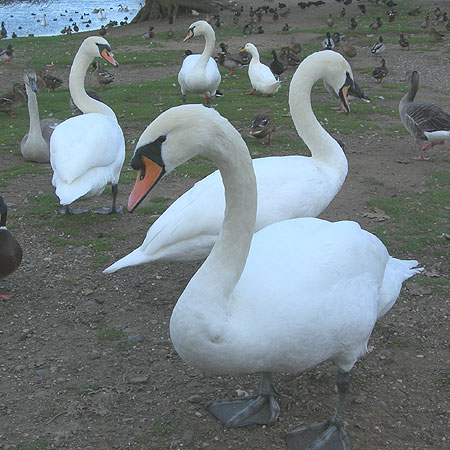
mute-swans-hornsea-27100.jpg

British Birding: Did you know that ducks like bread?

Furthering our ongoing research into ducks and their affinity to bread, my wife and I went back to Hornsea Mere armed with bread, seed and chocolate donuts. First of all we tried throwing bread, which was very predictably well recived by Ducks, Geese and Swans alike. Coots also seem partial to bread, although they don’t do well when it comes to fight over a slice. Carrion Crows, Jackdaws and Black-headed Gulls also take bread when it is available although they don’t seem keen to get in amongst the ducks. Ultimately, though, size counts and when Mute Swans get together they are able to grab a monopoly on bread and aren’t scared to stick their heads into a car to get at it.

The ducks, geese and swans at Hornsea Mere must be suffering from the obesity trend that is becoming a problem in the Uk judging by the number of people coming to feed them, and it is worth noting here, in the interest of ornithology, that our Tesco’s super budget brown bread seemed to be bottom of the list of preferences. The seed was definitely the most prefered food here with a rugby scum-like battle over it whenever I threw out a handful. However, Canada Geese show a marked preference for chocloate donuts, which were avoided by all other birds. It is likely that waterbirds do not often get the opportunity to taste chocolate donuts, but why Canada Geese have an affinity for them demands more investigation. Perhaps it is something to do with their transatlantic origin.

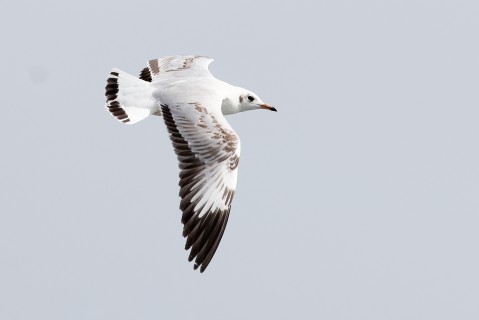
Having got a little bored with the ducks I started to throw pieces of bread into the sky for the gulls to catch and within seconds there was a cloud of them above our heads – a dangerous situation. In ana attempt to get some pictures I just pointed my digital camera towards them and held down the button when on action mode. I got some reasonable photos after selective cropping and enhancing in photoshop – this is the magic of digital cameras, even photographic neanderthals like myself can get some good shots.

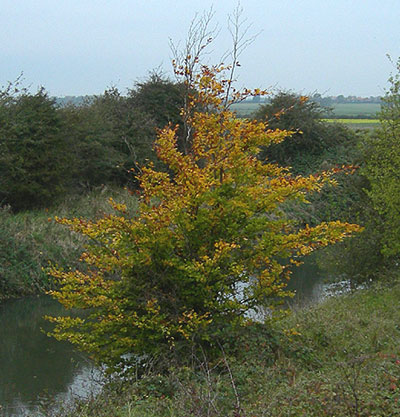
tree.jpg

British Birding: Coot versus Moorhen

A dim but very calm day today and the numbers of winter visitors are beginning to build up at Eske. On my walk to the lake this morning I saw just 2 Meadow Pipits and a group of about 100 Common Gulls on the way up. However, at the lake hundreds of Redwings and Fieldfares kept flying out of the trees and bushes and wildfowl numbers had increased a little since last week.

Most interesting was a Chiffchaff calling from amongst some willows. I don’t see very many Chiffchaffs here in the spring or summer and it may be that this one has arrived to winter here; one did so last winter. Wildfowl and waterbird numbers were 9 Mute Swans, 26 Greylag Geese, 64 Tufted Ducks, 14 Shoveler, 51 Wigeon, 163 Mallard, 11 Teal, 3 female Goldeneye, 13 Great Crested Grebes, 1 Little Grebe, 4 Gadwall, 1 female Pochard, 11 Cormorants and a handful of Coots and Moorhens.

At the small pond at Pulfin Fen I watched a Moorhen cruising along, minding its own business, casually pecking at a piece of vegetation whenit was mugged by a Coot. Instead of letting go of the reedy fragment it pulled back on it. The Coot also pulled and it created something of a tug-of-war. Neither bird would give up and some flapping and scratching began followed by the Coot pecking the Moorhen. Eventually the Moorhen won the pulling battle and the Coot just sat there and watched the Moorhen finish its piece of weed. Peculiar really, it’s not like there isn’t plenty of weed to go around.

I also noticed a colourful tree beginning to lose its leaves, with a bright yellow fringe.

A few other birds were feeding in the trees, with fewer leaves on the trees they are easier to see now; a Great Spotted Woodpecker on a dead tree, a few Blue Tits, a Great Tit and some Chaffinches were easy to pick out amongst huge flocks of Redwings. On the way back I noticed a Grey Heron in a field and a female Kestrel hunting in a fashion more like a Sparrowhawk. By this time the wind had increased and it was a good time to go home for lunch.

, ,

Earth in the Balance

A few days ago I wrote a short book review on Al Gore’s book “Earth in the Balance” on bookreviewblog. For anyone who is interested in environmental ideas this is an excellent source of information. Gore does a great job of taking a holistic view of environmental problems and this book was published in 1992, proof that the author is not jumping on the environmental bandwagon in the last few years – something that he has been accused of.

Here is my mini review: Earth in the Balance by Al Gore.

Free WordPress Themes