An afternoon on the beach

What to do when the sea is calm and seawatching from Flamborough Head is pretty much a waste of time? Head to the beach at Bridlington, that’s what!

Unfortunately, the northerly winds that made seawatching at Flamborough on monday so good were not repeated today making it a pretty unrewarding past-time. In a couple of hours I saw much lower numbers of Kittiwakes and Gannets than on monday and just 5 Fulmars, although I did get lucky with 1 Arctic Skua coming quite close to shore. The only auks I saw were 6 very distant Razorbills, although plenty of Shags were busy flying back and forwards. The only other birds of interest were a group of 12 Common Scoters flying north.

I guess I will have to pay more attention to the weather report before heading back to Flamborough; any easterly or northerly winds over the next few months should turn up some good birds.

Heading to Bridlington’s north beach, I walked to the most northerly end to have a look at the gulls that hang out where some freshwater springs feed into the sea. A couple of hundred Kittiwakes were bathing, about 50-60 Herring Gulls, 13 Lesser Black-backed Gulls, 9 Great Black-backed Gulls and 7 Black-headed Gulls were all loafing around as well as around 20 Sandwich Terns, with a number of adults feeding juveniles. Also present on the rocks were a few waders: 2 Sanderling (actually they were on the beach), 1 Bar-tailed Godwit, 9 Turnstones, 23 Oystercatchers, 8 Ringed Plovers and 3 Knot. Far out to sea a couple of Gannets could also be seen fishing.

The sunshine lent itself more to eating ice cream than to birdwatching so I headed into town to get one.

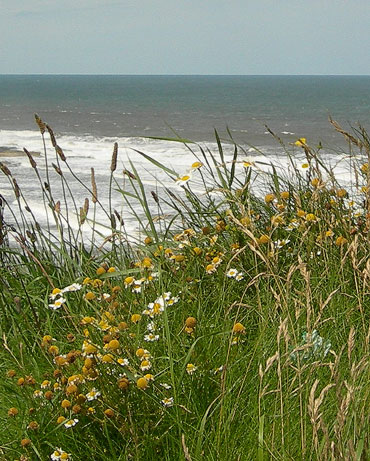
flowers-flamborough-30070.jpg

British Birding: Seabirds at Flamborough Head

Finally, the sunshine came out, so I had to get out. However, I badly twisted my ankle a few days ago so walking was out of the question, therefore I decided to go back to Flamborough Head to just sit and watch the seabirds.

On arrival a stiff northerly breeze was creating quite a swell on the sea and blowing large numbers of seabirds close to shore – the prospects of seeing something interesting were better than I had thought. I sat in a sheltered spot  on the cliff top and watched the birds from 11.30 am to 2.15 pm. Very large numbers of Kittiwakes, both adult and juvenile, were feeding and heading north along with good numbers of Gannets. Herring Gulls, Lesser Black-backed Gulls and Greater Black-backed Gulls were also numerous, with a few immature Common Gulls. Manx Shearwaters were also heading north in small groups, with a total of 14 birds seen throughout the period. I also saw about 40 Flumars cruising around and about 20 Sandwich Terns.

Although there were large numbers of these species present, there was  little else, with only about 10 Guillemots, 8 Puffins and 30 Razorbills seen, and constantly staring across the sea began to make me dizzy, particularly when the sun went in and the colour of the sea became dark – as you can imagine, if just looking at the sea makes me dizzy then going on a pelagic trip is out of the question. I have been known to suffer seasickness even before the boat had left port!. I did see a  single Oystercatcher flying south and also a Whimbrel going in the same direction. As I was getting ready to leave I decided to have a last look and very quickly found an adult Great Skua coming quite close to the shore. Quite exciting as this was a new species for me. I’m not really sure how I’ve failed to see this species in the past as it isn’t especially uncommon – more to do with my lack of interest in standing on windy cliffs in autumn than its scarcity.

One more interesting species also turned up a few minutes afterwards – a dark morph Arctic Skua, which was attacking Kittiwakes and a Fulmar, but it didn’t seem to get a meal from them. Also worth a mention are 3 Harbour Porpoises that were hunting in the area; they are actually pretty common here and anyone spending an hour or so watching the sea here is likely to spot some.

After a successful time watching the seabirds just 2 Linnets and 4 Jackdaws flew past on my way back to the car.

, ,

Scarlet Pimpernel

They seek him here

They seek him there

Those Frenches seek him everywhere

Is he in Heaven?

Or is he in Hell?

That demned illusive Pimpernel.

Odds fish m’dear!

Flamborough Head

Yesterday I suddenly realised that I hadn’t seen any seabirds this year and as Flamborough is just 40 minutes away I drove there whilst the weather was acceptable. I didn’t see anything unexpected but it was nice to watch large numbers of Kittiwakes, Gannets, Puffins, Razorbills and Guillemots go about their business.

Lots of Gannets were flying past, both north and south with quite a number of juveniles amongst the flocks. Kittiwakes were the most numerous with better numbers of juveniles fledging than in the previous few years when the breeding season was a massive failure. Below is a picture of Kittiwakes nesting on one of the cliffs.

Whilst watching these a single Fulmar flew past as did a pair of noisy Sandwich Terns. Good numbers of House Martins and Swifts were feeding in the air and a couple of Skylarks were in aerial song. On the rocks below the cliffs were large numbers of gulls; Herring Gull, Lesser Black-backed Gull, Great Black-backed Gull and a single Black-headed Gull along with a few Oystercatchers and a lone Redshank.

I took a walk around some of the farmland adjacent to the cliffs where I came across a Pied Wagtail, a Wren, a male Reed Bunting, 2 Meadow Pipits and a Coot on a farm pond. This farmland is being managed for wildlife and there were loads of nice flowers in the field margins including piles of Kidney Vetch, pictured below.

Blea Tarn and Eskdale

With another huge fried breakfast inside me I headed uphill from Boot village towards Blea Tarn. The by now customary Yellowhammers, Willow Warblers, Wrens and Chaffinches were joined by plenty of Robins, including a number of juveniles, and a family party of Great Tits.

Once upon the ridgetop a Raven flew over doing its best demonstration of its “graak, graak” call and a Kestrel was hunting over some very boggy land. Somehow I got a bit lost amongst the crags and bogs, which is strange as this is exactly what happened to my dad and I when we came up here 27 years ago – he carried me across the bogs – this time I had to manage on my own getting very wet feet in the process. I found Blea Tarn and nearby Stiny Tarn where a Reed Bunting was busy calling – a quite unexpected species here. The view across the valley to Harter Fell, where I was yesterday was quite good and foretold the rain that was to come later.

Harter Fell

I walked across the moors where some old druid circles exist and some farmers were using sheepdogs to round up sheep before heading downhill. The path down was full of birds with 5 Tree Pipits, 2 juvenile Great Spotted Woodpeckers, a male Blackcap, a Whitethroat and many more common species.

Back down in the valley I walked down to the River Eske and along through the woods. Whilst walking across some fields I came across some juvenile Swallows being fed by their parents and allowing me to approach very closely: a nearby sheep seemed very interested in the whole episode too!

The woodlands were once again alive with species; Coal Tit, Nuthatch, Treecreeper, Spotted Flycatcher, Goldcrest, Blue Tit, Song Thrush, Great Spotted Woodpecker, Green Woodpecker and a pair of Jays. The river Eske here is very beautiful, I remember having picnics here when I was small but today a Grey Wagtail was picnicking on insects. Heading back to the car the rain began to fall quite heavily so I drove to the coastal village of Ravenglass.

A ridiculously long walk

After a large cooked breakfast I headed up Eskedale through some beautiful, mossy woodland – immediately, a Spotted Flycatcher showed itself, perching on a fence post. On closer inspection there was a whole family of Spotted Flycatchers, noisly flitting about with the young begging for food. The flycatchers were just part of a feeding flock of birds with a juvenile Redstart, 2 Song Thrushes, 5 Coal Tits and a family of both Great and Blue Tits. A little further along the woodland took on the appearance of something from Lord of the Rings with mossy boulders and twisted trees everywhere. A pair of Treecreepers were feeding on the trees and a couple more Song Thrushes were hunting for food.

At about 10 am some cloud came in and it began to rain which made me think that I was in for a very wet day. Whilst the rain was at its hardest I messed around with my camera and took some photos. I got this one of a tree.

When the rain eased off I strolled along stopping often to watch the birds; a Garden Warbler, some more Spotted Flycatchers and a Nuthatch were interesting as was a close up view of a calling Buzzard. In a small plantation of conifers a male Siskin briefly came into view before flying across the valley.

By the time I reached the bottom of Hardknott Pass the rain had stopped so I headed further up the valley stopping to watch a Grey Wagtail in a stream and to take in more birds amongst the open oak woodland. Two more Garden Warblers were feeding, Chaffinches, a Mistle Thrush and yet more Spotted Flycatchers. The abundance of this species was nice to see. When I was in my early teens, Spotted Flycatchers were so common back home that I would hardly stop to look at them, now they are mostly gone, but it was nice to see them so common here – if only British woodlands were always this good.

Heading up the valley I gained height quickly and the bird species began to change with Meadow Pipit, Wheatear, Yellowhammer and a juvenile Whinchat all present. In the river a Grey Wagtail was busy feeding 2 very recently fledged chicks below a small waterfall. As one goes further up Eskedale the birds thin out, but the views become spectacular with waterfalls and high mountains all around.


The only problem is that getting to all this great scenery involves hiking up loads of steep and wet trails, by this time my feet were already soaked so that I was just taking the shortest route to where I wanted to go, whether that was straight through a bog or not. I had to spare a thought for an old friend of mine who used to accompany me on hiking trips in the past. I was very fit at the time and used to leap up the mountains while he huffed and puffed away; now that I am not quite so fit I have some idea of how he felt. Bogs and steep climbs aside there was still some time to stop and look at the birds with a pair of Ravens calling from some crags and a male Stonechat amongst the bracken.

Once at the top of my climb, the valley opened out into one of the most spectacular views in England. Here the valley is wide and boggy, with a rocky stream through the middle and high mountains all around, like an ampitheatre. This was a good place to have lunch and an even better place for those wishing to overdose on Meadow Pipits, although anyone wishing for more than fabulous views and Meadow Pipits should stay away! Below are a few pictures from my lunch spot, but they hardly do the area justice.


Afterwards I headed towards Moasdale in order to descend and on my way to the pass into this valley I came across a Skylark, which I usually think of as a bird of the lowlands but I guess there is plenty of habitat for it up there, and a distant flock of 15 Ravens swooping around a mountain top. The treck down Moasdale was pretty rough with no real track so it was a case of slogging through more bogs, although it was very pretty. Finally, with the sun now out and very hot, I reached the eastern side of Hardknott Pass and stopped a while to watch the cars going up and down this crazy road. It can be very exciting driving up this pass, or scary, depending on your point of view: here’s a picture of it.

Hardknott Pass

From here I made the dubious decision to head down the Duddon valley instead of heading over Hardknott Pass. Fortunately the birds began to become more abundant and varied with a male Redpoll landing on a fence in front of me, a Grey Heron fishing in the River Duddon, a pair of Buzzards mewing on a crag, many Swallows, 4 Wheatears, a party of Long-tailed Tits and 5 Carrion Crows feeding on a dead sheep in the river. The valley is very beautiful and the boggy meadows were full of yellow Bog Asphodel and pink Heath Spotted Orchid.

Heath Spotted Orchid

By this time I was very tired and not relishing the very long walk around Harter Fell to get back to Wha House Farm and a shower, so I decided to take the more direct route via the summit of Harter Fell, which in hindsight wasn’t the best choice I’ve ever made. The trail was hopeless and I had to constantly consult the map and try and work out where I should be heading. Somehow I made it to the right place, but not before making several stops to admire the fantastic views of the mountains in the sunshine. I have been up here many times but somehow I am still mesmerised by the scenery. By this time I was so knackered that the birds could be damned – particularly the, by now, quite tiresome Meadow Pipits and Wheatears. Although a Buzzard being chased by a Raven was quite good. The view from the summit was great, particularly the view down upon Hardknott Fort, an old Roman encampment. From this height all the rooms of the fort could quite clearly be seen.

Hardknott Fort

The descent back to the farm was torture, I thought my knees were going to explode, and by this time a dodo could have turned up and I wouldn’t have been interested. However, after a shower, some food and a pint of Sneck Lifter I managed to rummage up the enthusiasm to watch a Black-headed Gull catching insects over a hay meadow that was in the process of being cut.
Eel Tarn and Burnmoor Tarn

I decided to go to the Lake District National Park for a few days, despite the weather forecast being for rather poor weather. The national park took me about 3 hours to get to, but the journey took another hour as I was heading for the western lakes, probably the most spectacular part.

I headed into Eskedale and found a B&B at the foot of Hardknott Pass, a place called Wha House Farm. It was a nice place to stay with lovely views and the lady running it was very friendly. The weather forecast was wrong, with fairly good weather, just a little cloud and only on the highest mountains, so I went off for a walk at about 3.45pm. Starting at the Woolpack Inn, I headed uphill to Eel Tarn. A number of birds were easily seen with a Greenfinch at the pub and a Willow Warbler in the trees just behind. A small conifer plantation behind the Woolpack Inn provided the launching point for 2 male Redpolls to perform their song flight. Unexpectedly, the bracken covered hillside was full of Yellowhammers in song, the dark colour of the bracken providing a perfect contrast for the vivid colour of the male Yellowhammers.

After a short climb I reached Eel Tarn, a very pretty spot with views of Harter Fell in one direction and Scafell Pike in another. A pair of Ravens flew overhead and on the tarn itself were two Mallard and a Little Grebe; both seemed a little out of place up here.

Eel Tarn and Harter Fell

It felt a bit strange to be up there again as the last time I visited Eel Tarn was 27 years ago when I was just 7 years old. My father used to take me for walks up there whilst my mother was getting ready to go out on our family holidays to a farm in Eskedale; needless to say the views are as good as ever although it was sad that my father is no longer here to join me on this walk.

With plenty of time before darkness I decided to walk further along to Burnmoor Tarn, another place I last visited as a child with my dad. The walk provided great views of nearby Scafell Pike as the clouds cleared to reveal the summit, although the footpath was soaked and lost amongst Sphagnum Moss and Bog Asphodel. Just as I was thinking that I should have seen more birds, a male Whinchat began calling from nearby bracken. It gave me good views for quite some time. Also showing themselves were a Wren and a Kestrel.

After sinking up to my knees in mud I reached a lonely Burnmoor Tarn where a strange hunting lodge is situated. On the lake were a pair of Great Crested Grebes and two pairs of Wheatears with young noisily feeding and fighting. The only tree for miles around is located next to the lodge and a Tree Pipit had managed to find it; funny how easy this is to seperate from Meadow Pipit when the two are seen close to each other – up here it is a Meadow Pipit heaven.

On the way back down into the valley I saw some more Whinchats before walking through some woodland where I saw a number of species: Chaffinch, Goldfinch, Wood Pigeon, Dunnock, Robin, Coal Tit and a juvenile Great Spotted Woodpecker. I walked back to the Woolpack Inn along the valley, through more woodland and farmyards and just before getting back to the car a Grey Heron flew out of a small stream and a Common Buzzard flew overhead.

Then off to the George the Fourth pub for chicken and leek pie which by that time was urgently needed.

Free WordPress Themes