Cormorant, Treecreeper and Tetnus!

Enough sunshine today to tempt me outside, just the short distance to Figham Common. Walking along the river flood defenses I could see that many of the fields to the east were flooded by a few centimetres of water. I expected to see some birds feeding on these such was the extent of the flooding – but nothing. I can only imagine that these fields which are usually used for sheep receive too much fertilizer and flood too infrequently for the invertebrates that wading birds such as Lapwings favour.

A Cormorant was in the river and must have found a very good fishing spot because it refused to fly away, even when I was only a few metres away – it simply continued to fish, catching something every 20 seconds or so.

The bushes and shrubs at the far end of the common were alive with Greenfinches, Chaffinches, Blue Tits, Great Tits and Long-tailed Tits, with lots of Blackbirds foraging under a row of mature beech trees; but just one Redwing and no Fieldfares. Interesting to me was a Treecreeper calling ina hawthorn bush, having seen one in the unlikely position of in a lone bush in the middle of flooded grass the last time I was at Figham. This location was not so wierd, but this bird seems to have decided that 10 beech trees and some hawthorn scrub constitues a woodland.

Plenty of Skylarks were singing, a few Reed Buntings seemed to be pairing and a nice male Yellowhammer was almost singing – he must think that spring is here already.

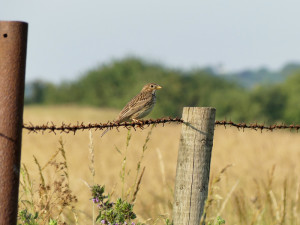
On my way back to the car I managed to slip in the mud and rip the skin on my left hand on a piece of barbed wire. The spike went right in and I was caught on the fence. When I unspiked myself I noticed that the barb was not only rusty but covered in cow’s hair and mud. Having not received a tetnus injection for 12 years I had the inconvenience of going to the doctor for an injection. Amazingly I was in and out in under 5 minutes having had the injection. Wow! This goes a small way towards restoring my faith in the NHS. There is still a long way to go though as they messed up my hernia operation last year.
More of Swinemoor

Just got back from a couple of hours walking around Swinemoor Common, Beverley. It wasn’t really a birdwatching walk, I was with three friends from college and we were inspecting the place for our management plan assignment. We came up with ideas like retaining the surface water through spring and summer, and grazing the grassland through late summer and autumn to manage it for wetland birds. The idea is to keep horses off of it through the breeding season to allow Lapwings and Snipe to raise their chicks without the threat of trampling. None of this is actually going to happen of course, it’s purely hypothetical.

Other idea we had were a bit of selective tree planting, nest boxes for tree sparrows, roosting boxes for bats and managing visitor access by encouraging them to use an interpreted trail.

However, there’s always time to look for birds and we saw quite a good number of Golden Plover, a couple of hundred in total, 40-50 Lapwings, 2 Snipe and 5 Redshank. Alongside were about 40 Common Gulls, 10-20 Black-headed Gulls and 2 Herring Gulls. A Grey Heron flew over too and a Kestrel hunting kept disturbing the waders and gulls.

ways-to-help-birds

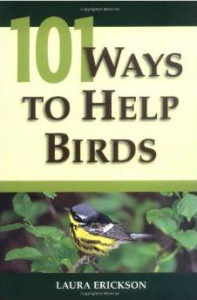
101 Ways to Help Birds

Most birdwatchers would like to help birds, but many people don’t go beyond feeding them in their back garden. Garden bird feeding is great, but for serious bird lovers there are lots of things that can be done to help birds.People who have gardens have a great resource that they can manage for birds and simple things like not using weed killers, slug pellets or any other chemicals will ensure that there is greater biodiversity in the garden and consequently more food, particularly when adults are feeding chicks.

Less obvious things we can do for birds are things which benefit the environment in general, like use the car less – do you really need to drive hundreds of miles to go twitching? A friend of mine said that when he does occasionally go twitching he tries to ensure that he gives other s a lift so at least one car is used rather than two (or three or four).

With bird conservation in mind I recently bought a copy of Laura Ericsson’s 101 Ways to Help Birds Read more »

Snow Showers

This morning we woke up and everything was white with snow. The snow showers carried on all morning, but by the afternoon most of it had melted. I went for a walk to Eske/Pulfin from 3-4.30pm expecting the cold weather to bring out some birds. I was pretty much wrong there, with just the normal collection of species present. Plenty of Wigeon on the lake, along with Mallard, Gadwall, Tufted Duck and Pochard and a few Great-crested Grebes.

The wintering Goldeneye has been joined by three more, all four are females.

The hedges did contain quite a few Long-tailed Tits, Great Tits and Blue Tits, but almost no finches at all; just a few Chaffinches and Greenfinches. Pulfin Fen was under quite a bit of water and loads of Teal were feeding there with a nice sunset in the background. In the distance to the north about 30 Mute Swans were feeding in fields and a distant Barn Owl was hunting along some ditches.

On the way back another Barn Owl flew very close by, illustrating how common they are in this area – I’ve sen more Barn Owls in the 2.5 years I’ve lived here than in the rest of my life put together!

The state of the footpath was interesting; the first 200 metres from the road were terribly churned up where people have wlaked along it, but after that it was far less muddy, showing just how few people walk more than a couple of hundred metres from their car!

An Unlikely Treecreeper

Having finished a peice of coursework, due in later this week, I found some time for a quick walk at Figham Common. What a bright sunny day it was too, but a wintery breeze finally brought some seasonal temperatures. I only had an hour an a half; from 2-3.30pm but there were plenty of birds around. However, the common is very muddy, there aren’t really any proper paths other than along the river, so decent boots are a good idea or you end up with cold, wet feet – like I did.

The first bird I spotted was a Barn Owl, hunting over the rushy part of the common. Figham seems to be a good place for this species, I’ve seen at least one here on all but one visit. As it neared a clump of trees a flock of about 60 Fieldfares flushed out and flew away making a racket. Just a little further along a male Stonechat sat on a fence post and was shortly joined by a female.

Unfortunately, the pasturemasters seem intent on keeping the common drained, I’m not really sure why, there are only a few cattle grazed here in the summer, and where tractors have been used to dig drainage channels it is difficult to pass without ending up to your knees in mud.

I crossed to the western section of Figham where there is very wet pasture, some scrub and a small rushy reedbed (actually it’s greater reedmace). Loads of birds here – hundreds of Redwings and Greenfinches feeding on hawthorn and these were joined by a Goldcrest. Heading towards the wettest area I heard a Treecreeper calling from a lone, and very stunted, hawthorn in the middle of a very boggy area. After some time I finally saw it, having thought that I must be mistaken – surely it could have found some better trees around to creep around on? There are some decent beech trees a few hundred metres away, they would have been much more suitable.

At the reedmace patch 15 Teal and about 35 Snipe were flushed – there always seem to be lots of snipe here – and a large female Sparrowhawk flew overhead. Not much else on the way back, just a Meadow Pipit and a first winter Reed Bunting, although there were more excellent views of the Barn Owl which didn’t seem to mind me being there.

A few Herring Gulls were calling overhead but I was too busy unsticking myself from the mud and trying to untangle myself from thorns and barbed wire to bother to take more than a quick glance.

As usual for my birdwatching walks near Beverley, I was the only person there. I guess the other birders are out somewhere better!

Eske (Or is it Pulfin Fen?)

Today I didn’t just think about birds, I actually went and looked at some!

From 11am to 1 pm I walked up the Hull river to an area known as Eske. However, part of this area is a Yorkshire Wildlife Trust reserve called Pulfin Fen, so I’m never really sure what to call this location. The weather was fairly good for birding, no wind at all and good visibility. I always walk to this spot from Hull Bridge and take the footpath on the eastern side of the river; there is a path on the western side, but there is no access to the lake from here. I’ve shaded the area where most birds are likely to be seen pale green.


There was almost no bird activity at all until I got to the first hedgerow alongside the path and suddenly there were birds everywhere. Mostly the hedge was full of noisy Blackbirds, Fieldfares and Redwings, stuffing themselves on hawthorn berries. A number of the Blackbirds were huge, so presumably these were birds from Europe.

However, whilst watching this lot, a small bird flew off and began foraging in a sheltered area under the hedge: I was pretty surprised to see that it was a ChiffChaff. I guess I shouldn’t have been that surprised really, I know they winter in the UK more and more, and this winter must be one of the warmest ever. Still, this far north I would imagine that it is unusual.

At the lake there were hundreds of Greylag Geese and lots of ducks, mostly Wigeon and Mallard, but there were also Teal, Shoveler, Pochard, Gadwall, Tufted Duck and a very welcome sight of two male Pintail. On the way back to the car a flock of around 200 Pink-footed Geese flew overhead and I finally saw my first Grey Heron of the year.

Somehow I still haven’t seen a Chaffinch this year. I wonder how long I can go without seeing one.

Corn-bunting21

Corn Bunting Data Analysis – British Birding

Today I spent most of my time analyzing the data I have collected observing Corn Bunting habitat selection. I initiated a study of Corn Buntings from May to August 2006 in order to record the crop selection of calling males in the study area and to attempt to make a map which would show all territories. I am currently in the third year of my degree, studying Wildlife and Countryside Conservation, and the data I have collected is to be discussed in my dissertation. I did all the fieldwork in East Yorkshire/North Lincolnshire and I am now writing up my findings and creating all the maps and graphs that are needed to illustrate them.

I surveyed in the region of 100 square kilometres near RSPB Blacktoft Sands and found 168 singing male Corn Buntings. I plotted their territories and recorded the crops that each was using, whilst mapping the land use of the entire area. Fortunately, the weather was really warm and sunny for most of the study period, so the task was very pleasant indeed. Read more »

Free WordPress Themes