Thailand Birding: MK Restaurant Bird Themed Coasters

MK is a chain of restaurants in Thailand that serve cook-it-yourself food. Basically you get a pot of boiling water, fresh vegetables and plates of meat/seafood to cook yourself; it is what is known as a suki style restaurant.

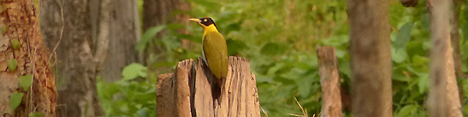
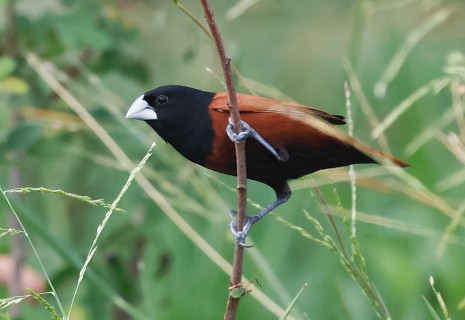
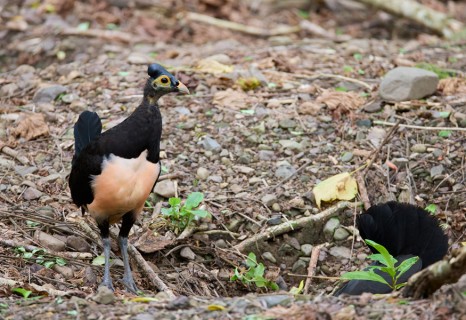
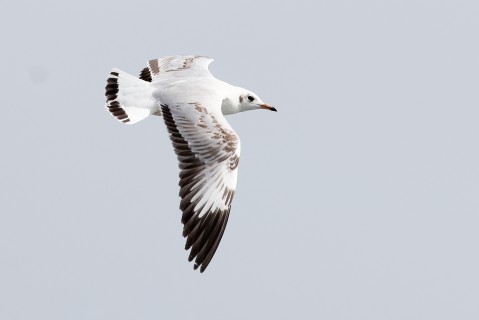
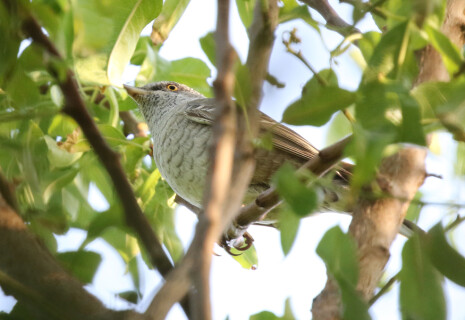
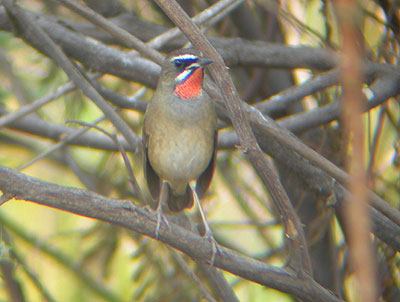
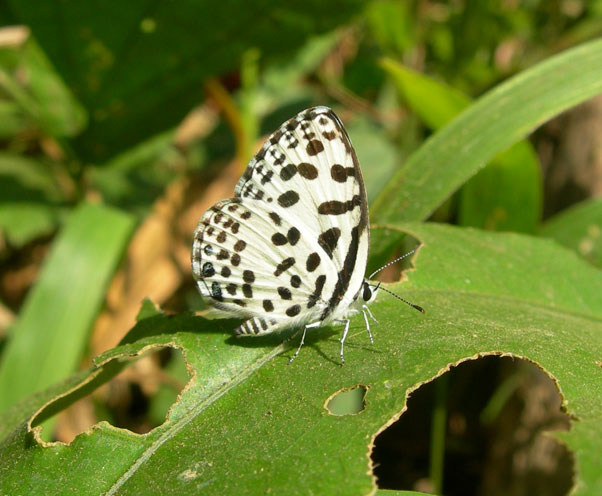
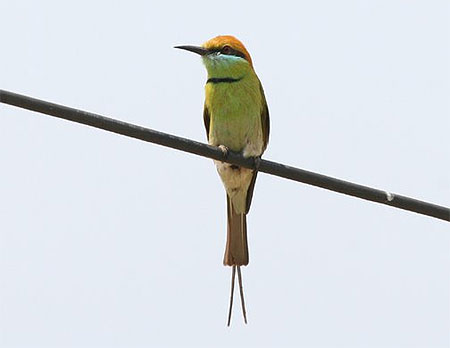
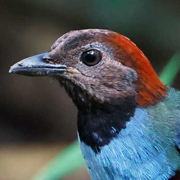
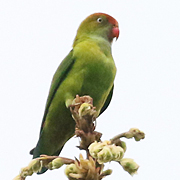
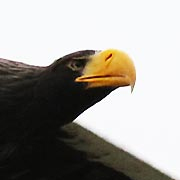
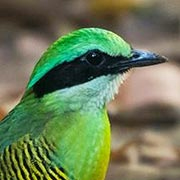
Recently, they have been using a set of coasters that feature birds. primarily they are birds of Thailand but there is also a selection of birds from around the world – big colourful birds like flamingo and toucan. Here are the ones that I have; collected by my wife’s family.

Click on the above pictures to see a large size version and look out an amusing typo.
MK Restaurants also have their own website for those that are interested: MK Restaurants.

, , ,

gak-gak

Hornbill at Ban Maka: Thailand Birding

Those birders visiting Kaeng Krachan and wishing to stay in comfort rather than camping in the national park, have a choice of a number of places close to the forest. I usually use Ban Maka which is a pleasant place to stay with air conditioned rooms, private bathrooms and excellent food as well as having helpful staff.

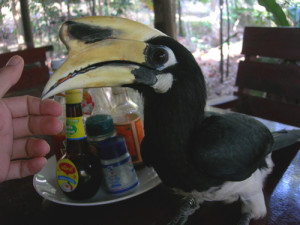
One of the features at Ban Maka is their tame Oriental Pied Hornbill which was given to the owner after a local had become tired of it. The hornbill goes by the name of Gak Gak ( the Thai name for this species is Nok Gak) and can be somewhat overfriendly. A bit of finger drumming on the table usually sees Gak Gak come swooping down looking for a tickle or some food. Read more »

Thailand Birding: Rusty-cheeked (Tickell’s Brown) Hornbill

Rusty-cheeked Hornbill is a recent split from Brown Hornbill and this taxon has been adopted by the BCST on their latest checklist of the birds of Thailand; formerly it was known as the tickelli subspecies of Brown Hornbill. At Kaeng Krachan this species is fairly easy to see with most sightings being between the Bang Krang campsite and stream 3. Sometimes this species can be quite unobtrosive but often gives itself away with its manic screeching.

The bird in the photos below was part of a flock of 9 birds and was checking out a nest hole beside the road at Kaeng Krachan in late February 2009. This was a nest hole which had been used the previous year by a pair which had successfully reared chicks and I have a vivid memory of them passing lizards to the young birds.

The BCST issued accompanying notes with their checklist and these make interesting reading; here I reproduce the notes on Rusty-cheeked Hornbill.

Rusty-cheeked Hornbill Anorrhinus tickelli and Brown Hornbill A. austeni
P. Poonswad (Hornbill Project Thailand; unpubl. data) has suggested that the genetic distance between these two taxa is at least as great as that between Great Hornbill Buceros bicornis and Rhinoceros Hornbill B. rhinoceros, and on this basis we tentatively treat them as distinct species following some earlier authors (e.g., Kemp 1988). It should be noted, however, that the vocalisations of the two “brown hornbill” taxa are very similar. In addition, although the females are highly distinctive, A. tickelli being dark-billed and A. austeni being pale billed, occasional whitish-throated male A. tickelli that appear inseparable from typical male austeni have been observed in tickelli groups (Anak Pattanavibool, in litt.).

, , , ,

rubythroat2.jpg

Thailand Birding: Siberian Rubythroat at Bueng Boraphet

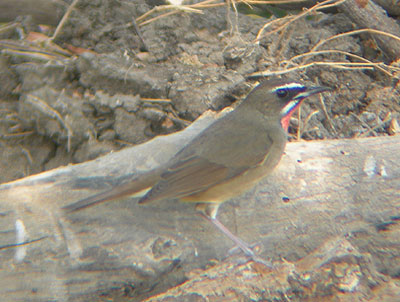
Over the last few months I have made a couple of visits to Bueng Boraphet in Nakorn Sawan province. This site is most famous for its waterbirds and a boat trip with the excellent Mr Phanom is memorable experience for birders and non-birders alike. Any boat trip at Bueng Boraphet is likely to provide lots of sightings of species such as Purple Swamphen, Pheasant-tailed Jacana, Bronze-winged Jacana, Purple Heron, Oriental Darter, Asian Openbill Stork, Lesser Whistling Duck and Cotton Pygmy Goose with many other species likely during the northern winter. However, another highlight for many people is the Siberian Rubythroat that Mr Phanom has provided food for and is now easily observed at close range.

For photographers this particular Siberian Rubythroat is especially attractive as this species is usually very skulking and the photo opportunities this bird provides are very unusual. I took a couple of reasonable photos with a digital camera through my binoculars.

Here is a link to a video clip was taken by Daniel Lopez Velasco in mid February 2009 and shows what a beautiful and obliging bird it is: Siberian Rubythroat at Bueng Boraphet.

Whilst this particular Siberian Rubythroat at Bueng Boraphet is particularly easy to see, in the same area we found 4 more Rubythroats skulking around in dry undergrowth; the dry margins of Bueng Boraphet are one of the best places in Thailand I know of to find this tricky, skulking species.

, , , ,

kkbutt8.jpg

Butterflies at Kaeng Krachan

Kaeng Krachan national park is well-known for its birdlife but it is also a fantastic place to find a huge variety of butterflies. At certain times of the year, during the wet season for example, it is worth staying out on the trails all day to find birds; things slow down during the middle of the day but good birds can still be found. However, right now in the dry season it gets really hot in the afternoon and there is almost no activity, making bird finding very difficult and tiring. A good option at this time of year is to spend some time at the second stream a little along the road from Bang Krang campsite to observe the butterflies in the mid day heat.

The butterflies congregate around the stream to take in minerals and quite often there are large flocks with many species amongst them. Some photographers put down a mixture of fish sauce and water to attract the butterflies to exactly the right spot, but there always seem to be enough butterflies present not to have to bother with this.

People with good quality cameras will be able to take some really excellent photos, and even with my small, compact digital camera some nice pictures can be obtained with patience.

, , ,

bee.jpg

Thailand Birding: Laem Pak Bia/Pak Thale & Tung Bang Jak

The shorebird sites of Laem Pak Bia and Pak Thale are well-known and frequently visited birding locations but by combining a visit to these areas with some time at the rice fields of Tung Bang Jak a wide variety and large number of species can easily be seen in a short space of time.

Recently, I was joined by a group of Dutch birders, Pierre van der Wielen, Marco Witte, Rob Struyk and Alma Leegwater, who spent one and a half days in the area. We easily saw the target species of Spoon-billed Sandpiper, White-faced Plover, Nordmann’s Greenshank and Malaysian Plover giving us time to visit Tung Bang Jak on our second afternoon.

Tung Bang Jak is an area of rice fields and other mixed agriculture which can be reached by turning left at the new road bridge which crosses the Petkasem Highway about 1.5 kilometres before reaching Petchaburi.


Green Bee-eater by Marco Witte 

When we arrived there were a number of areas where rice stubble was being burned, and this seemed to attract large raptors; presumably large insects, small rodents and lizards were easy to find in these conditions. With 5 pairs of sharp eyes and Pierre’s expertise in raptors we saw 15-20 Black Kites, 5 or 6 Brahminy Kites, 1 adult Imperial Eagle, 2 sub-adult Steppe Eagles, 2 Greater Spotted Eagles, a juvenile Eastern Marsh Harrier, 1 Common Kestrel and a Booted Eagle.

Apart from the raptors, other interesting birds were 18 Yellow-breasted Buntings (a species which seems to be very scarce these days), 150+ Streaked Weavers at a pre-roost site with large numbers of Baya Weavers, 60+ Red-throated Pipits, 13 Grey-headed Lapwings as well as a single Cinnamon Bittern, Yellow Bittern, Oriental Reed Warbler, Slaty-breasted Rail and Bluethroat.

In all we saw more than 130 species in one and a half days and had an excellent time.

More photos from the trip can be viewed at Marco Witte’s gallery: Birds of Laem Pak Bia/Pak Thale & Tung Bang Jak.

, , , ,

yonok.jpg

Thailand Birding: Yonok Wetlands

It has been a long time since I have written anything about the Yonok Wetlands project, instigated by Mick Davies and Dowroong Damlamajak, near Chiang Saen. The reason for this is not my lack of support for the project, just that I have been very busy; however, it is now time for me to point out some of the good work that Mick and Dowroong have been doing.

Yonok Women’s Group
Dowroong has set up the Yonok Women’s Community/Conservation Group centred around the village of Ban Huai Nam Rak which meets on a regular basis to spread the conservation message at community events such as festivals and fetes. The group works at creating a community spirit and encourages this to spread to local conservation issues. Perhaps their greatest success is persuading local markets to stop the sale of wild birds as a food item, something which has had a major impact on the level of bird trapping in the area.

Harnessing the energy of local women’s groups to further conservation of the Chiang Saen area is an excellent move and this strategy has been one that has been proven to work well. In Kenya Wangarai Maathai initiated the idea of the planting of trees with women groups in order to conserve the environment and improve the people’s quality of life. She has since gone on to win the Nobel Peace Prize in 2004 and to become Kenya’s Assistant Minister for Environment, Natural Resources and Wildlife. Perhaps Dowroong can go on to do the same in Thailand?

Hunting on the Mekong
Mick and Dowroong’s vigilance identified that hunters from Laos crossing into Thailand was a serious issue for bird conservation along the Mekong at Chiang Saen. With assistance from the local unit of the Thai Royal Navy, this problem has been addressed and an increase in waterbirds along the Mekong was immediately noted.

The full story on this, with photographs, can be read in Mick’s own words here: Laos Hunters Invade Thailand.

Chiang Saen Lake/Yonok Wetlands & Ramsar Convention
Mick quite rightly questions the value of the Ramsar Convention and its application in Thailand. It seems that the local Ramsar representative in the Chiang Saen region is one of the biggest culprits in encroachment into wetland habitats having turned an area of Yonok wetlands into an area for private rice cultivation. It appears that this representative is to face prosecution for these actions – “This RAMSAR guy is currently facing prosecution for stealing YONOK WETLAND “LAND” for rice planting for his personal gain” [Quote from Yonok Wetlands website].

The Ramsar Convention is essentialy a voluntary conservation treaty that any nation can sign so long as it complies with a few commitments such as designation of Ramsar sites, the “wise use” of wetlands, establishment of reserves and the training of wetland researchers and the consultation with other nations in regards to trans-boundary wetlands. These commitments are rather poorly defined and open to a wide variety of interpretations. On top of this there is little in the way of enforcement. This comes from the Ramsar Convention website;

The Ramsar Convention is not a regulatory regime and has no punitive sanctions for violations of or defaulting upon treaty commitments – nevertheless, its terms do constitute a solemn treaty and are binding in international law in that sense. The whole edifice is based upon an expectation of common and equitably shared transparent accountability. Failure to live up to that expectation could lead to political and diplomatic discomfort in high-profile international fora or the media, and would prevent any Party concerned from getting the most, more generally, out of what would otherwise be a robust and coherent system of checks and balances and mutual support frameworks. Failure to meet the treaty’s commitments may also impact upon success in other ways, for example, in efforts to secure international funding for wetland conservation. In addition, some national jurisdictions now embody international Ramsar obligations in national law and/or policy with direct effect in their own court systems.

Recent Sightings
Mick and Dowroong regularly update their recent sightings page and it nearly always contains records of birds which are very scarce in Thailand. They regularly see species such as Jerdon’s Bushchat, Long-billed Plover, River Tern, River Lapwing, Grass Owl etc. Take a look at their sightings page and if the birds on there whet your appetite then maybe you can visit them to help in their conservation efforts.

, , , ,

Free WordPress Themes