red-backed-shrike2.jpg

Birdwatching In UK: A Day at Dungeness

Back in the UK it is always nice to catch up with some birds that I haven’t seen for ages due to being in exile in Thailand. Having been back for a few weeks and already met up with most of the commoner birds I decided to head to the shingle headland of Dungeness on a hot, sunny day yesterday.

I didn’t get there at prime time, arriving somewhere around 10.30am but there were still some nice birds to see on the RSPB reserve. With migration beginning now in earnest there were lots of Whitethroats, Wheatears and Chiffchaffs to be seen and a couple of Whinchats were also amongst the migrant flocks. The star though was an incredibly tame Red-backed Shrike. This species was once a common breeder in Britain but is now pretty much relegated to passage migrant. This was only the 4th one I have seen in Britain and even managed to get a couple of photos.
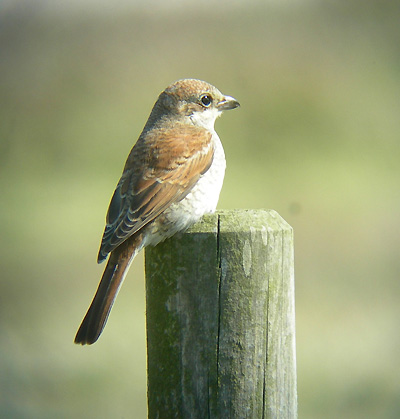

Red-backed Shrike
(Photo by Nick Upton)
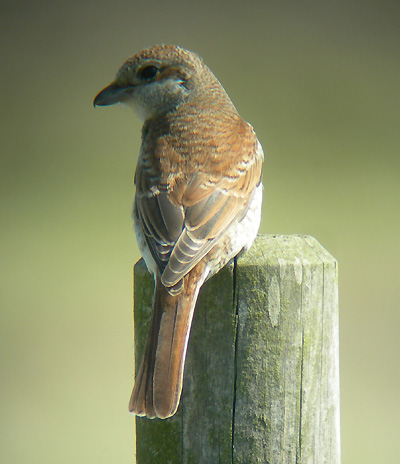

Red-backed Shrike
(Photo by Nick Upton)

Another very uncommon species that was present at Dungeness was a Great Egret, only the second I have seen in UK but a very common bird back in Thailand. However, several Marsh Harriers, a Hobby, a Sparrowhawk and a Sedge warbler were nice birds to see.

Seawatching
After leaving the RSPB reserve I spent an hour outside Dungeness nuclear power station watching sea birds on the warm water “patch”. In that brief time I managed to see a number of species that I haven’t seen for quite some time; these included 1 Arctic Tern, several Sandwich Terns, 1 Arctic Skua and 1 Great Skua but in the warm sunshine I started to feel sleepy so left for a cold drink.

Back on the Reserve
I had an hour left before I needed to go home so I went back to the RSPB reserve where I had heard a Black-necked Grebe had been seen. Sitting in a hide it didn’t take long to locate this bird which had only a little of its black neck remaining but it put on a good show. 2 Black Terns were also great to see and Ruddy Duck was another year tick for me.

All in all I had a really nice day at Dungeness and this is a really good time to visit. 5 Clouded Yellow butterflies were also really nice to see although rather frustrating as just as I was about to press the botton on my camera to photograph one, it flew away. That’s wildlife I guess.
tripreport-minla.jpg

Thailand Birding: Doi Inthanon Summit

  
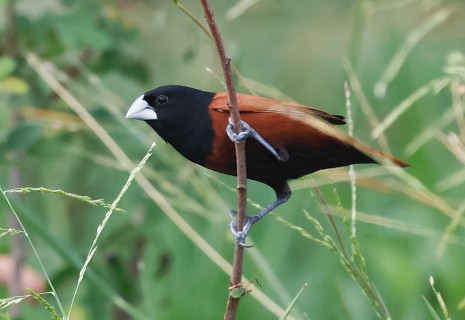
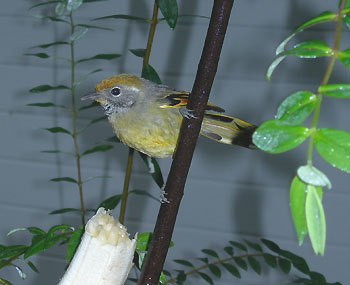
Chestnut-tailed Minla at summit of Doi Inthanon
(Photo by Nick Upton)

The summit of Doi Inthanon is one of my favourite birding spots in the world. There are a number of species which are specialities of the summit and most of them are fairly easy to see and can even be found in the worst of weather conditions – they are vitually guaranteed. The above photo was taken next to the coffee/hot chocolate hut next to the summit toilets. The people at the coffee stand put out bananas and the birds come to eat them, only a few feet away from where people are standing.

I was on the summit of Doi Inthanon in mid July with Robert King and the weather was terrible; strong winds, rain and cold. However, in two visits (both in the same conditions) we managed to see the following species:

Chestnut-crowned Laughingthrush
Chestnut-tailed Minla
Yellow-bellied Fantail
Ashy Woodpigeon
Ashy-throated Warbler
Davison’s Leaf Warbler
Green-tailed Sunbird
Snowy-browed Flycatcher
Pygmy Wren Babbler
White-browed Shortwing
Dark-backed Sibia
Flavescent Bulbul
Blue Whistling Thrush
Rufous-winged Fulvetta
Yellow-cheeked Tit

We ended up at the summit of the mountain when the weather further down was too poor for birding – at the top it was just a little better and as it is higher up there is more chance of a break or the sun buring the cloud off for a while. Certainly on our second visit we had about 10 minutes where the sun almost broke through and we had time to see the Ashy Woodpigeons and Green-tailed Sunbirds were encouraged enough to come out and feed on flowers in the garden at the top.

One thing about being at the summit of Doi Inthanon in the rain is that the elfin forest looks amazingly lush and the plants are wonderful covered in raindrops.

A full report of the 14 day trip around Thailand in July 2009 can be read here: Rainy Season Birding Tour of Thailand, 1st-14th July 2009.

klcpool.jpg

Thailand Birding: A Day in Petchaburi Province

Yesterday I met David Scott in Cha-am and we went on a tour of various habitats in Petchaburi province.

Dry Dipterocarp Forest at Khao Look Chang
Our first stop of the day was a patch of dry dipterocarp forest at a location called Khao Look Chang, it is right next to the Wildlife Friends of Thailand‘s Wildlife Rescue Centre and is protected by Look Chang Temple. Our first birds were a pair of Rufous Woodpeckers which were amazingly confiding and gave us an excellent start. I then went back to the car to get something I had forgotten and on the way back saw 2 Blue-winged Pittas. I alerted David to this and after a little searching we both got a good view. Read more »

hornbill.jpg

Thailand Birding: Wetland and Forest Birds in July

July is not the time of year that most birders plan a visit to Thailand but if it is the only time that is available it shouldn’t put you off. On 22nd July I visited wetlands at Muang Boran Fishponds, Bang Poo and Bang Poo Soi 119 with Mark and Jonty Hiley and it turned out to be a good visit too.

Wet Season Specialities
There are some birds that are just not around during the dry season or they are scarce and/or in drab winter plumage, but in the wet season they are easily found and/or in summer plumage. We enjoyed beautiful summer plumage Pheasant-tailed Jacanas, Javan Pond Herons, Asian Golden Weavers and Baya Weavers and also saw a couple of Black Bitterns and Oriental Pratincoles along with a male Watercock - these sights would not be available in the dry season, although one would see more species at that time of year.

Other Interesting Birds
Two Stork-billed Kingfishers at Muang Boran Fishponds were the morning’s highlight, but Yellow Bittern, Asian Openbill, Painted Stork, Collared Kingfisher, Golden-bellied Gerygone, Striated Grassbird, Bronze-winged Jacana, White-browed Crake and a flight view of Fulvous-breasted Woodpecker were all nice additions to the above mentioned species.

A real surprise was a female Thick-billed Pigeon in a low tree at Bang Poo which was obviously exhausted. Perhaps it had got caught up in a storm and blown from some forest quite distant from Bangkok.

Off to Khao Yai
At around 1pm we moved on to Khao Yai, arriving outisde the park at about 4pm. We did some birding outisde the park, seeing Red-breasted Parakeet, Black-collared Starlings on a nest, Coppersmith Barbet, Lineated Barbet, Ashy Drongo, Spangled Drongo and a female Plain-backed Sparrow but perhaps the best bird was a juvenile Mountain Hawk Eagle near the bat cave which we managed to get perched and viewable in the telescope.

Khao Yai
On the 23rd we entered Khao Yai national park. The entry fees now seem to be set at 200 baht for foreigners.

When spending just one day in the forest in the wet season the worry is that it will rain all day and there will be few birds, but apart from about 45 minutes rain in the monring we were lucky. The first sighting was an Asian Elephant feeding by the side of the road from the fire station lookout. We found out later that 2 silly people had stopped their motorbike and got off to take photos and were then attacked by the elephant. Luckily they got away unhurt but give some respect to these animals, they can be dangerous.


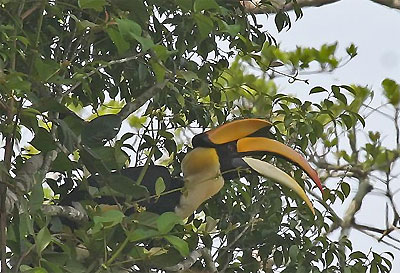
Great Hornbill
(Photo by Merl Arnot)

Although things were slow at times, patience and a positive attitude resulted in a lot of good sightings. the most enjoyable birds of the day were Great Hornbill, Oriental Pied Hornbill, Green Magpie, Laced Woodpecker, Black-and-buff Woodpecker, Red-headed Trogon, Orange-breasted Trogon, White-crested Laughingthrush, White-browed Scimitar-babbler, Green-eared Barbet, Moustached Barbet, Sultan Tit, Hill Myna, Golden-crested Myna and Thick-billed Pigeon, in fact it was a pretty decent list of birds, seen well, for just one day.

The journey back to Bangkok took about 3 hours.

, , , ,

Butterflies at Khao Soi Dao

At the end of April 2009 I spent a few days at Khao Soi Dao Wildlife Sanctuary in Chantaburi province. I was hoping to see any of the specialities of the site: Eastern Green Magpie, Blue-rumped Pitta, Siamese Partridge and Rufous-throated Fulvetta.

Unhappily I failed to get even a sniff of any of these birds and after rereading Charles Davies’s trip report it seems that one must get higher up the mountain for these birds.

Well, apart from no sign of any of those birds birding was good. Blue-winged Pitta was absurdly common and easy to see – I saw at least 10 different birds well. Other nice species that I saw were a male Banded Kingfisher, a couple of pairs of Banded Broadbills, Dusky Broadbill, Orange-breasted Trogon, 3 Pompadour Green Pigeons (lots of Thick-billed), Scaly-breasted Partridge and Black-browed Fulvetta.

Whilst I am always a birder first and foremost, what really made the trip (apart from nice accommodation and food) was the huge number of butterflies present.

I managed to creep up on only a fraction of the butterflies present as I have to get very close as I am only using a small compact digital camera (Nikon Coolpix 7600), but at one spot lots of butterflies were feeding on rotting fruit and this seemed to make them drowsy and more approachable – I guess they were getting drunk on the natural alcohol being produced as the fruit decomposed.

For those who are interested I have made a few updates on the Khao Soi Dao page of thaibirding.com, which include details of where I stayed: Khao Soi Dao and the identity of most of these butterflies. 

, , , ,

pitta_eared_6907.jpg

Thailand Birding: Eared Pitta Photograph

Sometimes when you are birdwatching, you just get lucky.

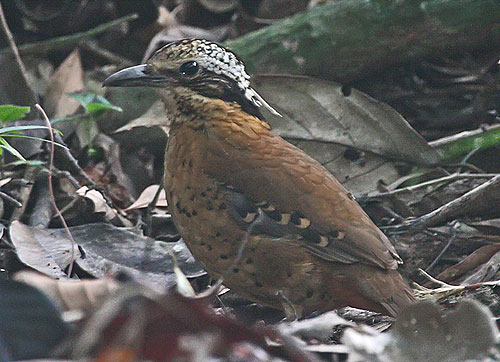
 One morning in March I was birding at Khao Yai National Park with Merl & Marty Arnot and it seemed that our luck was out with light but persistent rain and poor visibility. After watching a number of common birds like Black-naped Oriole, Green-eared Barbet, Asian Fairy Bluebird and Scarlet Minivet, I suggested a walk on the loop trail near the old HQ where I had seen Eared Pittas before.

Excellent Views of Male and Female Eared Pittas
We had walked only about 400 metres along the trail when a brownish bird flew from the ground along the trail in front of us and luckily landed within view. All three of us managed to get an excellent view of a female Eared Pitta, foraging around in the undergrowth. After some time I heard more rustling around a short distance away and saw the male. We watched both birds at a distance of about 10 metres for roughly 10 minutes before Merl asked if he could get closer for a photo. Given the light and the fact that he would have to be very close I didn’t think there was much chance but the Pittas didn’t seem concerned by us so I told him to go ahead.

The Photo
Merl sneaked forward a step at a time and unbelievably got to within about 5 metres of the male Eared Pitta. Even so, with the poor light conditions, the fact that Merl was not using flash and that the Pitta was constantly moving its head as it foraged I thought the chance of a decent shot was very slim indeed. Then, as if on cue, the Pitta froze, totally motionless, allowing Merl to get a photo even in very low light conditions – amazing.

Here is the photograph.

, , , ,

ky_whitebandedhedgeblue.jpg

Thailand Birding: Khao Yai in the Wet

Khao Yai national park is one of the busiest national parks in Thailand and at certain times (typically public holidays in the dry season) it can get uncomfortably busy. However, it was lovely to visit the park in mid May this year (16th-18th) and to see the park with very few other people around.

Now, very few birders make the trip to Thailand in the wet season and it is certainly true that a dry season visit will produce many more species, but I actually find the wet season very good for birding in the forest and this trip lived up to that.

In fact it wasn’t really wet at all with only about 1 hour’s birding being lost to rain.

Birds such as Red-headed and Orange-breasted Trogon were easy to find and broadbills were very vocal so it didn’t take much effort to see Banded, Silver-breasted and Long-tailed Broadbills in one morning. Lots of other resident species were abundant and easily seen, species like Thick-billed Pigeon, Moustached Barbet, Green-eared Barbet, Oriental Pied Hornbill, Green Magpie etc were all nice. One of the highlights, as ever, were fantastic views of Great Hornbills. I have seen this species 100s of times but it is still always a highlight of any trip for me.

Another couple of nice birds which I wouldn’t really expect to see outside the rainy season were a Stork-billed Kingfisher at Pa Gluyai Mai campsite and 3 Hooded Pittas in a territorial dispute.

Other Wildlife

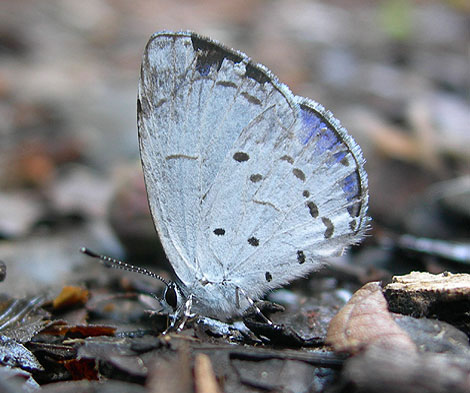
Apart from an abundance of birds, this trip also turned up a lot of other wildlife, including this  White-banded Hedge Blue butterfly above which was feeding on rotting fruit.

The wet season is the best time to see elephants at Khao Yai and sure enough there was one sub adult at a salt lick by the side of the road one evening. The commonest mammals at Khao Yai are Variable Squirrel, Pig-tailed Macaque, Sambar, Muntjac and Cambodian Striped Squirrel and these were frequently seen. Other mammals that I saw included Yellow-throated Marten, Common Palm Civet, Golden Jackal, Grey-bellied Squirrel and a fantastic White-handed Gibbon laying back on branch taking an afternoon nap.

For the real wildlife enthusiast there were a whole range of lizards all around, including some water monitors and a wonderful python on the road one night.

All in all you shouldn’t let the rainy season put you off of visiting Thailand for birdwatching, although the leeches were quite voracious!

, , , ,

Free WordPress Themes