shama.jpg

Thailand Birding: A Strange place to Nest

 
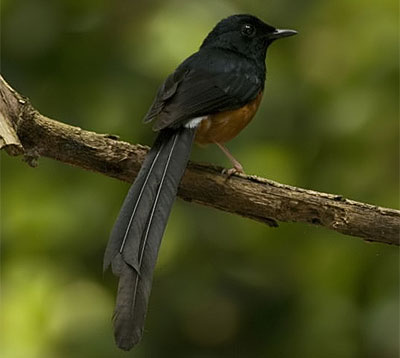
Male White-rumped Shama by Alex Vargas

A few days ago I received this interesting message from Bob Harwood. 

A couple of months back one of the employees at Khao Soi Dao Wildlife Sanctuary pointed to a White-rumped Sharma hanging around the office, and told me it had a nest in the glove box of the rubbish truck there. The truck was in use at the time, a few hundred metres away, and I went and looked at the nest, which had some eggs in it (2 or 3, I think). The truck is parked in front of the office when not being used, and the windows are down (I think they are broken). It appears the bird wasn’t bothered about it’s nest travelling all over the place each day! I never got an opportunity to check what happened after that, but thought I’d ask you if that is unusual or not.

Whilst I am unable to confirm whether this is unusual or not, I suspect that it is not as I have heard many similar tales of nesting by Robins and Blackbirds in UK in vehicle engines and other ridiculous places; considering these species are related to Shamas it would suggest that this behaviour is a characteristic of birds in this group of species.

It certainly creates an amusing picture in my imagination of the female Shama riding around in the nest all day as the truck is in use.

, , , ,

akbutterfly.jpg

Some Butterflies of Thailand

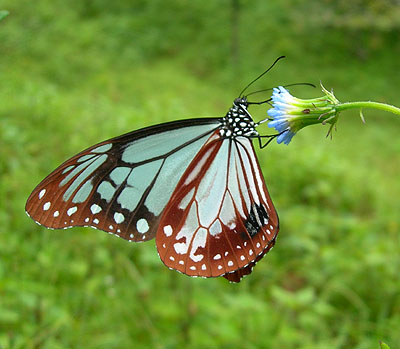
I have recently returned from a trip which took me to Kaeng Krachan and Chiang Mai, which explains why I have not written recently. There will be a couple of trip reports and other notes to follow but for now I have a couple of galleries of butterflies to display.

Photographing butterflies in the wet season proved far easier than in the dry season. The lower amount of solar energy would explain this, making the butterflies sluggish and less prone to flying away; of course, casting little or no shadow also helps get close at this time of year.

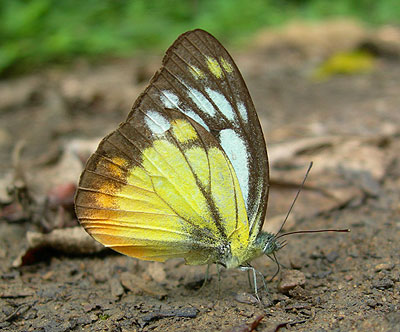
Here is one of the best pictures I obtained at Kaeng Krachan, followed by a few thumbnails of some others.

The following is the best butterfly photo I got at Doi Ang Kang. It was easy to creep up on this butterfly as it was very sluggish after a brief rain shower.  

The thumbnails that follow were also taken at Doi Ang Kang in July and they include a photograph of a bee.

, , , ,

Thailand Birding: Bang Pra in the Morning

On 8th July Andrew Ley and I took a trip to Bang Pra to look for the specialities of that site and just to take in a wide variety of birds.

Leaving Bangkok at 5am saw us arrive at Bang Pra at a little after 6am, at which time birds were very active. It didn’t take us long to find a Greater Racket-tailed Drongo making a noise and a couple of Lineated Barbets performed very nicely by perching on a dead tree. In the early morning it is easy to find birds around the small lake and regular species such as Racket-tailed Treepie, Yellow Bittern, Common Iora, Yellow-vented Bulbul, Little Cormorant are always much in evidence and they didn’t disappoint this time either.

Woodland Birds
Bang Pra has a decent expanse of fringing woodland and although birding was a little slow we found a good selection of species for this habitat throughout the morning. We had good views of Laced Woodpecker twice, lots of Rufous Treepies, a number of Greater Racket-tailed Drongos, a Green-billed Malkoha, 2 Black-throated Laughingthrushes, a group of White-crested Laughingthrushes, an Asian Barred Olwet, Brown-throated Sunbird and Olive-backed Sunbird.

One thing I always like about a visit to Bang Pra is that a good number of large and showy species are often seen, as the above list proves. This is not confined to the woodland however.

Waterbirds
In the winter months a number of shorebirds can be found at this site. In July, though, only resident species are available to birders. We found Yellow Bittern, Cattle Egret, Great Egret, Little Egret, Javan Pond Heron, White-throated Kingfisher, Little Cormorant, Black-winged Stilt, Red-wattled lapwing and Oriental Pratincole. In addition to these we found 3 Painted Storks and had 7 Spot-billed Pelicans fly in and land on the water before taking off again.

The storks and pelicans at Bang Pra originate from Khao Khieo open zoo, about 10 km away, but both species have set up breeding colonies outside of the zoo and have existed as wild birds for many years. Many birders in Thailand don’t count these birds but it depends on the criteria one uses for “ticking” a bird. In my opinion these 2 native species, which were both virtually extirminated from Thailand, have lived independently of the zoo for long enough to be included on my lists: if they had been purposely released at Bang Pra we would call it a successful reintroduction so I think their presence should be celebrated. Whether one includes them as wild birds or not, the sight of them is impressive none the less.

Grassland Birds
The grassland habitats at Bang Pra are very productive for birdwatchers. Andrew and I found both Indochinese and Australasian Bushlarks, Paddyfield Pipit, Zitting Cistiocola, Bright-headed Cisticola, Green Bee-eater, Chestnut-capped Babbler, Yellow-bellied Prinia, Plain Prinia, Long-tailed Shrike, Hoopoe, Scaly-breasted Munia and Ashy Woodswallow in these habitats.

This used to be an excellent place to easily see quail but one has to look harder now, although they are still present. We spent a lot of time trying to track down calling male Chinese Francolins (which are common here and make a rather maniacal call), but eventually got good flight views of a female. We also flushed a Barred Buttonquail which we didn’t see well but I could identify from its dark colouration and bright buffy undertail coverts.

By 11am we were both very tired having done a lot of walking and extremely hot: Bang Pra is always a very humid and hot location. We were lucky in that the sun stayed behind the clouds, so were spared the direct sunlight, but humidity was, as always, close to unbearable.

Having seen an excellent selection of birds we returned to Bangkok, making the trip in little over an hour.

, , , ,

pitta.jpg

Thailand Birding: Blue-winged Pitta

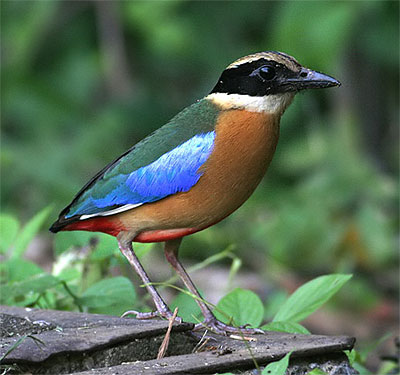
Blue-winged Pitta is a wet season breeding visitor to most of Thailand and its distinctive call can be heard in June and July.

Peter Ericsson sent me a link to some photographs that he recently obtained of Blue-winged Pittas; they are superb and definitely worth a look. Here is one to whet the appetite but take a look at the whole gallery: Blue-winged Pitta.

, , , ,

bayaweavernest.jpg

Thailand Birding: Bang Poo Soi 119, Bang Poo & Muang Boran Fishponds

On the 7th July I paid a visit to the Bang Poo Soi 119, Bang Poo and Muang Boran Fishponds with Andrew and Beth Ley from Australia. They were on a 2 day stopover on their way home from London and I collected them from the airport and we headed straight to Bang Poo Soi 119, arriving at about 8.20am. It has to be said that a 12 hour flight from London is not the best way to prepare for a day’s birding in the heat, but they got lucky with the weather and cloud kept things a lot cooler than usual.

Bang Poo, Soi 119
Our first stop in front of the university campus was by far the most productive of the day with a good selection of waterbirds. First birds of the day were a couple of lovely Pheasant-tailed Jacanas which were viewed at close range. On closer inspection around a dozen of this species could easily be found. These were swiftly followed by a number of Bronze-winged Jacanas which although they were more numerous were harder to get a good view of as they crept around in the vegetation.

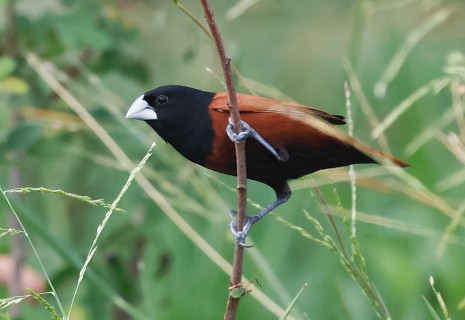
Our tactic here was just to stand near the car and wait for what would reveal itself. In all, we probably spent about 1 hour at this spot and obtained good views of a nice variety of species including Cotton Pygmy Goose, Javan Pond Heron (which by now has very worn plumage), Cattle Egret, Little Egret, Little Cormorant, Yellow Bittern, Black Bittern, Long-tailed Shrike (including a juvenile begging adults for food), Plain Prinia, Baya Weaver, Asian Golden Weaver, White-breasted Waterhen, White-throated Kingfisher, Indian Roller, Chestnut Munia, Barn Swallow, Asian Palm Swift, Asian Pied Starling and Red-wattled Lapwing.

After squeezing all the species we could from this spot we moved along to a spot where a Baya Weaver colony is right next to the road. Stopping here we admired the beautiful nests with at least 3 males busy weaving away. I took a couple of photos of the nests, the best one is below.
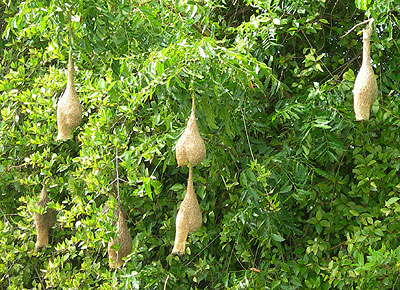
Getting back into the car a Fulvous-breasted Woodpecker flew across the road, a nice addition to my list for this location.

As we cruised around looking for other bird hotspots things quitened down and it was tricky to find new birds. Baya Weavers were everywhere and we saw common species such as Red Collared Dove, Spotted Dove, Oriental Magpie Robin, Streak-eared Bulbul and Great Egret along the way. At this location Asian Openbill Storks are very common and we saw plenty of them circling on thermals, in fact one group easily numbered more than 1000 birds!

Struggling to add Koel, Black-winged Stilt and Scaly-breasted Munia to our list we moved back towards the university and stopped at a different set of pools. Here we found more Jacanas and a nice White-browed Crake – a bird which seems unusually common in this area. We also found a squeeky Pied Fantail lurking around a building and a pair of Scaly-breasted Munias feeding on ripe seeds. Striated Grassbird is usually easily found at this location but on this occasion we had to wait about 3 hours for our first sighting, but fortunately one flew in and landed right in front of us – a good view of one of my favourite species. However, the most noteworthy bird we saw was a single flyover Whiskered Tern in very worn breeding plumage; a failed breeder I would presume.

Lunch at Bang Poo
With a decent haul of birds we headed to nearby Bang Poo for some lunch at the excellent seafood restaurant at the end of the pier. We scanned the mudflats for early returning shorebirds and amongst the many Javan Pond Herons and Little Herons we found 2 Lesser Sand Plovers; early returning birds or birds that didn’t migrate?

For the record, this was what we ordered;

  • Deep fried Snapper in garlic
  • Crab fried Rice
  • Shrimps in sweet chilli sauce
  • Fried chicken and cashew nuts
  • 2 bottles of coke
  • 1 bottle of water
  • 2 glasses of lemon ice punch

This came to a total of 610 baht, a little under £10!

Muang Boran Fishponds
After this excellent lunch we drove out to Muang Boran Fishponds for a short time but as Andrew and Beth were both starting to feel the effects of their long flight we didn’t stay long – long enough though to see plenty of birds: Pheasant-tailed Jacana, White-browed Crake, Little Grebe, Little Cormorant, Yellow Bittern, Oriental Pratincole, Bronze-winged Jacana, Large-billed Crow, Javan Pond Heron and White-breasted Waterhen amongst others.

With these species satisfying everyone’s needs I dropped Andrew and Beth off at the Avana Hotel, Bang Na for a much-needed rest.

, , , ,

Thailand Birding: Kaeng Krachan & Tung Bang Jak

I took another trip out to Kaeng Krachan National Park on the 4th and 5th July with a couple of American birders. Whilst birding was very slow, we did see some really good species. In fact Kaeng Krachan always seems to produce something really good although it can be hard to predict exactly what will be seen. On this visit we did not see any Black-crested Bulbuls which are possibly one of Thailand’s most common species whereas we did find some of the much rarer birds.

I have written a trip report for this short stay – Kaeng Krachan & Tung Bang Jak, 4-5th July 2008 – which includes the afternoon we spent at the nearby wetlands as the frustration of few birds in the forest drove us to a more productive habitat.

Highlights of the trip included Collared Falconet, Black-thighed Falconet, Great Slaty Woodpecker, Black-backed Kingfisher, Red-bearded Bee-eater, Crested Jay, Black-and-red Broadbill, Banded Broadbill, Silver-breasted Broadbill, Green Magpie, Streaked Weaver, Asian Golden Weaver, Greater Painted Snipe and Pheasant-tailed Jacana.

In total we saw 108 species – a very good selection of birds, particularly for the wet season when there are fewer birds present in Thailand.

, , , ,

pigeon.jpg

Thailand Birding: Huay Kha Kaeng

The Wildlife Sanctuary of Huay Kha Kaeng is one of the most pristine forest habitats in mainland Southeast Asia and part of Thailand’s extensive Western Forest Complex. However, amongst travellers it is little know and few birders have tapped into the huge potential for birdwatching this location has. With this in mind it was interesting to receive an e-mail from Peter Ericsson with a short trip report on his recent visit to this site.

I have reproduced the trip report here – Huay Kha Kaeng – on thaibirding.com in an attempt to collect all the resources for birdwatchers in Thailand in one location, but the report can be seen in its original format with photographs here: Huay Kha Kaeng.

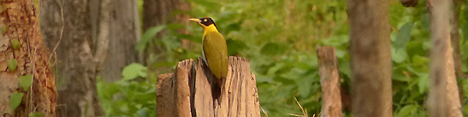
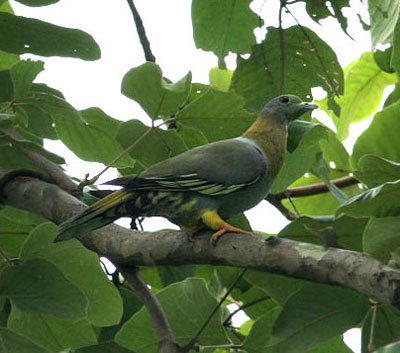
Some of the highlights from Peter’s trip were Yellow-footed Pigeon, Black-headed Woodpecker, Collared Falconet, Blue-winged Pitta, Black Baza and Red-billed Blue Magpie.

Free WordPress Themes