
Shells from Hat Chao Samran

Whilst lazing around on the beach last week at Hat Chao Samran I decided to expand my skills as a naturalist and go shell collecting! The only issue constraining this self-improvement is my complete lack of any book to help me identify what I found.

Quite an amazing variety of shells were easily found on the various strandlines on the beach. Many of the shells were tiny or just fragments of larger shells, but here is a gallery of the complete shells that I collected in about 30 minutes.

Fortunately, I have a contact for shells – Pam Piombino. She kindly sent me the following information on the above collection with the caveat that she was working from memory, without the benefit of her books so that if anyone has anything to add or any corrections please post your remarks here.

“From left to right:Row 1: First two shells are from the large family Turridae, known by the notch at the top of the aperture. The genus might be either Inquisitor or Liphiotoma. Species, I don’t have a clue. 3rd. shell a bivalve, that I would guess is in the family Luncinidae, another large group. 4th shell: Family PlicatulidaeRow 2: First shell: Family Arcidae, perhaps Anadara antiquata. 2nd shell: Family Arcidae, perhaps Anadara natalensis?? 3rd shell perhaps family Mactridae? 4th shell: Family Muricidae, genus Murex, species ??Row 3: 1st shell: Family Turritellidae, Genus probably Archimediella. 2nd shell: Family, Architectonicidae, perhaps Architectonica stellata??? 3rd shell: Family Marginellinae? 4th shell: Family Fissurellidae: Genus, Diadora  species maybe ruppellii.

Row 4: 1st shell, Family Naticidae. 2nd shell: Family Cerithiidae, Genus?. 3rd shell: Two different species, not sure without seeing teeth. 4th shell: Family Cardiidae

Row 5: Last shell, Family Plicatulidae”

Pam also gave this sensible piece of advice.

“If you are going to spend some time trying to find shells, please be aware that there are several members of the Conus family that can kill you. Please look up pictures of: Conus geographus, C. textile, C. striatus, C. quasimagnifucus, and C. aulicus. Never, ever handle these unless you are sure they are very dead. There is no safe way to pick up a living member of these species as they have a harpoon that can bend to any angle to stab you. If I see a fresh one on the edge of the water or on the beach, I get a stick and make sure that the animal inside is gone. “
, ,

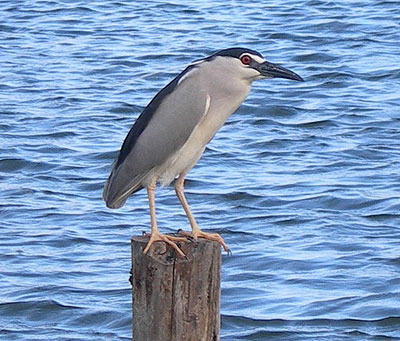
nightheron.jpg

Thailand Birding: Hat Chao Samran, The King’s Project and Cha-Am

At the weekend my wife and I took a trip to the beach at Hat Chao Samran, in the Laem Pak Bia area. Now, this was never supposed to be a birding trip but I take my binoculars everywhere so I can grab any opportunity to look at something with feathers.

Beach Food
A short drive up the beach from the main parking area at Hat Chao Samran takes one to a small selection of seafood restaurants that spill onto the beach itself. The food in most of these shops is good and fairly cheap, so my wife and I decided to spend the afternoon stuffing our faces and sitting on the beach.

Out to sea a number of Little Terns were fishing, including a number of juveniles. One bird I watched caught a fish and flew up high with it before tossing it into the air. As the fish fell, the tern caught it again in mid air and performed the same trick twice more; interesting behaviour. Other birds from the beach included Little Egrets, Red Collared Dove, Blue-tailed Bee-eater and an unidentified Accipiter.

The King’s Project
After about 4 hours of eating, napping and reading it began to cool down a little and I suggested a drive around the King’s Project area to see some birds. This spot is always packed with birds and they can be approached very closely in the car. At this time of the year it was mostly only common species to be seen, but they make quite a sight at only a few metres distance. Even a photography dullard like myself can get some interesting shots by sticking a compact digital camera out of the car window and randomly pressing the button.

With this series of pictures I put the camera on action mode and held down the botton. Okay, so they aren’t the best Little Cormorant pictures you will ever see but I like the effect of the series of shots – a bit like one of those flicker books kids make.

As we left the King’s Project the rain began which made a couple of football-playing monks run away for shelter. Both of us felt like staying so we decided to head to Cha-Am to find a hotel and some bars and restaurants for the evening.

Cha-Am
My advice would be forget Cha-Am as a destination for anything. The beach road is overdeveloped, the beach not so great and at this time of year it was dead at night. With such a huge number of places to stay and hardly anyone there we easily found a reasonable room with air-con for 500baht. I have heard that the tourist industry is suffering in Thailand and I would suggest that it because of rampant overdevelopment, flooding of the market with poor quality resorts and services and the fact that many of these beaches just are not nice at all.

Despite this we had a pleasant evening and in the morning Blue-tailed Bee-eaters were abundant in the trees along the beach and a pair of White-rumped Munias were in the hotle car park. At the far north end of the beach there was a group of 7 Pacific Reef Egrets – 1 dark morph and 6 white.

, , , ,

sunbird3.jpg

Thailand Birding: Olive-backed Sunbird


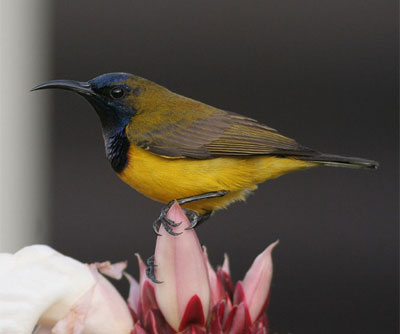
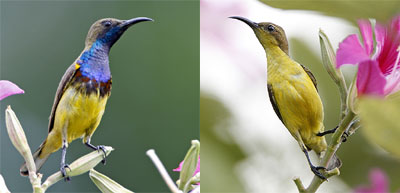
Male & female Olive-backed Sunbirds by Johan Svensson

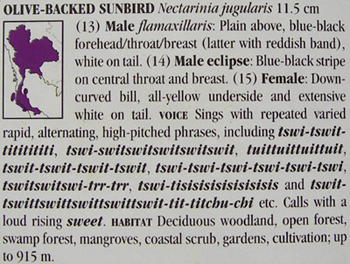
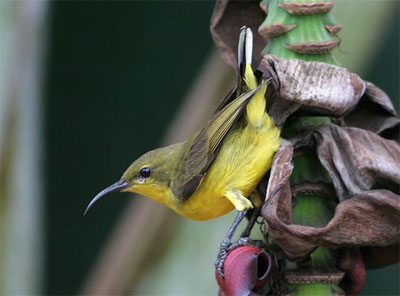
Olive-backed Sunbird (Nectarinia jugularis) is one of those species that gets widely overlooked when birdwatching in Thailand; it is small, it is not particularly colourful (although the male is attractive enough) and it is commonest in habitats such as parks and gardens in which birdwatchers don’t spend much time. It is, however, quite remarkable for its adaptability, being found in virtually all habitats from mangroves, to forest edge: in fact, Olive-backed Sunbird is so ecologically tolerant that it is common even in plantations and cities, making it Thailand’s most abundant and widespread sunbird as this range map and accompanying text from A Field Guide to the Birds of Thailand indicate.

Olive-backed Sunbird in Bangkok’s Parks
For those intending a birding vacation in Thailand, Olive-backed Sunbird is almost certainly going to be seen, but it is by visiting a park that the best and most protracted views are likely to be obtained, where the species is very common: Lumphini Park, Suan Rot Fai and Suan Luang in Bangkok are all good places to study this interesting little bird. 

Olive-backed Sunbird in Gardens
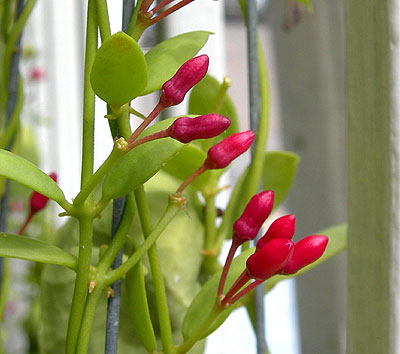
Olive-backed Sunbird takes nectar from flowers, as the scientific name suggests, as well as taking insects from leaves and spider’s webs and it is interesting to see that it pierces the base of the flower to “steal” the nectar rather than taking it from the flower’s aperture and effecting pollination. I quite often get the opportunity to watch this interesting behaviour as I have my breakfast in the morning when a pair of Olive-backed Sunbirds visit some flowering plants in our yard; sometimes it feels like we are having breakfast together. The flowers they favour in our yard are tiny, clustered affairs that don’t seem to have an opening and piercing the flower is the only way for the sunbirds to get in to the nectar.


Sunbird-attracting Flowers by Nick Upton

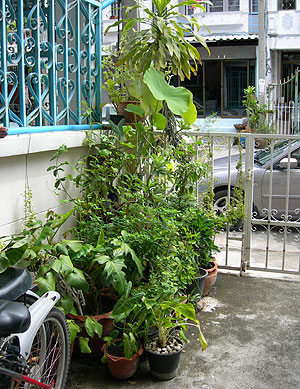
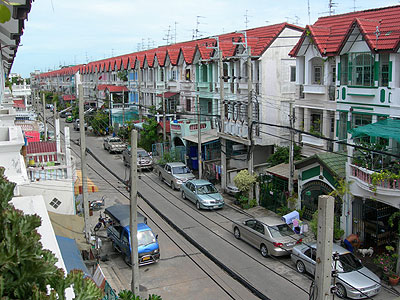
In fact that Olive-backed Sunbirds make it into our tiny front yard at all is proof of how ecologically tolerant the species is: we have a small corner filled with pot plants in a street where the only vegetation is in the form of similar collections of pot plants in people’s yards and balconies. The area I live in is quite built up but there are a few areas of wasteland and fruit orchards remaining within a few hundred metres or so, however, this pair of sunbirds nests in a neighbour’s yard and seem to spend their whole time in this one street.


The small collection of plants in my yard that attracts sunbirds


The street I live in along with a pair of Olive-backed Sunbirds

The two above photos give some idea of how adaptable Olive-backed Sunbirds are in their habitat requirements: this is one of the few species that, happily, can live alongside humans in urban areas. Species such as this are important in connecting city dwellers with nature; this pair have certainly engaged my wife’s niece and nephew who wait for the sunbirds to appear on Saturday and Sunday mornings.

Observing & Photographing Olive-backed Sunbird Behaviour
Rather unusually for a small bird, Olive-backed Sunbird’s usual cluth size is just 2; one would assume that the energy expended in collecting enough nectar and insects for more than two young would push the parents beyond their limits of endurance. The nest is an untidy but complicated sac which hangs from vegetation and can frequently be found in gardens in Bangkok – the abundance of this species would certainly make it an interesting subject for armchair ornithologists to study: certainly photographers find it a good subject as these lovely photos by Peter Ericsson prove.


Female Olive-backed Sunbird by Peter Ericsson


Male Olive-backed Sunbird by Peter Ericsson

For more photos of Olive-backed Sunbird check out Johan Svensson’s beautiful collection of pictures of this species: Olive-backed Sunbird.

Those interested in learning much more about Olive-backed Sunbird and other sunbirds should get hold of a copy of Sunbirds: A Guide to the Sunbirds, Spiderhunters, Sugarbirds and Flowerpeckers of the World (Helm Identification Guides), it is available for less than £10 ($20).
Acknowledgements: Some of the information here comes from Phil Round’s book The Birds of the Bangkok Area.

, ,

Slaty-backed Gull

Gulls of Europe, Asia and North America by Klaus Malling Olsen & Hans Larsson

Having recently discussed the addition of Slaty-backed Gull to the Thai list, it seems only natural to talk about Gulls of Europe, Asia & North America which attempts to deal with all the races of large gulls that have caused so much confusion over recent years, as well as all the other, more well-understood gull species. Gull taxonomy is a confusing subject to most birders, indeed many birders just don’t care but I would sugggest that trying to get to grips with difficult species and plumages of gulls is a good way to improve birding skills as well as lend another way to find interest in birds which are often disregarded as common and unintersting.

If you want good reference material to help you enjoy and identify gulls then this book is excellent. Read more »

latestadditionsgull.jpg

Thailand Birding: Additions to the Thai Bird Checklist

Craig Robson’s Field Guide to the Birds of Thailand, published in 2002 did a great job of updating older field guides, particularly with the inclusion of species which had been added to the Thai list since publication of Lekagul & Round’s Guide. However, since then even more species have been added, so many that the Robson guidebook is beginning to look rather out of date already. A revised version of lekagul and Round is available in Asia Book Stores in Thailand which depicts many of the most recent additions to Thailand’s avifauna, but for non Thai readers, the bad news is it is only available in Thai – still, the pictures and range maps are clear enough for all.

On thaibirding.com I keep a list of the newest additions that I know of here: Recent Additions to Thai Checklist, there are notes on all the species mentioned.

The most recent addition is Slaty-backed Gull; read more about its discovery in Thailand here: Slaty-backed Gull.


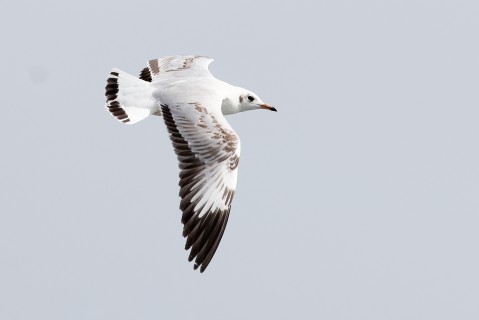
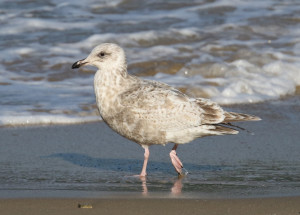
1st Winter Slaty-backed Gull by Alex Vargas

The additions to the Thai checklist since the publication of Robson, as I know them, are:

  • Pallid Harrier
  • Long-tailed Wren Babbler
  • Chestnut-cheeked Starling
  • Mew Gull
  • Greater Scaup
  • Isabelline Wheatear
  • Demoiselle Crane
  • Red-headed Bunting
  • Red-billed Starling
  • Lesser Black-backed Gull
  • Grey Phalarope
  • Large-billed Reed Warbler
  • Grass Owl
  • Mekong Wagtail
  • Spotted Wren Babbler
  • Little Gull
  • Mongolian Gull
  • Black-necked Grebe
  • Long-tailed Duck
  • Slaty-backed Gull

For more information on the additions take a look at the annotated list here: Recent Additions to Thai Checklist.

, , ,

dragonfly3small.jpg

Dragonflies

Sometimes it is nice to broaden ones appreciation of nature; it is all too easy to become too focused on birding in Thailand with so many species to find; so whilst counting waterbirds at Muang Boran Fishponds on Saturday I found some time to try some photos of the dragonflies and damselflies that are so abundant there. I saw at least 4 species but only managed to get photos of a couple.

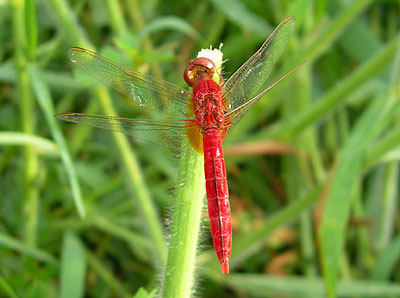
One species of bright yellow dragonfly was especially numerous and extremely active and unapproachable, leaving me with just one semi-okay picture, but another species was much easier to get close to and photograph.

Below is one of the better pictures I obtained followed by thumbnails of some others of varying quality.

  , ,

Thailand Birding: Wet Season Waterbird Count

Whilst waterbird counts are conducted in midwinter in Asia through the Asian Midwinter Waterbird Census, the numbers of waterbirds present in the wet season doesn’t seem to attract much attention in Thailand. Having been visiting Muang Boran Fishponds for years I am fully aware of the large numbers of waterbirds present but having read more on the subject, the possibility of it holding significant numbers of some species appeared to me.

On Saturday 7th June I visited the site with the express purpose of counting waterbirds. The full results can be seen here along with some other notes on the observations: Waterbird Count at Muang Boran Fishponds.

The highest numbers were recorded for:

  • Cattle Egret – 91
  • Indian Cormorant – 83
  • Little Grebe – 72
  • Pheasant-tailed Jacana – 66
  • Bronze-winged Jacana – 65
  • Little Cormorant -61
  • Javan Pond Heron – 54
  • White-browed Crake – 47

Further counts will be conducted over the next few months.

Other Birds
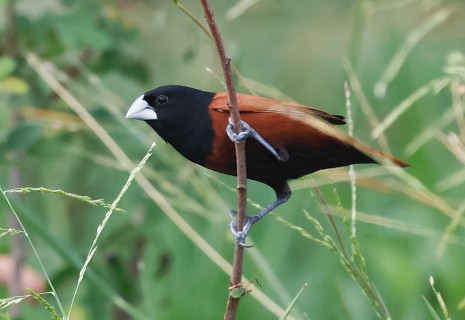
Whilst I focussed my attention on waterbirds, it would take a particularly tunnel-visioned birder not to notice other species. On this visit I saw a total of 50 species in just over 4 hours, with some of the nicer ones being 9 Asian Golden Weavers, 1 Chestnut Munia, 12 Striated Grassbirds, 1 immature Brahminy Kite and juveniles of Oriental Pratincole and Black-winged Stilt.

A couple of birds were of interest due to their timing. 1 Barn Swallow was seen as was a singing Oriental Reed Warbler. Neither of these is normal at this time of year, but neither are they unprecedented; small numbers of Barn Swallows can be found year-round and there are a couple of other rainy season records of Oriental Reed Warbler.

, , ,

Free WordPress Themes