bangpra.jpg

Thailand Birding: Quick Visit to Bang Pra

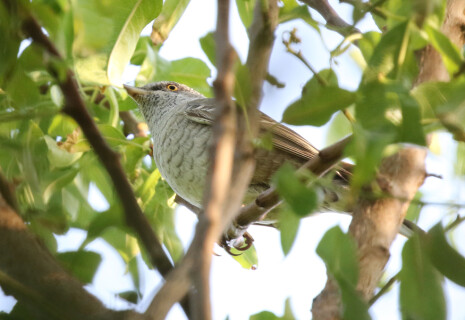
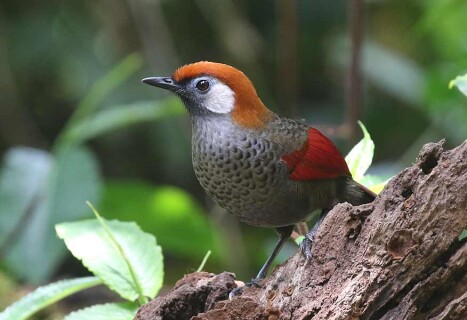
On the morning of 5th June I joined Gabby and Alex Vargas for a trip to Bang Pra in Chonburi province in the hope of finding some Quail. Unfortunately, we arrived rather later than hoped which reduced our chances of finding these tricky birds due to the human disturbance that had already begun. However, in the fringing woodland we managed to find 2 Asian Barred Owlets, a pair of Rufous Treepies feeding young, several Greater Racket-tailed Drongos and a group of splendid White-crested Laughingthrushes: Bang Pra is one of the easiest places to see this common but secretive bird.

Finding Quail
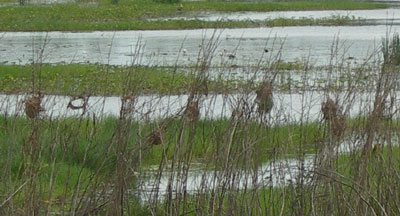
Rain Quail, Barred Buttonquail, Yellow-legged Buttonquail, Small Buttonquail and Blue-breasted Quail all occur here, but seeing them is becoming increasingly difficult due to severe habitat degradation. Raised water levels, over grazing, over use by locals and vegetation compaction by birdwatchers’ vehicles has seriously reduced the amount of quail habitat at this site. The below picture illustrates the poor condition of grassland and marginal habitat.
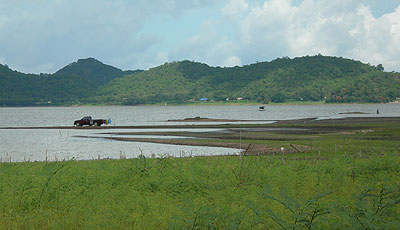
Even with these problems it should be possible to find some of these species by walking around the grassy areas and scanning amongst the vegetation for the birds coming out to feed. Listening out for the call of the Rain Quail is also a good tactic. However, it takes some considerable effort and in the heat and humidity at Bang Pra it can be difficult to persevere; this was the case on this occassion and after a few Indochinese Bushlarks, a single Australasian Bushlark, Zitting Cisticolas and Paddyfield Pipits enthusiasm was low. Patience, perseverance and tolerance of extreme heat and humidity are the keys to finding difficult birds in Thailand so that our brief stroll only produced common birds such as Oriental Pratincole, Great Egret, Little Egret, Black-winged Stilt and Red-wattled Lapwing.

Large Waterbirds
A number of large waterbird species are present at Bang Pra, either feral colonists from the nearby zoo or as releases from the nearby waterbird breeding facility. On this visit we saw a single Spot-billed Pelican circling in the sky and 5 Painted Storks in the shallow water, both of these species have established breeding colonies after escaping from the open zoo at Khao Khieo.

Other good waterbirds seen in the past include Oriental Darter and Malayan Night Heron but on this trip we had to settle for the common birds such as Little Cormorant and Cattle Egret; we did get some nice views of Yellow Bittern however.

Some Common Birds at Bang Pra
Leaving Alex in the car to recover from the heat, Gabby and I walked along a trail to see what we could find. In fact it amounted to very little as by this time it was 10am – hot and low on bird activity. We found a number of the more common birds for the location:

  • Long-tailed Shrike
  • Sooty-headed Bulbul
  • Streak-eared Bulbul
  • Plain Prinia
  • Common Iora
  • Green Bee-eater
  • Green-billed Malkoha
  • Spotted Dove
  • Peaceful Dove
  • White-throated Kingfisher
  • Asian Pied Starling
  • Common Myna
  • White-vented Myna
  • Pied Fantail
  • Greater Coucal
  • Oriental Magpie Robin
  • Yellow-vented Bulbul

We did find a few less common species too, an immature Chinese Sparrowhawk was most impressive, perched in a tree consuming prey before flying away and a few Brown-backed Needletails amongts the House Swifts and Asian Palm Swifts, soaring overhead.

This relaxed pace did give me time to take a few photographs of the habitat at Bang Pra.

With that we found it was time to leave for some food and refreshment. Arriving late, walking very little and leaving early is not the best policy for birdwatching in Thailand but with so many birds available it is always possible to see something of interest.

Thailand Bird Photographs

Another interesting e-mail arrived in my inbox today, this time from Alex Vargas to let me know that he had spent some time updating his photo galleries on pbase.

Alex has a growing gallery of not only Thai birds but others from around the world. However, his Thai birds photo gallery is the one I spent most time looking at and he has some really nice photos of some really nice birds. Of course, the nature of birdwatching in Thailand means that he still has many species to add to his catalogue, which should allow him to maintain an interest for a long time to come.

I have reproduced here a few of Alex’s photos of birds of Thailand.

Take a look at all of Alex’s photos: http://www.pbase.com/alex_vargas

, , , ,

attacked-female-common-koel.jpg

Koels Attacked at Viang Yonok – Just a Myna Incident!

Excuse the terrible pun but I just received a very interesting e-mail from Ian Smith, of Viang Yonok Hotel in Chiang Saen, which I thought I would share. 

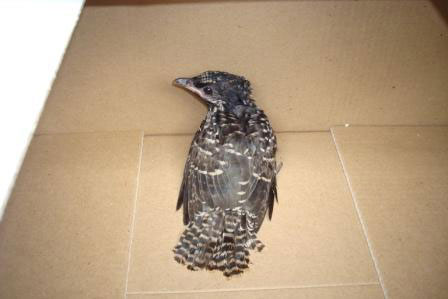
We have noticed how agressive the Common Mynas are. Every day they dive bomb one of our cats when she walks out into the garden. At first we thought it was just because she was in the vicinity of their nest, even though this is high up in the roof our our entrance gateway. Then this got worse until they divebomb her wherever she is in the garden. They even do it to the dogs sometimes. 30 minutes ago, our gardener came running with a female Koel which was being attacked by two Mynas. He rescued her and I’ve put her in a cardboard box for a couple of hours. A male was also attacked but is still in the tree.

Here are the two pictures Ian sent me.

 What is the Explanation for this?

These two birds appear to be juveniles, the first a male and the second being a female. Koels are nest parasitic in the same way as Cuckoos, and Mynas are often used as host species; in early May I saw 2 male Koels being fed by a pair of Black-collared Starlings close to Kaeng Krachan National Park. It is strange that the Mynas which could be the host parents were seen attacking the Koels as once the host species has accepted the parasite they usually take care of them until fully fledged, indeed the two males I saw being fed were in virtual adult plumage. It could be possible that another species has hosted these Koels and the Mynas recognise them as nest parasites, although I would have thought that Ian would have seen the real host parents,  or that as the chicks get close to adult plumage the Mynas have realised their mistake.

From Ian’s description of the Mynas attacking cats and dogs it certainly seems like he has a particularly aggressive pair on his property. Another example of what makes birdwatching in Thailand so interesting.

, , ,

pheasantmap1.gif

Thailand Birding: Pheasant-tailed Jacana

Pheasant-tailed Jacana is a species that many visiting bird watchers ask me about. It is one of those colourful and strangely-shaped birds that capture people’s imagination and although it is fairly widespread in Thailand, found in the better quality freshwater wetlands, it is not a common species by any means and in order to see it birders usually need to visit one of its strongholds.


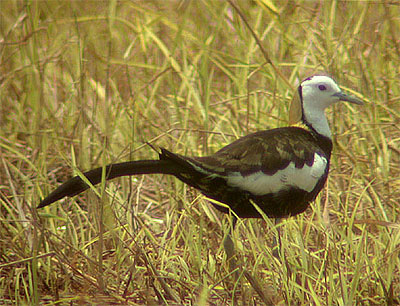
Pheasant-tailed Jacana by Peter Ericsson

Where to see Pheasant-tailed Jacana
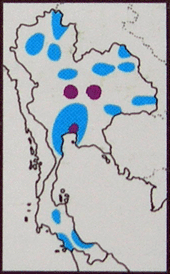
Pheasant-tailed Jacana prefers marshy wetlands, overgrown fishponds and areas with floating vegetation. In winter they can be found at many sites throughout Thailand, from the far south to the far north but only breed at a few sites in the Central Plains. Below is the distribution map from Craig Robson’s Field Guide to the Birds of Thailand.

Some of the best sites to see Pheasant-tailed Jacana on a winter birding trip to Thailand are:

Pheasant-tailed Jacana breeds at the last four sites listed and can be seen all year round; breeding close to Bangkok was only discovered relatively recently. At Tung Bang Jak small numbers of breeding Pheasant-tailed Jacanas can be seen and they can be found throughout similar freshwater wetlands all around Bangkok; there are probably dozens of sites where they breed in small numbers but, at Muang Boran Fishponds in Samut Prakarn, I counted at least 80 birds in  breeding condition just a few days ago.

In Phil Round’s new book, The Birds of the Bangkok Area, he has quoted my sighting of 120 birds at Muang Boran Fishponds on 23rd February 2003 as the largest single count in Thailand. Going through my records though I noticed that I counted 165 on the 1st January 2004 and 192 on 22nd February 2004; it seems perhaps this site is the best place in Thailand to find this species in large numbers?

A Few Interesting Pheasant-tailed Jacana Facts

  • The species has reversed sex roles with the female defending a territory and building the nest. The male incubates the eggs and tends the young.

  • The alarm call is a strange, high-pitched mewing sound

  • The chicks are able to swim at just 1-2 hours old

  • Most migrants have left Thailand by late April

Pheasant-tailed Jacana Links
Peter Ericsson, Johan Svensson and Alex Vargas all have photographs of Pheasant-tailed Jacana in Thailand.

There are 3 video clips of Pheasant-tailed Jacanas here: Hydrophasianus chirurgas.

The Wikipedia entry for Pheasant-tailed Jacana is here: http://en.wikipedia.org/wiki/Pheasant-tailed_Jacana

Amazing Bird Video Clips

Some time ago I created a page called 10 Wonderful Bird Videos on Squidoo.com. For those that haven’t seen it, take a look; there are 10 video clips from various contributors which show amazing examples of bird behaviour.

The ten clips include:

1 Birds of Paradise Crazy Courtship

2 Flock of Starlings Attacked by Peregrine Falcon

3 Albatross Flying School

4 Great Hornbill Feeding Mate

5 The Incredible Call of the Lyrebird

6 A mass of Shearwaters

7 Keas Vandalizing a Car

8 Eagle Aerial battle

9 Hummingbird on Nectar Feeder

10 Crow Makes and Uses Tool to get Food

11 Shoplifting Seagull

Okay, so it’s called 10 Wonderful Bird Videos but there are 11; I added one more after being made aware of the shoplifting gull. For those that have not seen them the clips of the Lyrebird, the Crow and the Gull are must-see material – the behaviour displayed by these birds is amazing. The Lyrebird mimicking a chainsaw is quite incredible and something that never fails to amaze.

10 Wonderful Bird Videos
, ,

Flowering Plants

On my visit to Muang Boran Fishponds on Saturday I took some time to photograph some of the flowering plants that I came across. Flowers are pretty easy to photograph as they don’t fly or run away and a quick snap on macro setting with just a compact digital camera gives some nice results.

, , , ,

weavernests.jpg

Thailand Birding: Wetland & Open-country species near Bangkok

Bangkok is surrounded by wetlands, indeed it is built upon them, and unfortunately the city is rapidly spreading out further, obliterating many wetland areas that were inhabited by wetland birds. The result is that many species that were formerly abundant are becoming ever scarcer. However, the fishponds close to Muang Boran in Samut Prakarn province remain a good place to see many of these species in good numbers: Muang Boran Fishponds.

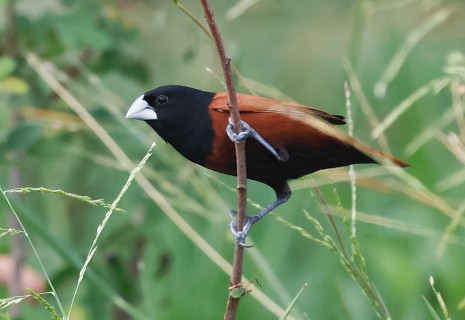
On Saturday 24th May I took a taxi to this site, arriving at about 6am in the morning. Arriving this early was a good plan as this turned out to be a particularly hot and humid day and by 10 am I was suffering from the heat. Birds are always abundant at this site and in the first few minutes I saw Chestnut Munia, Plain Prinia, Cattle Egret, Great Egret, Little Egret, Javan Pond Heron, Little Grebe, Little Cormorant and Striated Grassbird.

Just a little further along the track I stopped to look over some pools which are usually pretty productive and sure enough there were a number of Bronze-winged Jacanas, Pheasant-tailed Jacanas and White-browed Crakes creeping around in the floating vegetation. All three of these species are common at Muang Boran Fishponds and Pheasant-tailed Jacana and White-browed Crake are more abundant here than anywhere else I know in Thailand. On this trip I saw at least 80 Pheasant-tailed Jacanas and over 20 White-browed Crakes – the highest count of the jacana I have made here was of 192 birds on 22 February 2004.

Striated Grassbird is always obvious here and to come to this site and miss it would mean you would have lost the use of both your eyes and ears as it constantly performs its song flight all around. At this time of year many pairs are making nests and making a rather shrill chip, chip call in addition to their song flight. This visit probably resulted in about 20 birds – I am not really sure as I wasn’t counting, but they were everywhere.

Quite close to where I usually enter this site is a large pond which has remained drained and dry for some months and here I found a flock of 148 Cattle Egrets in the company of numerous Javan Pond Herons and a few Red-wattled Lapwings. This area is also being heavily used by Oriental Pratincoles which now have numerous young. Interestingly, the adults, although still breeding, are in quite an advanced state of moult and in flight their profile looks quite different than it did just a month ago – now they have much stubbier wings as their flight feathers are regrowing. Another species I saw here (well, heard more than saw) was Zitting Cisticola which also likes the grass and bare patches created when these pools are drained and a pair of Long-tailed Shrikes were in the company of a juvenile.

After dodging some noisy dogs I watched the waterbirds on another large pool, this time one that has been flooded for some time. It was full of both jacana species, crakes, pond herons and other waterbirds. Here I also saw a couple of Black Bitterns and a Black-crowned Night Heron flying overhead. A male Koel flew out of a tree here chased by a couple of Streak-eared Bulbuls, presumably it was seen as a threat. A number of other common birds were also to be found in this area including Oriental Magpie Robin, the ubiquitous Asian Pied Starling, Common Myna and White-vented Myna, Red Collared Dove and Peaceful Dove. One rather less common bird was a Purple Heron; this site holds up to 11 Purple Herons in the winter but most of these are winter visitors, however, I always see this species in ones and twos throughout the summer and possibly they breed somewhere nearby.

Moving along I walked towards the location of an Asian Golden Weaver colony, another scarce bird but ever present here. A few nests were in use (see photo below) and I saw around 16 individuals, but with birds in the nest there were undoubtedly more around.

This pond is another which is excellent for waterbirds and both Jacanas are always numerous here and on this visit I also saw Indian Cormorant, Little Cormorant, Black Bittern, Cinnamon Bittern, Yellow Bittern, White-browed Crake, Common Moorhen and Watercock here.

Whilst many species of birds can be found here, one rather upsetting problem is the abundance of suspended hooks sued to deter birds from eating all the fish. rRather than deter the birds they simply get caught on the hooks and die. On this visit I found a number of corpses but shockingly I came across a Little Grebe and Greater Painted Snipe caught by hooks and still alive. I have written a short article about this with photos, including one rather bloody one of the Painted Snipe on thaibirding.com: Birds Dead & Dying at Muang Boran Fishponds.

With this and the heat I decided it was time to go. On the way out I added I number of species to the day list, including Brahminy Kite, a pair of Black-shouldered Kites, 2 Indian Rollers and Yellow-bellied Prinia. Also of note were a couple of birds that are usually considered winter visitors: 1 Intermediate Egret, 1 Oriental Reed Warbler, 9 Barn Swallows. In reality all of these species are known to be present in small numbers throughout the summer but it is always interesting to see birds such as these outside of their usual time in Thailand.

I saw 59 species of bird on this visit to Muang Boran Fishponds which is a high total for birdwatching in Thailand at this time of year, however, in mid winter over 70-80 species is normal.

, , ,

Free WordPress Themes