Thailand Birding: Best to get out before 10 am!

It seems to have become a habit of mine in Thailand to go birding at ridiculous times of the day recently. At this time of year it is light at 6am and by 9am it is already hot and sticky with bird activity in rapid decline – between these times is when most birds will be found. Yesterday, however, after dropping my wife off at work and having a late breakfast I decided to drive down to the fishponds and other pools that are a few kilometres from where I live. For anyone who knows Bangkok/Samut Prakarn, this area is close to King Mongkut’s University, Bang KunTien campus, towards Samut Sakorn.

Over the last few years, this area has been subjected to a lot of development, and this is continuing so I wonder how long there will be any habitat left here. Just 5 years ago there were few buildings out this way but now there are factories, housing estates and shops springing up here there and everywhere. Still, for now there are still some nice birds to be found. The first birds of interest I found were four Whiskered Terns. This is a common wintering bird but to find them this late in the year makes me think that they aren’t going to leave.

Further along I found a large pool in the process of being drained. This contained a large number of Javan Pond Herons, a few Little Egrets, a Black-crowned Night Heron and 5 Common Redshank. Although this is another wintering bird, there are usually reports of small numbers of non-breeders present throughout the year in Thailand.

Further on there are a number of freshwater pools with reedy fringes and here I found most of the birds for the day. A small colony of Asian Golden Weavers was nice, with 3 males giving nice views as they sat atop reeds, several Striated Grassbirds called noisily and a number of Little and Indian Cormorants sat around on posts, apparently admiring the view.

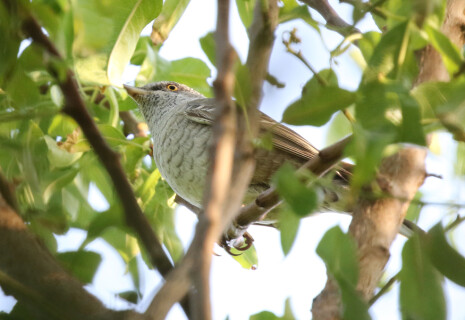
Despite the time of day and heat there were a fair number of other birds around, mostly common species, but still nice to see; Greater Coucal, Streak-eared Bulbul, Great Egret, Little Grebe, Plain Prinia, Yellow Bittern, Scaly-breasted Munia, Eurasian Tree Sparrow, Red Collared Dove, Spotted Dove and Little Heron to name just a few. Whilst watching a Striated Grassbird calling from the top of a dead tree a couple of interesting birds flew past – firstly 7 Cotton Pygmy Geese, 6 males all involved in an aerial battle over a single female, and then a Black Bittern – a summer visitor to Thailand. Another summer visitor was a single Oriental Pratincole on a wet, muddy pool.

As I moved to another spot, a passed an area of flat, dry ground – a former pool that has been filled in and allowed to settle before development – but for now a pair of Little Terns were nesting on it and they were so close to the road that I could see the chicks and was attacked by the male. I moved on a little to watch them from a less disturbing distance and also spotted at least 3 more pairs of Little Terns on nests. I was a little surprised to find them nesting this far inland (it’s about 10km from the sea here) but I suppose the dry, stony habitat was about right for them.

I moved off, in the car to investigate some roads heading towards the sea. They didn’t go far before turning into mudslides so I stopped, but I did find a group of 7 more Whiskered Terns (only 2 of which were in summer plumage) and 4 more Little Terns. I also came across a small heronry containing small numbers of Little Egrets, Black-crowned Night Herons and Little Cormorants.

With lunchtime approaching I went home but found 3 more Whiskered Terns on the way. It looks like small numbers of non-breeders will be staying on through the summer.

I have created a thread on the thaibirding forums for others to record their sightings of late staying winter migrants: Migrant Dates.

, , ,

swallow.jpg

Thailand Birding: A few Winter Visitors are still present

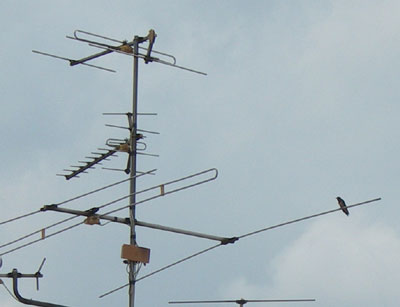
Today, whilst working on the computer, I was alerted to the sound of a chattering Barn Swallow outside. On looking up, I noticed a single swallow on the same TV mast that I photographed some swallows on a few weeks back: Late Winter Migrants.

In fact Barn Swallows are pretty much always found in Bangkok through the summer in small numbers, but this incident reminded me of some of the winter visitors that I saw over my recent 4-day trip from 8th to 11th May: Kaeng Krachan, Tung Bang Jak & Khao Yai, 8-11th May 2008.

8th May – Kaeng Krachan
3 Fork-tailed Swifts
“A few” Chinese Pond Herons
Small numbers of Barn Swallows
1 juvenile, pale marph Oriental Honey-buzzard

9th May – Kaeng Krachan
2 Chinese Pond Herons
Small groups of Barn Swallows

10th May – Tung Bang Jak
3 Oriental Reed Warblers
17 Barn Swallows
7 Whiskered Terns
1 Indian Pond Heron
3 Chinese Pond Herons

11th May – Khao Yai
2 Brown Shrikes
7 Barn Swallows
1 Chinese Pond Heron

We also saw a couple of passage migrants; 1 Crow-billed Drongo near the Khao Yai Bat Cave on 10th May and 1 Japanese Sparrowhawk attacking a pair of Red-wattled Lapwings at Khao Yai on 11th.

Whilst birdwatching in Thailand over the next few weeks I will continue to look for migrant species.

Others are encouraged to post their sightings of migrant species, with dates, on this thread on the thaibirding forum: Migrant Dates.
, , ,

elephant2.jpg

Thailand Birding: 4 Day Trip: Kaeng Krachan, Tung Bang Jak, Khao Yai

I recently got home after a four day birdwatching trip to Kaeng Krachan, Tung Bang Jak and Khao Yai with four Japanese ladies led by Shoko Sakaeda. Quite frankly the forest birding was very slow, although what we lacked in quantity we made up for in quality species. At this time of the year virtually all the winter migrants have departed and there are just simply lfewer birds to be found. Many of the resident birds populations are increased in the winter by migrant individuals too so even common species like Ashy Drongo, Bar-winged Flycatcher-shrike, Black Drongo and Black-winged Cuckooshrike were few and far between.

I have posted a trip report with some notes on our accommodation and other useful information for others who may be doing similar trips here: Kaeng Krachan, Tung Bang Jak & Khao Yai, 8-11th May 2008.

Some of the highlights of the trip were; Oriental Pied Hornbill at Kaeng Krachan and Khao Yai; Great Hornbill and Tickell’s Brown Hornbill at Kaeng Krachan; Black-thighed Falconet, Black Eagle, Mountain Hawk eagle, Changeable Hawk Eagle and Crested Serpent Eagle at Kaeng Krachan; Japanese Sparrowhawk and Shikra at Khao Yai; Black-and-red Broadbill, Banded Broadbill, Silver-breasted Broadbill, Dusky Broadbill and Black-and-yellow Broadbill at Kaeng Krachan; Orange-breasted Trogon at Kaeng Krachan; Indian Pond Heron, Pheasant-tailed Jacana, Cotton Pygmy Goose, Purple Heron, Asian Openbill, Streaked Weaver, Asian Golden Weaver and Fulvous-breasted Woodpecker at Tung Bang Jak; Bamboo Woodpecker at Kaeng Krachan and Stork-billed Kingfisher at Khao Yai & Kaeng Krachan.

Although the birding was slow, we got quite lucky with mammals with White-handed Gibbon, Dusky Langur, Black Giant Squirrel, Grey-bellied Squirrel, Burmese Striped Squirrel at Kaeng Krachan and Variable Squirrel, Pig-tailed Macaque, Sambar, Barking Deer, Golden Jackal and Asian Elephant at Khao Yai. We saw one bull elephant early in the morning and two young elephants in the dark at about 7pm on the road towards Haew Narok – both very memorable sightings.

, , , ,

swallows.jpg

Thailand Birding: Late Winter Migrants

At this time of year birders in Thailand are witnessing the end of the spring migration and it is interesting to note the last dates that many of the commoner species are seen. Today, as I was driving to the market, I saw 6 Barn Swallows swooping around a wood yard in the suburbs of Pra Pra Daeng, southwest Bangkok. I imagine that the wood had attracted a fair number of insects which in turn had attracted the Swallows. I guess it is possible that these will be the last of the Swallows for a while.

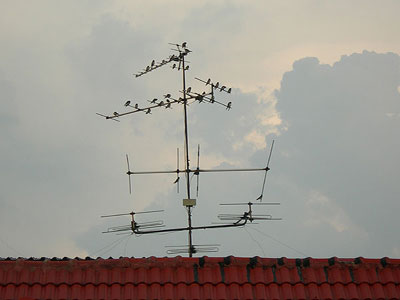
This incident reminded me of another, about a week ago. A storm was rolling in and a whole load of Barn Swallows began to collect on TV masts opposite my bedroom. I took a couple of pictures at the time but forgot about them until now. Here is the best one which shows a group of Barn Swallows shortly before they all flew off as the storm approached.

For readers who have their own interesting dates for migrants (late winter visitors, summer visitors or returning winter visitors) please post them in this thread of the thaibirding forums: Migrant Dates.

ltshrike.jpg

Birding at Suan Luang in the Afternoon | Thailand Birding

It is important to go out at the right time of the day when bird watching in Thailand and I was recently reminded of this when I took a late afternoon trip to do some birding at Suan Luang as I was bored with lurking around the house. Afternoon trips in Bangkok can be a risky strategy due to the chaotic traffic that builds up in the late afternoon and early evening but I travelled to the park when things were quiet; the journey home was another story though. Although Suan Luang can be quite a nice birding spot in the morning, I wasn’t expecting too much on this visit as the park gets busy in the afternoon. However, with such low expectations I was pleasantly surprised with a nice selection of birds.  Read more »

Thailand Birding: 1 Day, 3 Sites, Lots of Birds

Bang Pra is an excellent site for seeing a wide range of species, with woodland, grassland and wetland habitats it is possible to see a high number of excellent species here. Combined with an afternoon at wetlands near Bang Poo and some coastal birds at Bang Poo itself, an excellent day of birdwatching is possible; this is exactly what Dierdre Robinson and I did on 26th April. Dierdre had contacted me as she had just one day in Thailand before moving on to a volunteer job in Bhutan and as she hadn’t been birdwatching in Thailand before, these three locations offered an excellent chance of seeing a lot of nice species well.

Having picked her up from the Queen’s Garden Resort hotel near Suvarnampum airport we arrived at Bang Pra at the peak of the bird activity. Before we had got out of the car we had been treated to the site of a flock of White-crested Laughingthrushes feeding on the road and calling to one another, several White-throated Kingfishers, Indian Rollers and Greater Racket-tailed Drongos; impressive birds all. After parking the car we made the most of the high level of bird activity. There seemed to be Lineated Barbets in every tree, giving us fine looks at this handsome bird and Racket-tailed Treepies seemed to be following us around. Within a short distance of the car park we also saw an Asian Brown Flycatcher – a late departee, a single Lesser Whistling Duck and excellent views of several Yellow Bitterns.

The level of bird activity in the region of the car park and small lake was quite remarkable and other species included Black Drongo, a migrant leucogenis Ashy Drongo, 2 colourful Black-headed Bulbuls, Sooty-headed Bulbuls, more White-crested Laughingthrushes and Green Bee-eater. Also notable was the high number of Hoopoes we saw. I usually see Hoopoe at Bang Pra, but this morning they were everywhere and I can only assume that the resident population had been increased by passage migrants. Before we had gone very much further we saw another good bird, Crow-billed Drongo. This passage migrant isn’t so often seen and many birdwatchers with long lists are still looking for it. As we moved alongside the woodland a pair of Vinous-breasted Starlings caught my eye. Unfortunately, Dierdre missed them as they flew into the woodland quite quickly but when we went into the trees to hunt the starlings out Dierdre noticed a Spotted Owlet watching us. As we returned its stare another flew away into the woods and eventually the bird that we had such a good view of joined it.

With Greater Racket-tailed Drongos and Hoopoes all around us we moved towards the grassland, seeing a Green-billed Malkoha on the way. The grassland habitat here used to be excellent for many species of quail, but now the raised water level and overgrazing of what grassland remains has degraded the habitat severely and we didn’t see a single quail. We did, however, hear a number of Chinese Francolins and they taunted us as we searched for them. One bird high in a tree was particularly frustrating as we should have been able to see it but just couldn’t. Still, we saw a lot of birds in the grass and at the water’s edge: Indochinese Bushlark and Australasian Bushlark were seen side by side and each was performing its own characteristic song – Indochinese from a post and Australasian from the sky. We also found a number of Paddyfield Pipits, a lovely Bright-headed Cisticola and many Zitting Cisticolas.

I was interested to see quite a number of winter migrants still present – it is always nice to note the latest dates that wintering species are seen. Those that we saw included numerous Oriental Reed Warblers in song, several Black-browed Reed Warblers, also singing, 2 Brown Shrikes, an Osprey, a few Chinese Pond Herons, 2 Common Sandpipers, 1 Little Ringed Plover , 2 Red-rumped Swallows and 1 tschutschensis Yellow Wagtail. Of course, these were far outnumbered by the breeding species such as Green Bee-eater, Red-wattled Lapwing, Oriental Pratincole and Black-winged Stilt which seemed to be everywhere we looked.

Waterbirds were a little thin on the ground and they also suffer from habitat degradation here, but we got good views of Painted Stork, Great Egret, Little Egret, Little Cormorant, White-breasted Waterhen, Javan Pond Heron and Chinese Pond Heron (Both very handsome in their breeding plumage) and a flight view of a male Watercock.

With the sun becoming unbearable we headed towards some shade but it was difficult to ignore new birds as we ran into a small colony of Baya Weavers, several Rufescent Prinias, Plain Prinias and Grey-breasted Prinias. Also a pair of Chestnut-capped Babblers was very nice indeed. However, with these successes we went back to the car for a drink and a rest. After a short break we decided on an early lunch and to head towards Soi 119 for new birds. This decision was taken because Dierdre had a broken toe and the idea of birding from the car sounded like a good one.

So, a few hours later we found ourselves at Soi 119, and that after I said I was unlikely to come back here very soon. Well, this time things were much more birdy and we saw a good selection of waterbirds here. Striated Grassbird, Bronze-winged Jacana, Pheasant-tailed Jacana, Yellow-bellied Prinia, Barn Swallow and Whiskered Tern were all quick additions to our day list at a very productive spot near the University building.

A little further along we found more Jacanas and as we wondered whether the gathering clouds were going to drench us we found a beautiful male Asian Golden Weaver sitting up on a post just begging us to watch him.

As we moved along we found some excellent pools where we found some very attractive species; 10 Cotton Pygmy Geese, White-browed Crake, male and female Watercock, Intermediate Egret and several White-winged Terns in full breeding plumage were very spectacular. With so many interesting and attractive birds to see it was difficult to move on but I wanted to give Dierdre a good look at Asian Openbill Storks. This was easy to do and we spent some time observing this species and we were amazed at the huge number of old snail shells in the area, these having been discarded by the storks. Close to the storks we found a single Grey-headed Lapwing which seemed to be very far south at a time I would expect it to have departed.

Although we had seen plenty of Baya Weavers, we hadn’t  seen any males so I kept stopping to find some. When I finally found a male we got out of the car and viewed this busy little bird and as we did a large V of Indian Cormorants flew overhead, a juvenile Brahminy Kite passed by and 2 Parakeets whizzed past us. I couldn’t identify the Parakeets, but they seemed green-headed but too small for Alexandrine; I suspect they were feral Ring-necked Parakeets, a species which I have heard is starting to establish itself in Thailand as it has done in England. However, the best bird of the day (at least for me) was just about to show itself. Behind us a starling had landed on a wire and was calling harshly. Through binoculars the light wasn’t good enough for me to be sure of its id, so I got the scope on it. The bird turned out to be a juvenile Rosy Starling, a new bird for me as I have always missed this species in UK and in Thailand – it is not at all common in either country. We had quite some time to watch this bird and eventually it flew off into some palm trees.

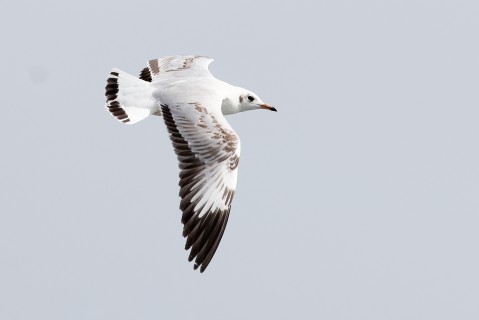
With a good haul of species and in need of a rest we headed to nearby Bang Poo. We parked up and walked along the pier to get a drink. However, we couldn’t ignore yet more species as we strolled along. Good numbers of Brown-headed Gulls were still present but most of the birds were sub-adults and had not yet come into breeding plumage. Plenty of Pacific Golden Plovers were also easily seen but this was the only shorebird species in any number; we also found a few Lesser Sand Plovers, 1 Common Greenshank and 1 Whimbrel. 2 Black-capped Kingfishers were also late wintering birds, very welcome by us, and a number of Little Herons was another new bird for the day. Other notable birds were around 100 Whiskered and White-winged Terns yet to depart for their breeding grounds.

After sitting in the air-conditioned restaurant on the pier, drinking coconut juice we were reinvigorated for a few last birds before leaving and we stood on the end of the pier to get good views of the shorebirds. As I was scanning the distance for something I took a moment to rest and spotted an Indian Pond Heron in breeding plumage right in front of us! This unusual bird for Thailand is being seen increasingly at this time of year when it can be separated from the Javan and Chinese Pond Herons but this was the first time for me in Thailand, although I had seen plenty in India. Eventually it flew away and we walked to the car as the rain finally began.

A little drive around Bang Poo found us 3 new birds for the day – Black-crowned Night Heron, Collared Kingfisher and Pied Fantail. Who can believe it took us all day to find a bird as common as Pied Fantail? I guess strange things like this is what makes birdwatching interesting and certainly unpredictable. With these species and a massive number of birds for the day I took Dierdre back to her hotel and we said goodbye.
, , ,

Thailand Birding: Storks, Weavers, Grassbird and Jacanas

Having dropped my wife off in Bang Na, on the morning of 20th April, I had most of the day to kill so I took a trip to Soi 119 (about 4 km beyond Bang Poo) which I had scouted out a few weeks earlier: Soi 119.

Last time I didn’t go beyond the entrance road to a large university (can’t remember its name) and I started there quickly seeing Cotton Pygmy Goose, Bronze-winged Jacanas, Moorhen, Egrets, Mynas and the very noisy Striated Grassbird. My real aim, though, was to see what the rest of the area had to offer.

It has to be said that I was a bit disappointed. The site has most of the same species as at nearby Muang Boran Fishponds but in nowhere near the same abundance. I spent quite some time driving around and covered a large distance to find birds.  Only in a few places did I see groups of egrets although Asian Openbill Stork was present in large numbers. Eventually I found 2 Pheasant-tailed Jacanas in splendid breeding plumage and I found a small colony of Baya Weavers, watching them busy at their nests. One pool had a few lingering waders including 1 Common Snipe, 5 Long-toed Stints, 4 Black-winged Stilts and a Wood Sandpiper but with the heat and the lack of good places to stop I decided to cut my visit short.

I guess I will still be going to Muang Boran Fishponds for my waterbirds!

Free WordPress Themes